

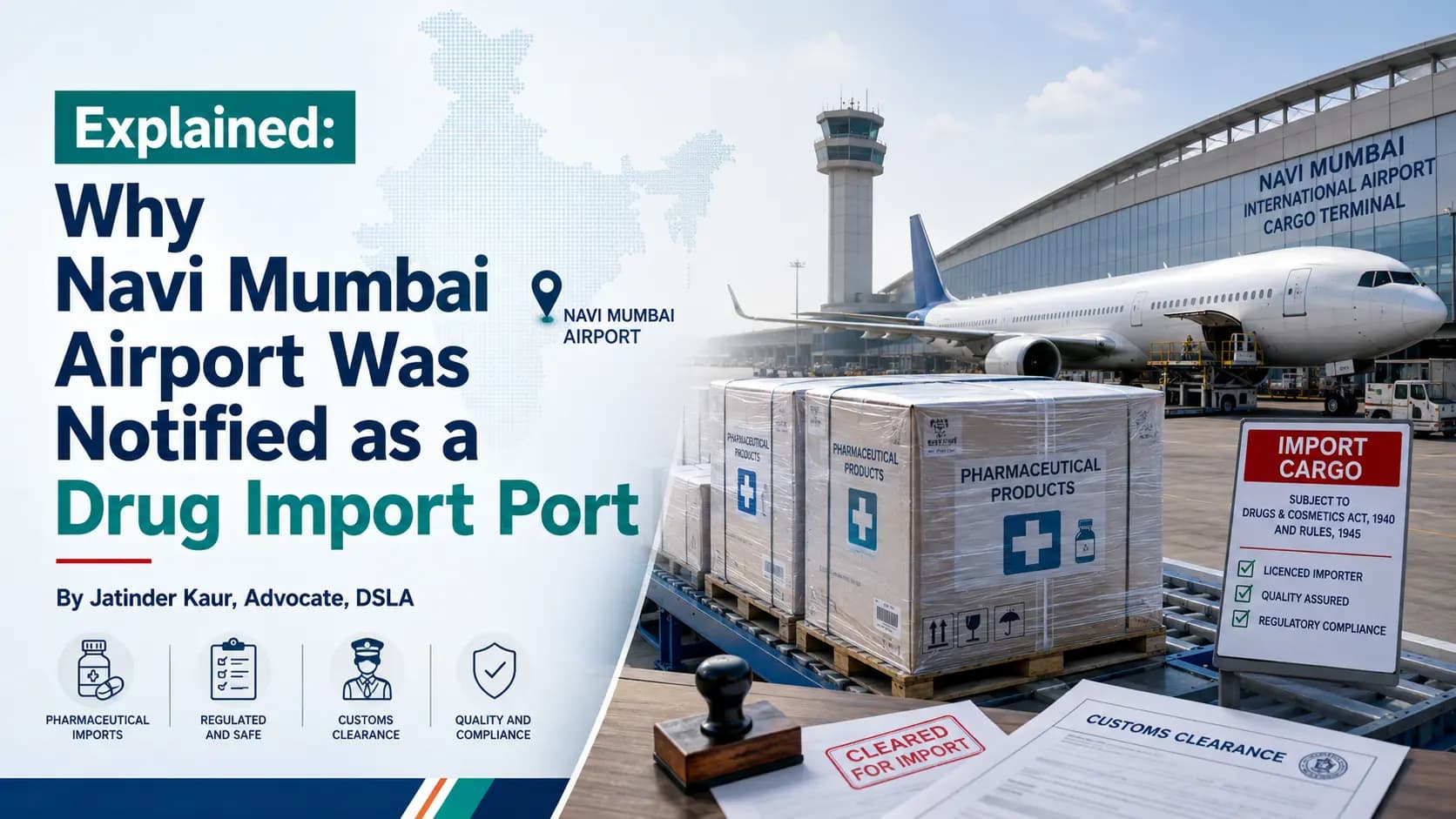
New Delhi (ABC Live): The Government has added Navi Mumbai Airport as an authorised drug import entry point under Rule 43A of the Drugs Rules, 1945. As a result, pharmaceutical importers now have another legal route into the country, while regulators continue to control the entry of medicines into India.
Key Points
- The Ministry of Health and Family Welfare has added Navi Mumbai Airport as a drug import port.
- The amendment changes Rule 43A of the Drugs Rules, 1945.
- India now has 42 notified drug import entry points across road, rail, ship and air routes.
- The Government issued the notification after consulting the Drugs Technical Advisory Board.
- The move aims to improve pharma logistics, trade facilitation and Ease of Doing Business.
- However, importers must still follow drug import licences, quality rules and customs procedures.
Why This Explainer Is Needed
India does not allow drug imports through all airports or ports. Instead, the law permits importers to bring medicines into the country only through notified entry points.
This restriction matters because medicines directly affect public health. Therefore, regulators need customs, drug-control and inspection systems at the point of entry.
Navi Mumbai Airport now joins that legal network. Consequently, pharma importers gain an additional authorised route to bring medicines and pharmaceutical consignments into India.
Moreover, the decision matters for Maharashtra and western India because the Mumbai region already plays a major role in cargo, trade, pharma logistics and healthcare supply chains.
What Has Changed?
The Ministry of Health and Family Welfare has amended Rule 43A of the Drugs Rules, 1945. Through this amendment, the Government has added Navi Mumbai Airport to the list of airports through which importers may bring drugs into India.
According to the official PIB release, the amendment aims to facilitate smoother movement of pharmaceutical consignments, strengthen logistics infrastructure and provide importers with another route for importing medicines into India.
The Gazette notification records the amendment as the Drugs (Ninth Amendment) Rules, 2026. In addition, the CDSCO Gazette notification page lists G.S.R. 561(E) dated 2 July 2026, which considers Navi Mumbai International Airport an authorised airport for drug imports under Rule 43A.
Earlier, importers could use only the airports and other entry points already listed under Rule 43A. Now, they can also use Navi Mumbai Airport, subject to all applicable drug import rules.
The total number of notified drug import entry points has now reached 42. These points include road, rail, ship and air routes.
What Rule 43A Means in Simple Words
Rule 43A specifies where importers may legally bring drugs into India.
In simple words, an importer cannot choose any airport, seaport, railway station or road point for importing drugs. Instead, the importer must use a place that the Government has specifically notified under the Drugs Rules, 1945.
Therefore, Navi Mumbai Airport needed legal notification before importers could use it for drug consignments.
The legal framework comes from the Drugs and Cosmetics Act, 1940, and the Drugs Rules, 1945, which regulate the import, manufacture, sale,and distribution of drugs and cosmetics in India.
Drug Import Port Dashboard
| Issue | Details |
|---|---|
| Airport added | Navi Mumbai Airport |
| Rule changed | Rule 43A, Drugs Rules, 1945 |
| Parent law | Drugs and Cosmetics Act, 1940 |
| Ministry | Health and Family Welfare |
| Consultation | Drugs Technical Advisory Board |
| Gazette notification | G.S.R. 561(E), 2 July 2026 |
| Total entry points | 42 |
| Routes covered | Road, rail, ship and air |
| Main purpose | Pharma logistics and trade facilitation |
Why Did the Government Add Navi Mumbai Airport?
1. To Improve Pharma Logistics
Pharmaceutical consignments often need quick and careful handling. For example, some medicines, vaccines, biological products and clinical materials may need cold-chain support.
Therefore, an additional airport route can help importers move sensitive consignments more efficiently.
2. To Give Importers More Flexibility
Importers earlier depended on existing notified airports and ports. However, with Navi Mumbai Airport now in place, companies can plan cargo movement via another authorised route.
As a result, importers may reduce delays, improve routing options, and better manage supply chains.
3. To Support the Mumbai Pharma Trade Region
Mumbai and nearby areas already support a large trade and logistics ecosystem. In addition, Maharashtra remains important for pharma manufacturing, warehousing, distribution and exports.
Therefore, the addition of Navi Mumbai Airport strengthens the region’s role in the regulated pharmaceutical trade.
4. To Reduce Pressure on Existing Gateways
Existing cargo gateways can face congestion. Consequently, one more authorised airport can help distribute cargo traffic more efficiently.
However, this benefit will depend on airport readiness, customs coordination, cold-chain capacity and drug-regulator support.
5. To Promote Ease of Doing Business
The Government has linked the amendment with trade facilitation and Ease of Doing Business.
Even so, the move does not remove safety checks. Instead, it adds one more legal route while keeping drug-control rules in place.
What This Means for Importers
| Importer Concern | Practical Meaning |
| Legal route | Importers can use Navi Mumbai Airport for drug imports |
| Licence | Import licences and permissions still apply |
| Quality | Imported drugs must meet legal quality standards |
| Documents | Importers must maintain proper regulatory records |
| Customs | Customs checks continue |
| Drug control | CDSCO oversight remains necessary |
| Cold chain | Sensitive consignments still need proper handling |
| Risk | Wrong documents can delay clearance |
What This Notification Does Not Change
This notification does not allow free import of drugs.
It also does not remove licensing, registration, labelling, shelf life, testing, or customs requirements.
Instead, the amendment only adds Navi Mumbai Airport as another authorised entry point. Therefore, importers gain a new route, but they must still follow the full regulatory process.
Why Regulatory Oversight Still Matters
Drug imports require strict supervision because poor-quality or unauthorised medicines can harm patients.
Therefore, notified ports serve as regulatory checkpoints. At these points, customs authorities and drug regulators can examine documents, inspect consignments and enforce import rules.
In addition, proper port notification helps regulators track pharmaceutical imports more effectively. This system also helps prevent illegal or unsafe drug movement.
ABC Live has previously examined India’s broader pharmaceutical and health-regulation challenges in its reports on the Draft National Pharmacy Commission Bill 2026, the NDCT Amendments 2026, and the India Biopharmaceuticals Policy Brief.
ABC Live Analysis
The Government has taken a practical logistics step rather than a major policy shift.
The amendment does not weaken drug regulation. Instead, it expands the legal infrastructure through which regulated pharmaceutical imports can enter India.
However, implementation will decide the real impact. If Navi Mumbai Airport receives proper customs integration, CDSCO coordination, cold-chain facilities and digital clearance support, the new route can help importers.
On the other hand, if systems remain slow or underprepared, the notification may bring limited immediate benefit.
Therefore, the Government must now ensure that the airport has the regulatory capacity to match its legal status.
Larger Policy Significance
India wants to strengthen its pharmaceutical supply chain. At the same time, it wants to improve trade facilitation without compromising public health.
This amendment fits that approach. It gives importers more choice, supports logistics efficiency, and keeps medicines within the legal import control system.
Moreover, the move shows that pharma regulation now depends not only on licences and standards but also on strong logistics infrastructure.
This issue also connects with wider health-policy questions that ABC Live has covered in its Health section, including reports on Ayushman Bharat and AB-PMJAY, as well as public-health regulation.
How We Verified
ABC Live verified this development from the PIB release issued by the Ministry of Health and Family Welfare on 8 July 2026.
We also checked the Gazette notification, the CDSCO Gazette notification records, and the legal position under the Drugs and Cosmetics Act, 1940, and the Drugs Rules, 1945.
The verification confirms that the Government amended Rule 43A after consultation with the Drugs Technical Advisory Board. It also confirms that the total number of notified drug import entry points has reached 42.
Sources & Resources
- Press Information Bureau: Government notifies Navi Mumbai Airport as a port for import of drugs
- Gazette of India: Drugs (Ninth Amendment) Rules, 2026
- CDSCO Gazette Notifications
- CDSCO: Drugs and Cosmetics Act, 1940 and Drugs Rules, 1945
ABC Live Internal Links
- Critical Analysis of Draft National Pharmacy Commission Bill 2026
- Critical Analysis of NDCT Amendments 2026
- India Biopharmaceuticals Policy Brief
- Critical Analysis of Ayushman Bharat and AB-PMJAY
ABC Live — Making Complex Public Issues Simple.