

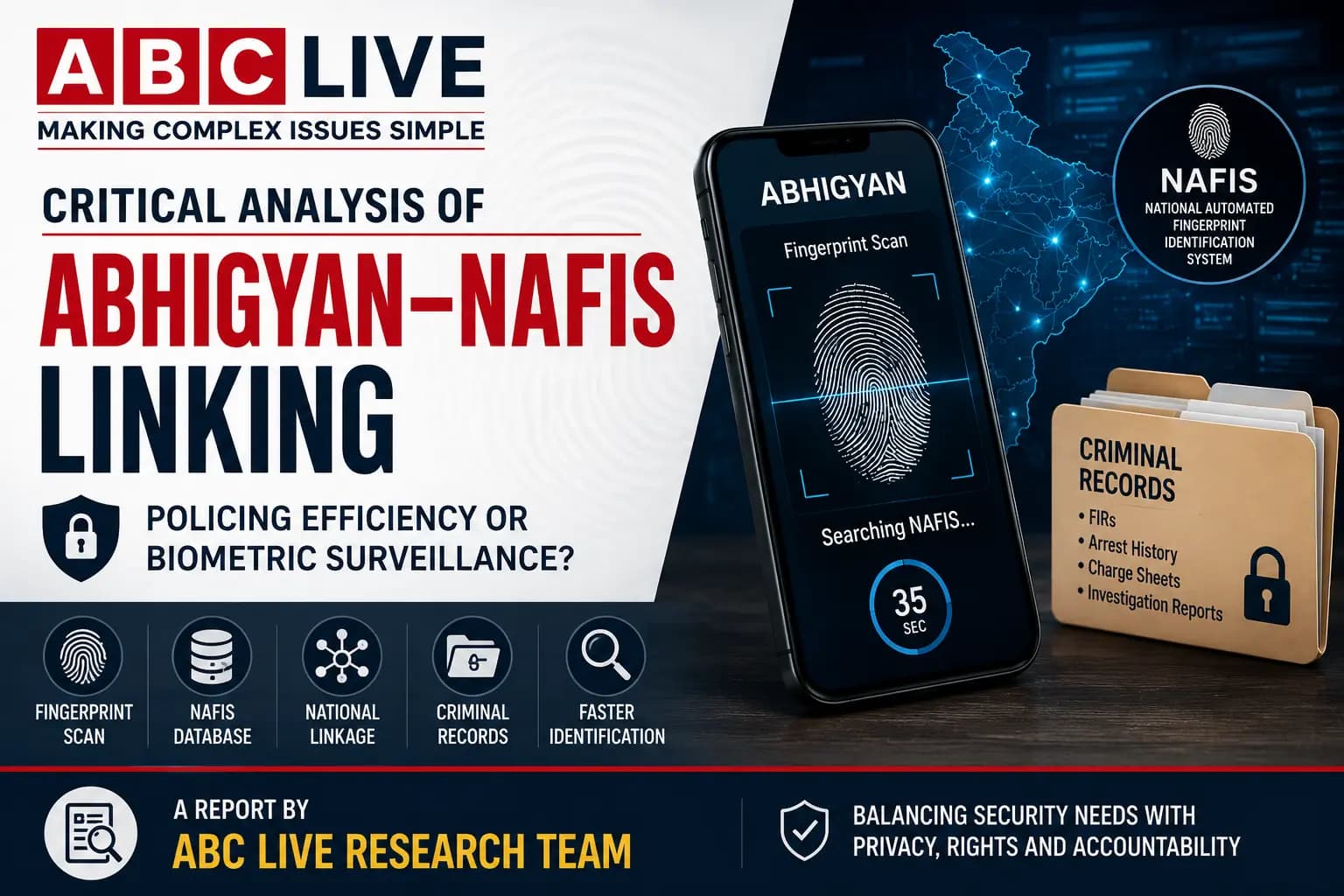
New Delhi (ABC Live): The Abhigyan App represents a major shift in India’s policing technology. According to the source material reviewed, the app enables police officers to scan fingerprints in the field through a smartphone and receive a criminal-history match from a national database within about 35 seconds. The database behind it is NAFIS, the National Automated Fingerprint Identification System, which reportedly contains more than 1.3 crore fingerprint records and connects with CCTNS, the nationwide police database containing FIRs, investigation reports, charge sheets, criminal histories and arrest records.
On the positive side, Abhigyan may help police identify repeat offenders, absconders, unknown accused persons and unidentified persons more quickly. Moreover, it can support faster field verification during urgent investigations.
However, the constitutional concern is equally serious. Once a police officer can scan a fingerprint during a routine vehicle check, street stop or suspicious-person inquiry, a normal policing encounter may become a national biometric database search. Therefore, the main question is not whether technology is useful. The real question is whether such search power has clear legal limits, independent oversight, audit trails, deletion rules and remedies for false matches.
Key Points
| Issue | Simple Meaning | Critical Concern |
|---|---|---|
| Abhigyan App | Mobile-based fingerprint search tool | Field officers get instant database access |
| NAFIS | National fingerprint database | People remain searchable across India |
| CCTNS link | Police records may connect with fingerprint identity | One scan may expose wider criminal-history data |
| 35-second result | Fast identification | Less time for careful verification |
| Legal basis | Biometric collection has statutory support | Search and query rules remain unclear |
| Privacy risk | Fingerprints are sensitive personal data | Routine policing may become biometric surveillance |
| Public interest | Faster investigation can help victims | Safeguards must protect innocent citizens |
Why This Critical Analysis Is Needed
India is moving from paper-based policing to database-driven policing. This shift can improve investigation, but it can also expand State surveillance.
Earlier, fingerprint matching usually required institutional steps, dedicated equipment or a formal process. However, Abhigyan changes the point of access. It puts the search function into the hands of field officers. As a result, a routine encounter can immediately trigger a search against a national biometric repository.
Therefore, the issue is not only administrative efficiency. It is also about constitutional governance. A system that can identify people quickly can also wrongly classify, repeatedly monitor or permanently suspect them unless the law controls its use.
What Abhigyan Changes in Policing
Abhigyan does not merely create another police app. Instead, it changes how police access biometric data.
The source material explains that NAFIS already works within India’s wider digital policing ecosystem through its integration with CCTNS. Because of this integration, a biometric match can do more than identify a fingerprint. It can retrieve connected criminal justice information across states, departments, agencies and police stations.
Consequently, a fingerprint search is not only a fingerprint search. It may become an entry point into FIRs, charge sheets, arrest histories, investigation records and related policing information.
This creates a serious risk. A person may not face scrutiny because fresh evidence links them to a crime. Instead, inclusion in the database itself may become the reason for repeated scrutiny.
Constitutional Framework After Puttaswamy
The Supreme Court in Justice K.S. Puttaswamy v. Union of India recognised privacy as an intrinsic part of the right to life and personal liberty under Article 21 and as part of the freedoms guaranteed by Part III of the Constitution.
Additionally, the Court’s privacy framework requires legality, legitimate State aim and proportionality. In simple words, the State must show a law, a valid purpose and a rational connection between the method used and the objective pursued.
Therefore, Abhigyan must satisfy three constitutional tests:
| Test | Question for Abhigyan |
| Legality | Which law authorises each field-level fingerprint scan? |
| Necessity | Why is the scan needed in that specific encounter? |
| Proportionality | Does the scan reveal only what is necessary, or does it expose excessive data? |
If these questions remain unanswered, Abhigyan may face serious constitutional scrutiny.
Legal Concern: Collection Is Not the Same as Search
The Criminal Procedure Identification framework expanded the type of data that may be collected, the persons from whom it may be collected, and the authority that may authorise such collection. PRS Legislative Research notes that the National Crime Records Bureau will act as the central agency to maintain these records and share data with law-enforcement agencies. It also notes that the collected data may be retained in digital or electronic form for 75 years.
However, the bigger problem lies elsewhere. The law may permit collection and retention, but it does not clearly answer when stored biometric records may later be searched. The source material rightly argues that collecting fingerprints and later querying them are two separate legal issues.
This distinction is crucial. A legal power to collect fingerprints does not automatically mean that every officer can scan any person during a routine stop and search the national database without a defined investigative purpose.
The Query-Based Privacy Problem
A fingerprint database becomes constitutionally sensitive when the State can repeatedly query it.
Under a query-based approach, the court or regulator should not look only at the final result of a search. Instead, it must examine the entire search design. This includes the database searched, the officer’s authority, the suspicion threshold, the purpose of the query, the information exposed and the inferences generated.
The source material argues that the constitutional concern depends on the scope of the computational query, the nature of the database, the information exposed and the inferences the State can draw from the output.
Therefore, Abhigyan must not be assessed as a simple identification tool. It must be assessed as a State query mechanism over a large biometric-policing database.
Risk of Routine Biometric Surveillance
The strongest criticism of Abhigyan is that it may reduce the practical threshold for biometric search.
If police can scan fingerprints during routine vehicle checks or street encounters, then ordinary citizens may become searchable subjects. Moreover, the term “suspicious individual” can be broad and subjective. Without written reasons and audit trails, the system may depend too heavily on field-level discretion.
This risk becomes more serious because NAFIS connects with CCTNS. A successful match may expose not only identity but also FIRs, arrest records, criminal histories and other policing information.
As a result, the system may convert past contact with the criminal justice system into a continuing ground for future suspicion.
False Match and Algorithmic Risk
Fingerprint systems are powerful, but they are not risk-free. Field-collected fingerprints may be partial, unclear, smudged or degraded. Additionally, automated matching often depends on similarity scoring rather than simple human certainty.
The source material warns that a 35-second response, although efficient, compresses the time available to assess reliability before the output influences police action. It also notes that when a match opens access to wider CCTNS-linked records, the consequences of an erroneous identification become much more serious.
Therefore, every Abhigyan match should be treated as an investigative lead, not as final proof of identity or guilt.
Data Protection Concern
The Digital Personal Data Protection Bill, 2023 recognised rights such as access to information, correction, erasure and grievance redressal. It also placed duties on data fiduciaries relating to accuracy, security safeguards, breach reporting and erasure after purpose completion.
However, PRS also noted that State exemptions on grounds such as national security, public order and prevention of offences may lead to data collection, processing and retention beyond what is necessary. It further noted that such exemptions may raise proportionality concerns under the right to privacy.
Therefore, Abhigyan cannot rely only on broad data-protection language. It needs a specific policing protocol that controls each biometric query.
Presumption of Innocence Concern
A person may enter a biometric database after arrest, detention or other legal process. However, arrest is not conviction. Therefore, long retention of fingerprints can create a serious fairness problem.
The source material highlights that a person arrested but never convicted may remain within NAFIS for decades. Through Abhigyan, such a person can be identified by any authorised officer in any location through an instant field query.
This weakens the presumption of innocence in practical terms. Although the law may not call the person guilty, the database may continue to treat the person as searchable.
Policing Benefits Cannot Be Ignored
A balanced analysis must recognise the security argument.
Abhigyan may help police:
| Benefit | Public Value |
| Identify unknown accused persons | Faster investigation |
| Link repeat offenders | Better crime detection |
| Trace absconders | Stronger enforcement |
| Identify unconscious or deceased persons | Humanitarian and forensic value |
| Reduce manual delay | Better field coordination |
Therefore, the solution is not to reject technology. Instead, the solution is to place technology under constitutional discipline.
ABC Live–DSLA Critical View
Abhigyan should be treated as a high-risk policing technology because it combines biometric identification, national database access and field-level discretion.
The public interest in crime detection is real. Nevertheless, public safety cannot become a blanket justification for suspicion-free biometric checks. Moreover, because NAFIS links with CCTNS, the informational impact of each fingerprint scan can go beyond identity verification.
Therefore, India needs a clear rule: no biometric field query without a defined legal purpose, recorded reason and audit trail.
Safeguards India Should Mandate
| Safeguard | Why It Matters |
| Written reason for every scan | Prevents casual or arbitrary use |
| Defined suspicion threshold | Stops routine mass checking |
| Audit log | Records who searched whom, when and why |
| Senior officer review | Adds accountability in non-emergency cases |
| Human verification | Reduces false-match harm |
| Limited CCTNS exposure | Prevents excessive data access |
| Deletion mechanism | Protects people not convicted |
| Citizen correction remedy | Helps wrongly flagged persons |
| Independent audit | Detects misuse and bias |
| Annual transparency report | Builds public trust |
Policy Recommendation
India should create a specific legal protocol for Abhigyan and NAFIS queries. This protocol should clearly define who may initiate a search, when it may be initiated, what level of suspicion is required, which data may be displayed, how long search logs will be stored and how misuse will be punished.
Additionally, the system should distinguish between three categories:
| Category | Suggested Rule |
| Crime-scene fingerprint | Search may be allowed with case reference |
| Known suspect verification | Search may be allowed with recorded suspicion |
| Routine public stop | Search should require stricter justification |
Such differentiation would allow genuine policing use while reducing the risk of mass biometric surveillance.
Final Conclusion
Abhigyan may improve investigation speed, field verification and criminal identification. However, when linked with NAFIS and CCTNS, it also gives the State powerful biometric search capacity.
Therefore, India should not treat Abhigyan as a simple police convenience app. It should treat it as a constitutional surveillance tool. The system must operate with legality, necessity, proportionality, auditability and citizen remedies.
Otherwise, a tool designed to identify offenders may gradually convert routine policing into routine biometric surveillance.
How We Verified
This analysis relies on the source material reviewed for Abhigyan, NAFIS, CCTNS integration, biometric search concerns and the query-based privacy model. It also relies on the Supreme Court’s official judgment in Justice K.S. Puttaswamy v. Union of India for the constitutional privacy framework, PRS Legislative Research material on the Criminal Procedure Identification framework, and PRS analysis of the Digital Personal Data Protection Bill, 2023.
Sources and Resources
- Source material reviewed: Abhigyan, NAFIS, CCTNS and database surveillance.
- Justice K.S. Puttaswamy v. Union of India — Supreme Court of India.
- The Criminal Procedure Identification Bill, 2022 — PRS Legislative Research.
- The Digital Personal Data Protection Bill, 2023 — PRS Legislative Research.
ABC Live Internal Links
- Critical Analysis of the Data Security Council of India — relevant background on cybersecurity, privacy and citizen representation.
- Critical Analysis: IFSCA Draft KYC–KRA Integration Circular 2026 — relevant comparison on shared data systems, privacy safeguards and correction rights.
- Critical Analysis of Property Attachment Under BNSS Section 107 — related legal analysis on safeguards, State power and due process.
ABC Live — Making Complex Public Issues Simple.