

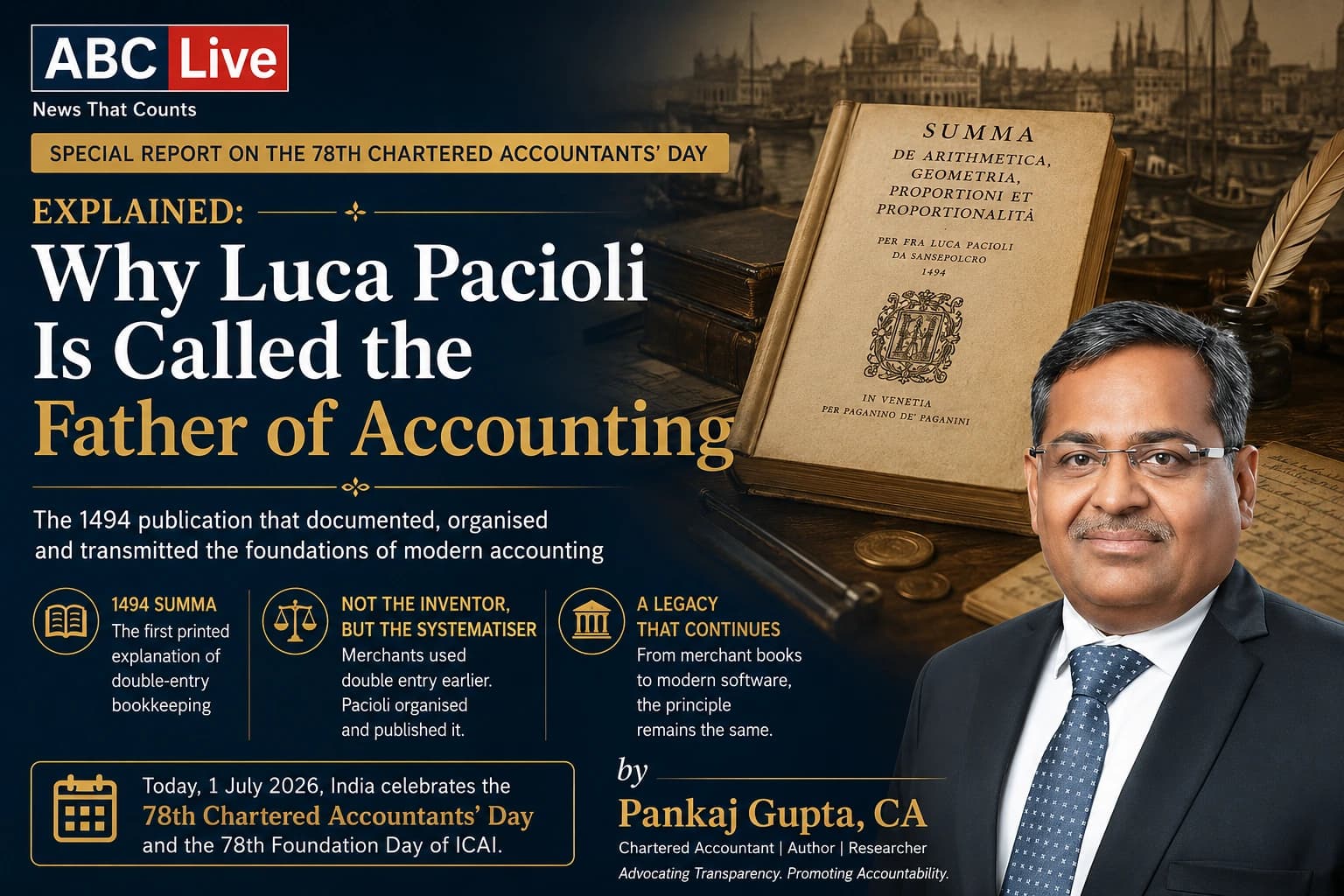
Luca Pacioli did not invent accounting or originate double-entry bookkeeping. However, his 1494 Summa offered the first printed, organised and teachable explanation of the Venetian bookkeeping method. Therefore, history remembers him as the Father of Accounting.
New Delhi (ABC Live): Today, 1 July 2026, India marks the 78th Chartered Accountants’ Day, which also commemorates the 78th Foundation Day of the Institute of Chartered Accountants of India (ICAI).
According to ICAI’s official invitation, the 78th CA Day celebrations are taking place at Vigyan Bhawan in New Delhi. Moreover, ICAI’s President’s communication identifies 1 July 2026 as the Institute’s 78th Foundation Day. Read the ICAI invitation for the 78th CA Day celebrations.
ICAI came into existence under the Chartered Accountants Act, 1949, which took effect on 1 July 1949. Since then, Chartered Accountants have contributed to auditing, taxation, financial reporting, corporate governance, insolvency, business advice and public accountability.
Therefore, on the occasion of the 78th Chartered Accountants’ Day, ABC Live is publishing this historical explainer to examine the origins of modern accounting and answer a frequently asked question:
Why is Luca Pacioli called the Father of Accounting even though he did not invent accounting?
The answer lies not in invention alone. Instead, it lies in documentation, organisation, publication and transmission.
Summary
Luca Pacioli was an Italian mathematician, teacher and Franciscan friar who lived during the Renaissance.
In 1494, he published Summa de Arithmetica, Geometria, Proportioni et Proportionalità. Significantly, the book included the first known printed and systematic explanation of double-entry bookkeeping. The Mathematical Association of America explains the historical importance of Pacioli’s Summa.
However, Pacioli did not invent accounting. Merchants in northern Italy had already used double-entry methods for generations. In fact, surviving records indicate that similar systems existed long before Pacioli wrote his treatise.
Nevertheless, his real achievement was different. He converted practical commercial knowledge into a clear, printed and teachable framework. Consequently, later generations associated his name with the foundations of modern accounting.
Key Points
- Luca Pacioli published his famous Summa in Venice in 1494.
- Moreover, the book contained the first printed explanation of double-entry bookkeeping.
- He explained inventory, journals, ledgers, debits, credits and balancing.
- However, Italian merchants had used similar methods before Pacioli.
- Likewise, Benedetto Cotrugli wrote about double entry in a manuscript in 1458.
- Therefore, Pacioli organised and popularised the method rather than inventing it.
- Meanwhile, modern accounting software still follows the basic logic of double entry.
- Finally, Pacioli was not a Chartered Accountant in the modern professional sense.
Why ABC Live Is Publishing This Explainer on CA Day
Chartered Accountants’ Day provides an appropriate occasion to examine the intellectual roots of the accounting profession.
Today, Chartered Accountants work with audit standards, tax laws, corporate disclosures, financial technology and regulatory systems. Nevertheless, the profession still depends on one basic principle that merchants used centuries ago:
Every financial transaction creates at least two connected accounting effects.
For example, when a business receives money from its owner, its cash increases. At the same time, the owner’s capital also increases.
Similarly, when a company buys an asset through its bank account, the asset increases while the bank balance decreases.
Therefore, accounting records both effects. As a result, double entry creates a connected and balanced financial record.
ABC Live has examined the present institutional role of the profession in Explained: Why ICAI Still Matters After NFRA Notification. That report explains how ICAI continues to shape professional education, ethics, accounting standards and audit quality even after the rise of the National Financial Reporting Authority.
This report, however, looks further back. Specifically, it examines how the bookkeeping principles behind the modern profession entered printed history.
Who Was Luca Pacioli?
Luca Pacioli was born in the Italian town of Sansepolcro during the 15th century. He later became a mathematician, educator, author and Franciscan friar.
At that time, the Italian Renaissance was transforming art, science, mathematics and commerce. Meanwhile, cities such as Venice, Florence and Genoa had developed extensive systems of trade, banking and commercial finance.
As commercial activity expanded, merchants needed reliable methods to record:
- money received and paid;
- goods purchased and sold;
- customer debts;
- amounts payable to suppliers;
- loans and interest;
- assets and property;
- capital invested by owners; and
- profits or losses.
Pacioli studied and taught mathematics. Moreover, he worked in an intellectual environment associated with Renaissance scholars and artists, including Leonardo da Vinci.
However, his most lasting contribution to business history came from one section of a much larger mathematics book.
What Did Luca Pacioli Publish in 1494?
In 1494, Pacioli published:
Summa de Arithmetica, Geometria, Proportioni et Proportionalità
The title broadly translates as a summary of arithmetic, geometry, proportion and proportionality.
Importantly, the Summa was not simply an accounting textbook. Instead, it brought together several areas of practical and theoretical mathematics, including:
- arithmetic;
- algebra;
- geometry;
- proportions;
- currency conversion;
- interest calculations;
- commercial mathematics; and
- bookkeeping.
The Mathematical Association of America identifies the Summa as a major mathematical publication containing the first printed treatment of double-entry bookkeeping. Therefore, the book occupies an important place in both mathematical and accounting history.
The accounting section carried the title:
Particularis de Computis et Scripturis
The title broadly means “particulars of accounts and records” or “details of calculation and writing.”
What Did Pacioli Explain?
Pacioli described the method that merchants used in Venice. However, he did not present accounting as a set of disconnected calculations. Instead, he explained a sequence through which a merchant could organise an entire financial record.
The system included:
- preparation of an opening inventory;
- recording transactions in a memorandum;
- transferring them to a journal;
- classifying them in a ledger;
- recording corresponding debits and credits;
- checking the balance of accounts; and
- closing the books after a financial period.
The National Library of Scotland’s Pacioli collection confirms that the Summa contained the first printed exposition of double-entry bookkeeping.
Significantly, the historical record also shows that Pacioli did not claim to have invented the system. Instead, he described what he called the “method of Venice.”
Therefore, his achievement rested in explanation and publication rather than invention.
What Is Double-Entry Bookkeeping?
Double-entry bookkeeping records every financial transaction through at least two corresponding account entries.
Suppose an owner starts a business by depositing ?1,00,000 in its bank account.
| Account | Accounting entry |
|---|---|
| Bank account | Debit ?1,00,000 |
| Owner’s capital | Credit ?1,00,000 |
First, the business receives money. Therefore, its bank balance increases.
At the same time, the business recognises the owner’s financial interest. Consequently, the owner’s capital also increases.
Thus, one transaction affects two accounts.
The basic balancing rule is:
Total debits must equal total credits.
However, this equality does not automatically prove that every transaction is genuine or correctly classified. Nevertheless, it helps accountants identify missing entries, calculation mistakes and internal inconsistencies.
How Double Entry Works in Daily Business
Suppose a business buys office furniture for ?50,000 through its bank account.
| Account | Accounting entry |
| Furniture account | Debit ?50,000 |
| Bank account | Credit ?50,000 |
First, the business gains furniture. Meanwhile, the amount available in its bank account falls.
Now suppose the business sells goods worth ?20,000 for cash.
| Account | Accounting entry |
| Cash account | Debit ?20,000 |
| Sales account | Credit ?20,000 |
In this case, the business receives cash. At the same time, it earns sales revenue.
Therefore, double entry does not mean recording the same information twice. Rather, it means recognising both financial effects of one transaction.
The Accounting Cycle Explained by Pacioli
Opening Inventory
Pacioli advised merchants to begin by preparing an inventory of their property and financial position.
For example, the inventory could include:
- cash;
- goods;
- land;
- buildings;
- amounts receivable;
- amounts payable;
- loans; and
- other commercial interests.
Therefore, the merchant began with a clear picture of what the business owned and owed.
Memorandum or Day Book
Next, the merchant recorded business events in chronological order.
This preliminary record captured the facts of the transaction before the merchant converted them into formal accounting entries.
Thus, the memorandum acted as the first stage of the accounting process.
Journal
The journal then translated each transaction into debit and credit form.
Therefore, the journal served as a bridge between the commercial event and its accounting classification.
Moreover, it created an ordered record of how each transaction affected the business.
Ledger
After that, the merchant transferred each entry to the appropriate account in the ledger.
For example, the ledger could contain separate accounts for:
- cash;
- merchandise;
- customers;
- suppliers;
- capital;
- loans; and
- expenses.
Consequently, the merchant could examine each account separately.
Balancing the Accounts
Finally, the merchant checked whether the debit and credit totals agreed.
This process created an internal checking mechanism. Moreover, it helped reveal incomplete or incorrectly transferred entries.
Therefore, balancing became an important part of financial control.
Did Luca Pacioli Invent Accounting?
No. Accounting existed long before Luca Pacioli.
Ancient states, religious institutions, traders and landowners maintained records of taxes, goods, debts, crops, property and payments centuries before the Renaissance.
Moreover, Pacioli did not invent double-entry bookkeeping.
Research published by the Business History Review indicates that merchants in northern Italy used double-entry systems more than a century before Pacioli wrote his famous account. Read the Cambridge University Press study on the oldest examples of double-entry bookkeeping.
Therefore, calling Pacioli the “inventor of accounting” would be historically inaccurate.
A more precise description is:
Luca Pacioli was the first major publisher and systematiser of double-entry bookkeeping.
In other words, he took an existing merchant practice, arranged its principles and published them in a form that readers could learn and reproduce.
Who Was Benedetto Cotrugli?
Benedetto Cotrugli was a merchant, diplomat and writer from Ragusa, now known as Dubrovnik.
In 1458, around 36 years before Pacioli published the Summa, Cotrugli wrote a commercial manual titled Libro de l’Arte de la Mercatura, or The Book of the Art of Trade.
Importantly, the manuscript included a discussion of double-entry bookkeeping.
Academic research identifies Cotrugli’s work as the earliest known surviving manuscript explanation of the double-entry method. Read the academic study of Benedetto Cotrugli’s accounting manuscript.
However, the manuscript did not enter print immediately. Instead, it appeared in printed form only much later.
Pacioli’s book, by contrast, appeared in print in 1494. Therefore, it circulated earlier and influenced a wider audience.
| Historical contribution | Person |
| Earlier surviving manuscript discussion | Benedetto Cotrugli |
| First printed systematic explanation | Luca Pacioli |
| Most widely recognised accounting figure | Luca Pacioli |
Consequently, Cotrugli deserves recognition as an important predecessor. Nevertheless, Pacioli achieved the wider historical influence.
Why Did Pacioli Become More Famous?
Several factors explain why accounting history remembers Pacioli more clearly than earlier merchants and writers.
He Used the Power of Printing
First, the printing press allowed publishers to reproduce and circulate books more widely than handwritten manuscripts.
Therefore, Pacioli’s work could reach merchants, teachers and students beyond one commercial centre.
Moreover, printed copies helped preserve the method in a stable form.
He Presented a Complete System
Second, Pacioli connected inventory, journals, ledgers, debits, credits and balancing procedures.
Consequently, readers received a working method rather than a collection of isolated suggestions.
As a result, the system became easier to understand and apply.
He Linked Bookkeeping With Mathematics
Third, the accounting discussion formed part of a larger mathematical work.
Therefore, Pacioli helped move bookkeeping from the private counting house into a wider educational and intellectual framework.
Moreover, he showed that accounting required logic, order and numerical discipline.
Merchants Could Apply His Method
Fourth, the Summa addressed real commercial problems.
For example, merchants could use the method to track customers, suppliers, property, cash, debts and capital.
Therefore, the book had practical as well as academic value.
Teachers Could Reproduce It
Fifth, Pacioli explained the process in an organised sequence.
As a result, teachers and commercial trainers could pass the system to new generations.
Consequently, the method acquired a life beyond the original publication.
His Principles Survived
Finally, the form of accounting changed considerably. However, the underlying double-entry logic remained central to modern financial systems.
Therefore, Pacioli’s influence survived even after handwritten books gave way to digital software.
Why Double-Entry Bookkeeping Was Important
Double-entry bookkeeping improved commercial management in several ways.
First, it helped merchants track amounts owed by customers.
Second, it showed how much the business owed to suppliers and lenders.
Third, it separated different categories of assets, debts, income and expenditure.
Moreover, it helped merchants calculate profit and evaluate their financial position.
In addition, the matching of debits and credits created a basic control against incomplete records.
Finally, it enabled businesses to manage more complex commercial activity.
Therefore, double entry did more than organise books. Instead, it strengthened business planning, financial discipline and accountability.
From Merchant Books to Modern Corporate Governance
Modern accounting now supports institutions far larger and more complex than the merchant businesses of Renaissance Venice.
Today, accounting information helps:
- investors evaluate companies;
- lenders assess borrowers;
- governments collect taxes;
- regulators supervise markets;
- directors monitor corporate performance;
- auditors test financial statements; and
- citizens examine the use of public money.
Therefore, accounting now operates as part of the infrastructure of institutional trust.
ABC Live examined this transformation in Explained: Evolution of the Working of CAG in India. That report explains how public audit expanded from checking accounts and procedures to assessing performance, governance and the use of public resources.
Similarly, modern corporate accounting now supports shareholder oversight, regulatory enforcement and public disclosure.
How Pacioli’s System Survives Today
Modern businesses use accounting software, cloud platforms, artificial intelligence, automated bank feeds and enterprise resource planning systems.
However, the underlying accounting structure still reflects the logic described by Pacioli.
| Pacioli-era practice | Modern equivalent |
| Opening inventory | Opening balance sheet |
| Memorandum book | Source documents and transaction feeds |
| Journal | Digital journal entries |
| Ledger | General ledger software |
| Debit and credit | Automated corresponding entries |
| Account balancing | Computer-generated trial balance |
| Manual closing | Digital period-end closing |
| Merchant review | Financial and management reporting |
Accounting software may hide debit and credit entries from ordinary users. Nevertheless, the system still creates those entries behind the screen.
For example, when a company records a credit sale, the software may automatically:
- debit accounts receivable; and
- credit sales revenue.
Thus, technology has changed the speed and scale of accounting. However, it has not removed the dual-entry foundation.
In fact, automation depends on clear accounting rules. Therefore, modern software has strengthened rather than displaced Pacioli’s underlying logic.
Is Double Entry Enough to Prevent Fraud?
No. A balanced ledger does not automatically prove that the accounts are truthful.
For example, a fraudulent transaction can still contain matching debit and credit entries. Similarly, a company may use false invoices, inflated asset values, hidden liabilities or manipulated estimates while keeping its trial balance mathematically equal.
Therefore, reliable financial reporting also requires:
- genuine supporting documents;
- internal controls;
- management accountability;
- independent audit;
- professional scepticism;
- regulatory oversight; and
- ethical conduct.
ABC Live examined this wider challenge in Explained: What NFRA’s ROMM Toolkit Fixes and What It Misses. That report explains why auditors must connect identified financial risks with specific audit procedures rather than depend only on standard checklists.
Thus, Pacioli’s system creates the financial record. Modern audit, however, determines whether that record deserves public trust.
Accounting and Corporate Identity
Modern financial reporting also requires regulators to identify the people who own, direct and control companies.
Consequently, accounting now interacts with:
- director identification;
- beneficial-ownership disclosure;
- statutory filings;
- related-party reporting;
- board responsibility;
- audit trails; and
- regulatory enforcement.
ABC Live’s report, Explained: Why MCA Moved Director KYC From Annual to Triennial, examines how India seeks to maintain accurate corporate identity records while simplifying compliance.
Therefore, accounting has moved far beyond handwritten books. It now forms part of a larger system of corporate transparency.
Moreover, modern accounting connects numbers with responsibility. Consequently, regulators can ask not only what happened but also who authorised it.
Accounting Beyond Companies
Accounting principles also support public finance, natural-resource assessment and environmental-economic reporting.
For example, governments increasingly examine how to record the monetary value and depletion of natural assets.
ABC Live analysed this development in Critical Analysis of India’s Coal Asset Accounting Framework. That report explains how accounting concepts now extend to national resources, depletion and climate-transition risks.
Therefore, the discipline that once helped Venetian merchants organise trade now supports questions of corporate governance, public finance and national resource policy.
Moreover, accounting now helps governments measure not only financial wealth but also the use of public and natural assets.
Was Luca Pacioli a Chartered Accountant?
No. Luca Pacioli was not a Chartered Accountant in the modern professional sense.
Modern Chartered Accountancy emerged centuries after Pacioli’s lifetime through statutory institutions, professional examinations, training requirements, ethical codes and regulatory systems.
Pacioli was primarily:
- a mathematician;
- an educator;
- a Franciscan friar; and
- an author.
Nevertheless, his work influenced the bookkeeping practices from which modern accounting professions later developed.
Therefore, the title “Father of Accounting” recognises his intellectual and educational contribution. It does not describe a professional qualification.
Is the Title “Father of Accounting” Accurate?
The title is broadly justified, but it requires qualification.
It is accurate because Pacioli:
- published the first systematic printed explanation of double entry;
- organised bookkeeping into a teachable process;
- connected commercial practice with mathematics;
- helped spread the Venetian method;
- influenced later accounting education; and
- described principles that remain relevant today.
However, the title becomes misleading when people assume that he personally invented accounts, journals, ledgers, debits or credits.
Instead, Pacioli inherited knowledge that merchants had developed through commercial experience.
His achievement was to:
Observe it, organise it, explain it, print it and transmit it.
Therefore, the title recognises his influence rather than an exclusive claim of invention.
Pacioli’s Continuing Legacy
Pacioli’s legacy appears whenever:
- a business prepares a ledger;
- a company records revenue;
- an accountant posts a journal entry;
- an auditor tests financial transactions;
- a bank reviews assets and liabilities;
- a government tracks expenditure; or
- an investor reads financial statements.
The tools have changed. For example, paper ledgers have become digital databases. Similarly, manual calculations have become automated processes.
Nevertheless, the central principle remains:
Every transaction changes at least two parts of the financial record.
That principle creates structure, balance and traceability.
Therefore, Pacioli’s influence continues even in an age of artificial intelligence and cloud accounting.
ABC Live Assessment
Luca Pacioli deserves the title Father of Accounting, provided that readers understand what the title actually means.
He was not the first person to maintain financial records. Moreover, he was not the first merchant or writer to understand double-entry bookkeeping.
Benedetto Cotrugli and generations of Italian merchants preceded him.
However, Pacioli transformed practical merchant knowledge into a printed, organised and teachable system. Consequently, double-entry bookkeeping travelled beyond individual trading houses and entered formal commercial education.
Therefore, his contribution was not invention in the narrow sense. Instead, it was codification, publication, explanation and transmission.
As India marks the 78th Chartered Accountants’ Day on 1 July 2026, Pacioli’s story also offers a reminder for the modern profession.
Accounting is not merely about making figures agree. Rather, its deeper purpose is to create reliable records, support accountability and protect financial trust.
Moreover, the profession’s value depends not only on technical knowledge but also on independence, ethics and public responsibility.
That lasting purpose explains why, more than five centuries after the publication of the Summa, the accounting profession continues to remember Luca Pacioli as the Father of Accounting.
Frequently Asked Questions
Who is called the Father of Accounting?
Luca Pacioli is commonly called the Father of Accounting because he published the first systematic printed explanation of double-entry bookkeeping.
Why is Luca Pacioli called the Father of Accounting?
He organised and published the bookkeeping practices used by Venetian merchants in his 1494 book, Summa de Arithmetica, Geometria, Proportioni et Proportionalità.
Did Luca Pacioli invent accounting?
No. Accounting existed centuries before Pacioli. However, he gave double-entry bookkeeping its first widely recognised printed explanation.
Did Pacioli invent double-entry bookkeeping?
No. Merchants had already used the method. Instead, Pacioli documented, organised and popularised it.
Who explained double entry before Pacioli?
Benedetto Cotrugli discussed double-entry bookkeeping in a manuscript written in 1458. However, Pacioli’s explanation entered print earlier.
What was Pacioli’s accounting section called?
It was called Particularis de Computis et Scripturis.
Is Pacioli’s system still used?
Yes. Modern accounting software still relies on corresponding debit and credit entries. However, computers now automate much of the process.
Was Luca Pacioli a Chartered Accountant?
No. He lived centuries before the creation of modern Chartered Accountancy institutions.
Why is Chartered Accountants’ Day observed on 1 July?
The day marks the establishment of ICAI under the Chartered Accountants Act, 1949, which came into effect on 1 July 1949.
Which Chartered Accountants’ Day is being observed in 2026?
ICAI is commemorating its 78th Foundation Day and 78th Chartered Accountants’ Day on 1 July 2026.
How ABC Live Verified This Report
ABC Live reviewed historical, academic, statutory and institutional sources.
First, the verification process examined ICAI’s official 78th CA Day invitation and institutional material.
Second, it reviewed the Chartered Accountants Act, 1949 through India Code.
Third, ABC Live examined the National Library of Scotland’s Pacioli collection and the Mathematical Association of America’s record of the Summa.
Moreover, the research reviewed academic studies on Benedetto Cotrugli’s 1458 manuscript and historical evidence of pre-Pacioli double-entry systems.
Finally, ABC Live compared Pacioli’s accounting cycle with modern journals, ledgers and trial balances.
As a result, the report distinguishes between three separate historical claims:
- the origins of accounting;
- the development of double-entry bookkeeping; and
- Pacioli’s publication and popularisation of that method.
Therefore, this distinction avoids the inaccurate claim that Pacioli personally invented accounting.
Sources and Resources
Chartered Accountants’ Day and ICAI
- ICAI: Invitation for the 78th CA Day Celebrations — Official invitation for the 1 July 2026 celebrations at Vigyan Bhawan, New Delhi.
- ICAI President’s Communication — ICAI’s official communication concerning its Foundation Day and professional developments.
- India Code: Chartered Accountants Act, 1949 — Official statutory record governing ICAI and the profession.
- ICAI: Institutional Overview — Explains ICAI’s statutory position and governance structure.
Luca Pacioli and Accounting History
- National Library of Scotland: Luca Pacioli — Explains that the Summa contained the first printed exposition of double-entry bookkeeping.
- Mathematical Association of America: Pacioli’s Summa — Provides historical information on the 1494 publication and its contents.
- Mathematical Association of America: Mathematical Treasures—Pacioli’s Summa — Reviews the significance of the work in mathematical and accounting history.
- Cambridge University Press: The Oldest Example of Double-Entry Bookkeeping — Discusses evidence that double entry existed before Pacioli.
Benedetto Cotrugli
- De Computis: Benedetto Cotrugli on Double-Entry Bookkeeping — Reviews Cotrugli’s 1458 manuscript and its bookkeeping chapter.
- Accounting, Business and Financial History: Benedetto Cotrugli on Bookkeeping — Identifies Cotrugli’s work as an early known explanation of double-entry bookkeeping.
Related ABC Live Reports
- Explained: Why ICAI Still Matters After NFRA Notification — Examines ICAI’s continuing role in accounting education, professional ethics and audit quality.
- Explained: What NFRA’s ROMM Toolkit Fixes and What It Misses — Explains how modern auditors assess and document financial-statement risks.
- Explained: Evolution of the Working of CAG in India — Traces the development of public accounting and audit in India.
- Explained: Why MCA Moved Director KYC From Annual to Triennial — Examines corporate identity, disclosure and accountability.
- Critical Analysis of India’s Coal Asset Accounting Framework — Explains how accounting principles now apply to national natural-resource valuation.
- About ABC Live — Learn more about ABC Live’s evidence-led reporting on law, governance, regulation and the economy.
ABC Live — Making Complex Public Issues Simple.