

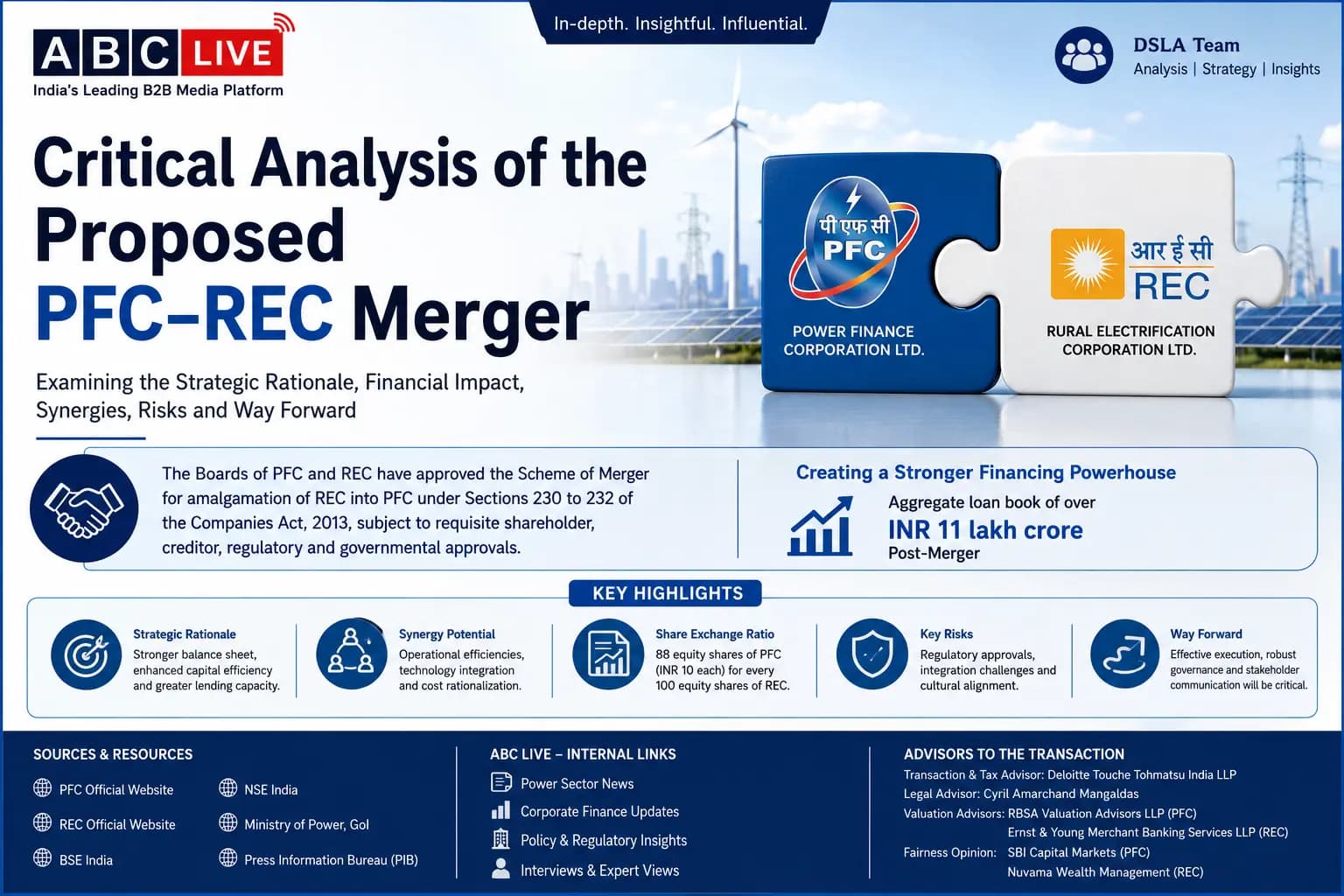
The proposed merger of REC Limited into Power Finance Corporation Limited could create a ?11 lakh crore public-sector financing institution. However, the 88:100 share-exchange ratio raises critical questions about government ownership, valuation transparency, capital requirements, sector concentration and future taxpayer exposure.
New Delhi (ABC Live in Association with DSLA): The Boards of Directors of Power Finance Corporation Limited and REC Limited have approved a scheme for the merger of REC into PFC under Sections 230 to 232 of the Companies Act, 2013.
According to the official Ministry of Power announcement published by the Press Information Bureau, the merger will create a public-sector financing institution with an aggregate loan book exceeding ?11 lakh crore.
Moreover, REC has published an official disclosure on the board-approved merger scheme. Under the proposed share-exchange ratio, REC shareholders will receive 88 fully paid-up PFC equity shares for every 100 fully paid-up REC equity shares held on the record date.
However, the merger is not yet final. Instead, it remains subject to approvals from shareholders, creditors, regulators, government authorities and the National Company Law Tribunal.
Furthermore, the scheme expressly requires the merged entity to continue as a government company. At the same time, the Government of India must retain majority voting rights and control, either directly or indirectly.
Therefore, the ownership condition is not merely a routine legal clause. Rather, it appears to be one of the central unresolved issues in the transaction.
Based on the currently available shareholding data and the announced 88:100 exchange ratio, the Government of India’s direct holding in PFC could fall from about 55.99% to nearly 42% after the merger, before any corrective capital or ownership transaction.
Consequently, the merger may require additional government action to restore majority ownership and voting control.
GEO Direct Answer: What Is the PFC–REC Merger?
The PFC–REC merger will combine REC Limited with its parent company, Power Finance Corporation Limited.
Under the scheme, REC will transfer its assets, liabilities, contracts, employees and obligations to PFC. Moreover, the transfer will take place under Sections 230 to 232 of the Companies Act, 2013.
REC shareholders will receive 88 PFC shares for every 100 REC shares held on the record date. Thereafter, once the merger becomes legally effective, REC will cease to exist as a separate listed company.
The combined institution will have an aggregate loan book of more than ?11 lakh crore. However, this scale will materialise only after the companies obtain all required approvals.
Most importantly, the merged institution must remain a government company. Therefore, the Government of India must retain at least the level of ownership and voting control required by law and by the merger scheme.
Key Findings
- The strategic logic is credible. A single institution could reduce duplication, combine treasury operations and support larger energy and infrastructure projects.
- However, the government ownership structure remains unresolved. The 88:100 exchange ratio could reduce the Government of India’s direct PFC holding to about 42%.
- Therefore, a second transaction may become necessary. The government may need to subscribe to fresh equity, acquire existing shares or restructure ownership before the merger becomes effective.
- Moreover, preference shares may not fully solve the problem. Such shares may satisfy the paid-up capital test, but they may not confer majority voting rights.
- Although independent valuers reviewed the exchange ratio, full valuation transparency is still missing. Detailed assumptions and sensitivity calculations have not yet entered the public domain.
- Furthermore, the merger may increase concentrated sector risk. Both PFC and REC finance the same electricity and infrastructure ecosystem.
- Consequently, taxpayer exposure requires careful disclosure. Any government capital infusion must show a clear economic benefit beyond merely restoring control.
PFC–REC Merger Dashboard
| Indicator | Position |
|---|---|
| Transferor company | REC Limited |
| Transferee company | Power Finance Corporation Limited |
| Share-exchange ratio | 88 PFC shares for every 100 REC shares |
| Combined loan book | More than ?11 lakh crore |
| Government holding in PFC | About 55.99% |
| PFC holding in REC | 52.63% |
| Estimated government stake after merger | About 42% |
| Estimated fresh PFC shares needed to reach 51% | About 80.64 crore |
| Governing provisions | Sections 230–232, Companies Act, 2013 |
| Present status | Board-approved, subject to approvals |
The official Press Information Bureau announcement confirms the ?11 lakh crore-plus combined loan book, the 88:100 exchange ratio and the requirement for continued government control.
However, the announcement does not yet provide the complete post-merger ownership plan. Therefore, investors and creditors still need further disclosure.
What Have the PFC and REC Boards Approved?
The two boards have approved a scheme of arrangement through which REC, the transferor company, will merge into PFC, the transferee company.
Once the scheme becomes effective, all REC assets and liabilities will move to PFC in accordance with the final tribunal-approved arrangement. In addition, REC shareholders other than PFC itself will receive PFC shares at the approved exchange ratio.
The companies have appointed several advisers for the transaction.
Deloitte Touche Tohmatsu India LLP is acting as the transaction and tax adviser. Meanwhile, Cyril Amarchand Mangaldas is acting as the legal adviser to both PFC and REC.
Similarly, RBSA Valuation Advisors LLP was appointed by PFC, while REC appointed Ernst & Young Merchant Banking Services LLP to prepare the joint valuation report.
Furthermore, SBI Capital Markets was appointed by PFC, while REC appointed Nuvama Wealth Management to provide separate fairness opinions.
The official REC merger disclosure confirms these appointments.
Although this advisory structure adds procedural credibility, it does not remove the need for public disclosure of the actual valuation methods and assumptions.
Therefore, shareholders should receive the detailed valuation material before voting on the scheme.
How the Merger Process Began
The present merger forms part of a longer consolidation process.
In December 2018, the Union Government approved PFC’s acquisition of the government’s 52.63% stake in REC. The decision can be examined in the Cabinet Committee on Economic Affairs announcement.
Thereafter, PFC completed the acquisition in March 2019. Consequently, REC became a subsidiary of PFC, although both companies continued as separately listed and independently managed institutions.
In February 2026, the boards granted in-principle approval to the restructuring proposal following the Union Budget announcement. REC’s official February 2026 disclosure confirms this development.
Therefore, the current merger effectively completes a consolidation process that began with PFC’s acquisition of control over REC.
However, completing the corporate consolidation does not automatically resolve the financial, governance and ownership questions.
Why the Merger Has a Strong Strategic Case
Elimination of Parent–Subsidiary Duplication
PFC and REC operate within the same public-sector financing system. Both institutions lend extensively to electricity generation, transmission, distribution and related infrastructure.
However, they maintain separate boards, senior management teams, compliance systems, treasury functions and technology platforms.
Therefore, the merger could remove some administrative duplication. Moreover, it could simplify governance, reporting and strategic planning.
Nevertheless, management must quantify the expected savings. General statements about efficiency are not enough.
Accordingly, the companies should disclose:
- Estimated one-time merger costs;
- Expected yearly administrative savings;
- Treasury and borrowing-cost savings;
- Technology-integration expenses; and
- The expected period for recovering merger costs.
Without these figures, investors cannot determine whether the merger will create measurable economic value.
Creation of a Larger Financing Institution
A combined loan book of more than ?11 lakh crore would make the merged PFC one of India’s largest specialised public-sector financial institutions.
Consequently, the merged lender may gain better access to domestic and international bond markets. In addition, it may become capable of financing larger transmission corridors, renewable energy parks, storage systems, and distribution reforms.
Furthermore, a larger balance sheet could support projects with long repayment periods and high initial investment requirements.
However, size does not automatically create financial safety. Instead, a larger institution becomes stronger only when it combines scale with disciplined lending, adequate capital and effective recovery systems.
Therefore, the merger should not be judged only by the size of the combined loan book.
Consolidation of Treasury Operations
At present, PFC and REC raise funds separately through bonds, bank borrowing, external commercial borrowing and other institutional sources.
A unified treasury could reduce internal competition for the same investor base. Moreover, it could improve liquidity planning and debt-maturity management.
However, the companies must explain whether the merger will actually reduce their average borrowing cost.
Furthermore, even if borrowing costs fall, borrowers will benefit only when the merged institution passes those savings through in its lending rates.
Readers may examine ABC Live’s analysis of the RBI swap facility for public-sector undertakings for the wider context of foreign-currency funding and public-sector borrowing risks.
Support for India’s Energy Transition
India requires substantial long-term capital for renewable energy generation, energy storage, green hydrogen, grid modernisation, and distribution reform.
Therefore, a larger public lender could finance projects that private institutions may consider too large, too long-term or too closely linked to public policy.
Moreover, the merged institution could coordinate finance across generation, transmission and distribution.
Nevertheless, an institution built around traditional power-sector lending will not automatically become an effective energy-transition bank.
Instead, the merged company will require new technical skills, climate-risk systems and project-assessment standards.
Therefore, it must distinguish between commercially sustainable energy-transition lending and policy-driven lending that may create future stress.
REC’s Financial Position Before the Merger
REC entered the merger process from a position of financial strength rather than immediate distress.
According to REC’s official financial-results announcement for the year ended March 31, 2026, the company reported:
- A loan book of approximately ?5.84 lakh crore;
- Profit after tax of ?16,282 crore;
- Net worth of ?84,290 crore;
- Capital adequacy ratio of 23.11%;
- Net Stage-3 assets of 0.12%;
- Net interest margin of 3.43%; and
- Earnings per share of ?61.71.
Furthermore, REC’s detailed accounts are available on its official financial results portal.
These figures show that the merger is not a rescue transaction involving a visibly failing company.
Therefore, the boards must provide stronger evidence of synergy.
In other words, because both institutions are financially significant, shareholders must be shown why consolidation will create more value than continued separate operation.
The Central Issue: Government Ownership Dilution
The most important unresolved question is not the size of the combined loan book. Instead, it is the ownership structure created by the share-exchange ratio.
The Ministry of Power Annual Report 2025–26 records that the Government of India owns approximately 55.99% of PFC.
Meanwhile, PFC owns 52.63% of REC.
Under the merger, PFC must issue shares to REC shareholders other than PFC itself. However, PFC cannot receive and hold its own shares against its existing REC stake.
Section 232 of the Companies Act, 2013 provides the statutory framework for mergers and amalgamations.
In particular, Section 232 requires shares held by the transferee company in the transferor company to be cancelled or extinguished.
Therefore, PFC’s 52.63% holding in REC cannot convert into PFC shares held by PFC itself.
Consequently, only REC’s remaining shareholders will effectively receive additional PFC equity.
ABC Live Ownership Calculation
| Calculation step | Approximate figure |
| Existing PFC equity shares | 330.01 crore |
| Government-owned PFC shares | 184.77 crore |
| Total REC equity shares | 263.32 crore |
| REC shares held by PFC | 138.59 crore |
| REC shares held by other shareholders | 124.74 crore |
| New PFC shares at 88:100 ratio | 109.77 crore |
| Post-merger PFC shares before corrective issue | 439.78 crore |
| Government shares after merger | 184.77 crore |
| Estimated government holding | 42.02% |
This calculation assumes that the share capital does not change materially before the record date.
However, the exact result may differ due to employee stock options, fractional entitlements, capital restructuring, or other provisions in the final scheme.
Nevertheless, the broad conclusion remains clear. The announced exchange ratio appears likely to reduce the Government of India’s direct holding below 51%.
Therefore, a separate capital or ownership transaction may become necessary.
How Much Fresh Equity Could the Government Need?
If the government relies only on a fresh issue of voting equity, it may require approximately 80.64 crore additional PFC shares to restore its holding to 51%.
Thereafter, the government could own approximately 265.41 crore shares out of an enlarged capital base of about 520.42 crore shares.
However, the actual fiscal cost would depend on the issue price.
Moreover, a listed company cannot issue shares to the government at an arbitrary value merely to restore control. Instead, the issue must comply with company law, securities regulations and valuation rules.
Alternatively, the government could acquire approximately 39.5 crore existing PFC shares from the market or other shareholders.
Although that option would avoid further dilution, it could involve significant public expenditure and influence the market price.
Therefore, shareholders must know the selected mechanism before they vote on the merger.
Can Preference Shares Preserve Government Control?
The merger scheme contains two distinct conditions.
First, the merged institution must remain a government company.
Second, the Government of India must retain majority voting rights and control.
Section 2(45) of the Companies Act, 2013 defines a government company by reference to government ownership of at least 51% of its paid-up share capital.
Therefore, preference shares may contribute to the paid-up-capital calculation, depending on the final structure.
However, voting rights create a separate legal issue.
Under Section 47 of the Companies Act, 2013, preference shareholders ordinarily vote only on matters affecting their rights, capital repayment, reduction of capital or winding up.
Moreover, preference shareholders gain wider voting rights only in specified situations.
Consequently, preference shares may help satisfy a capital-based government-company test. Nevertheless, they may not provide the majority voting rights expressly required by the merger scheme.
Therefore, the final ownership instrument must provide genuine and legally enforceable government control.
Possible Ownership-Restoration Mechanisms
| Mechanism | Possible advantage | Main concern |
| Fresh voting-equity issue to government | Directly restores majority voting rights | Requires public funds and dilutes other shareholders |
| Government purchase of existing PFC shares | Avoids further share issuance | May be expensive and influence market prices |
| Pre-merger transfer of REC shares | Changes who receives PFC merger shares | Requires a separate transaction and valuation |
| Government-controlled holding company | May preserve indirect control | Adds another ownership layer |
| Combination of equity and other securities | Could reduce immediate fiscal burden | Must still meet voting-control conditions |
| Revised exchange ratio | Could reduce dilution | Requires fresh valuation and fairness review |
The government could select one mechanism or combine several.
However, it must disclose the economic burden rather than leave it hidden within a condition precedent.
Furthermore, minority shareholders must know whether the final solution will dilute their holdings or change expected earnings per share.
Is the 88:100 Share-Exchange Ratio Fair?
The proposed ratio gives one REC shareholder 0.88 PFC shares for every REC share held.
A joint valuation exercise supported the ratio and separate fairness opinions.
Although that process provides procedural assurance, it does not provide complete transparency.
Therefore, before statutory shareholder meetings, the companies should disclose:
- The valuation date;
- The valuation methods used;
- Weight assigned to market prices;
- Weight assigned to book value and earnings;
- Treatment of PFC’s controlling stake in REC;
- Dividend assumptions;
- Capital-distribution assumptions;
- Sensitivity to market-price changes;
- Treatment of REC earnings already consolidated within PFC; and
- Impact of any fresh government capital issue.
A fairness opinion does not mean that every shareholder receives the same economic outcome.
Instead, it generally indicates that the exchange ratio falls within a professionally supportable range, given the assumptions used.
Therefore, shareholders require access to the reasoning, not merely the names of the advisers.
Scale Does Not Automatically Create Diversification
Both PFC and REC lend heavily to the electricity sector.
Their borrowers include generation companies, transmission entities, state power utilities, distribution companies, and energy infrastructure projects.
Therefore, the merger combines two large balance sheets, but it does not necessarily combine two different risk pools.
For example, if both institutions lend to the same state utilities or power projects, the merger may increase borrower- and state-level concentration within a single institution.
Consequently, the merged company should disclose:
- Top borrower exposures;
- State-wise exposure;
- Distribution-company exposure;
- Government-guaranteed loans;
- Non-guaranteed loans;
- Private-sector exposure;
- Renewable and thermal lending shares;
- Foreign-currency borrowing exposure; and
- Stress tests for delayed state payments.
ABC Live’s report on RBI lending rules for REITs and InvITs provides wider context on leverage, infrastructure exposure and lender safeguards.
Will the Merger Reduce Competition?
PFC and REC already belong to the same corporate group. Therefore, they may not operate as fully independent competitors.
Nevertheless, separate boards and management teams can still produce different lending judgments, pricing decisions and project assessments.
Once merged, borrowers may lose even this limited institutional alternative within the public power-finance system.
Moreover, the government may become heavily dependent on a single institution for implementing power-sector schemes.
Consequently, the merger could create a single point of operational, technological and credit failure.
The Competition Commission of India’s combination-regulation portal explains the merger-review framework applicable to qualifying transactions.
However, formal competition clearance does not answer the wider policy question.
Specifically, policymakers must consider whether one dominant public lender will improve credit discipline or reduce useful institutional diversity.
ABC Live’s report on CCI’s approval of MUFG’s Shriram Finance transaction explains how competition review operates in large financial-sector combinations.
The Risk of Creating a Too-Important-to-Fail Institution
A lender with a ?11 lakh crore-plus loan book will become systemically important to India’s power, banking, and bond markets.
Therefore, if the merged institution later faces a major asset-quality shock, the government may have little practical choice but to provide support.
This implicit sovereign backing may lower borrowing costs.
However, it may also weaken market discipline because lenders and bondholders could assume that the government will protect the institution.
Consequently, the merged entity requires stronger governance, including:
- Independent risk oversight;
- Borrower-concentration limits;
- State-level exposure limits;
- Climate-risk assessment;
- Public stress testing;
- Transparent capital-retention policies;
- Strong internal audit; and
- Parliamentary and public accountability for policy-directed lending.
Readers may examine ABC Live’s critical analysis of the RBI Annual Report 2025–26 for the broader financial-stability context.
Taxpayer Risk: Who Will Pay to Restore Control?
The ownership condition may require a substantial government transaction.
Therefore, the Ministry of Finance and Ministry of Power should disclose:
- The estimated number of additional shares required;
- The expected issue or acquisition price;
- The source of budgetary funds;
- The impact on government finances;
- The expected return on public investment;
- The effect on minority shareholders;
- The effect on earnings per share; and
- The impact on future dividend payments.
Public capital may be justified when it increases lending capacity or protects financial stability.
However, a capital injection used only to repair dilution created by the merger structure requires a clear public-interest explanation.
Moreover, the government should compare this expenditure with alternative uses of public funds, including direct investment in transmission, storage and distribution reform.
Employee and Technology Integration Risks
Financial mergers often focus on valuation and capital.
However, operational integration determines whether the promised efficiencies become real.
PFC and REC operate separate credit systems, technology platforms, human resource structures, and regional offices.
Therefore, the merged institution must integrate these systems without disrupting loan accounts, borrower services, project funding or recovery proceedings.
Accordingly, the boards should publish an integration roadmap covering:
- Employee protection;
- Seniority and promotion;
- Pay and pension differences;
- Office consolidation;
- Loan-processing systems;
- Data migration;
- Cybersecurity;
- Vendor contracts;
- Borrower communication;
- Internal audit; and
- Pending litigation and recovery proceedings.
A rushed technology merger could lead to reporting errors, account mismatches, or cybersecurity weaknesses.
Therefore, the merger’s effective date should depend on operational readiness, not merely legal approval.
Regulatory and Legal Approval Framework
The merger is governed by Sections 230 to 232 of the Companies Act, 2013.
Because PFC and REC are listed companies, the scheme must also comply with the Securities and Exchange Board of India framework.
The relevant requirements for listed companies can be examined in the SEBI Master Circular on Listing Obligations and Disclosure Requirements.
Furthermore, the specific regulatory framework for restructuring of listed companies is set out in the SEBI Master Circular on Schemes of Arrangement.
The merger process may involve:
- Government approval;
- PFC shareholder approval;
- REC shareholder approval;
- Creditor approval;
- Stock-exchange review;
- SEBI compliance;
- Reserve Bank of India examination;
- Competition Commission review, where applicable;
- National Company Law Tribunal sanction; and
- Tax and stamp-duty approvals.
Under Section 230, a scheme generally requires approval by a majority representing three-fourths in value of the members or creditors present and voting at the tribunal-directed meeting.
Therefore, the explanatory statement placed before shareholders and creditors will become a critical document.
What Shareholders Must Know Before Voting
Full Valuation Report
The companies should publish the joint valuation methodology, fairness opinion reasoning, assumptions, and sensitivity analysis.
Moreover, the disclosure should explain how the valuers treated PFC’s existing control over REC.
Post-Merger Shareholding
The explanatory statement should disclose the capital structure:
- Before the merger;
- Immediately after the share exchange;
- After cancellation of PFC’s REC holding;
- After any government capital issue; and
- After completion of the ownership-restoration process.
Without this information, shareholders cannot measure the final dilution.
Cost of Maintaining Government Control
The government should disclose whether it plans to issue new equity, acquire existing shares or use another government-controlled entity.
Furthermore, it should disclose the expected fiscal cost and funding source.
Pro Forma Financial Statements
Investors need combined income statements, balance sheets, capital adequacy figures, and stress scenarios.
In addition, the companies should publish the expected impact on earnings per share and return on equity.
Integration Costs and Savings
The boards should quantify recurring savings, one-time costs and the projected break-even period.
Otherwise, investors will have no measurable basis for assessing the claimed efficiencies.
Concentration Risk
The merged institution should disclose borrower-level, state-level, technology-level and scheme-level exposure.
Moreover, it should publish stress tests for delayed payments by state power utilities.
Dividend Policy
PFC and REC have historically attracted investors seeking dividends from public-sector companies.
Therefore, the merged company should explain whether the ownership-restoration transaction will affect its dividend policy.
PFC–REC Merger Timeline
| Date | Development |
| December 2018 | Government approved PFC’s acquisition of REC stake |
| March 2019 | PFC acquired 52.63% of REC |
| February 1, 2026 | Union Budget announced restructuring |
| February 6, 2026 | Boards granted in-principle approval |
| June 28, 2026 | Boards approved the merger scheme and ratio |
| June 30, 2026 | Government announced the approved scheme |
| Future stage | Shareholder, creditor and regulatory approvals |
| Final stage | National Company Law Tribunal sanction and effective date |
The official REC in-principle approval announcement and the subsequent Press Information Bureau release establish the key stages of the process.
However, any proposed completion date remains dependent on regulatory and legal approvals.
ABC Live–DSLA Risk Assessment
| Area | Rating | Critical observation |
| Strategic rationale | 8/10 | Scale and coordination could improve |
| Financial strength | 8/10 | Both institutions enter from a strong position |
| Valuation transparency | 5/10 | Detailed assumptions remain unavailable |
| Government ownership clarity | 3/10 | Control-restoration mechanism remains unresolved |
| Risk diversification | 5/10 | Similar loan exposure may increase concentration |
| Institutional competition | 5/10 | Separate lending judgments may disappear |
| Operational readiness | 5/10 | Public integration plan is not yet available |
| Taxpayer transparency | 4/10 | Fiscal cost remains unclear |
| Overall assessment | 6/10 | Strategically credible but structurally incomplete |
ABC Live Critical Analysis
The PFC–REC merger has a defensible strategic foundation.
India needs long-term financing for electricity infrastructure, renewable energy, transmission systems, storage and distribution reform.
Moreover, maintaining two separately listed public lenders within one corporate group creates overlap.
However, the merger should not be judged only by the size of the combined balance sheet.
A larger institution may raise funds more efficiently. Nevertheless, it can also concentrate risk, reduce alternative credit judgments and increase the probability of future taxpayer support.
Most importantly, the 88:100 share-exchange ratio appears to create a government-control problem that requires a second transaction.
ABC Live’s calculation indicates that the Government of India’s direct holding could fall to around 42% before corrective action.
Therefore, the ownership solution forms part of the merger’s economic substance.
Shareholders cannot properly evaluate the scheme until they know who will provide the additional capital, how many shares will be issued or acquired, what price will apply and how minority investors will be affected.
Furthermore, they need to know whether earnings per share, dividends and return on equity will decline after the corrective transaction.
The merger should proceed only after the boards disclose the full valuation, ownership, concentration risk, and operational integration framework.
Otherwise, shareholders may approve one transaction without knowing the cost of the second transaction required to make the first legally workable.
Recommendations
Publish the Ownership-Restoration Plan
The Government of India, PFC and REC should jointly disclose the mechanism for maintaining majority voting control before the shareholder meetings.
Moreover, the disclosure should explain whether control will remain direct or indirect.
Release Detailed Valuation Information
The companies should publish the valuation methodology, assumptions, weightings and sensitivity ranges.
Furthermore, they should explain how the ratio treats PFC’s existing ownership of REC.
Disclose the Fiscal Cost
The government should reveal how much public money may be required to preserve control.
In addition, it should disclose whether Parliament will see the expenditure through the Union Budget or another public-sector transaction.
Publish Pro Forma, Capital Data
The merged institution should disclose expected capital adequacy before and after any government capital issue.
Moreover, it should provide stress scenarios for major borrower defaults and delayed state payments.
Establish Concentration Limits
The board should adopt borrower-level, state-level and distribution-company exposure limits.
Therefore, scale should be accompanied by stronger risk controls.
Protect Independent Risk Governance
The merged institution should maintain independent directors, a specialised risk committee and strong review mechanisms for large loans.
Furthermore, policy-driven lending should remain subject to clear credit standards.
Publish an Integration Roadmap
The companies should disclose milestones for technology, employees, offices, contracts, and loan account migration.
Consequently, investors and borrowers will be able to track whether integration remains on schedule.
Link Management Accountability to Results
Management should report actual borrowing savings, administrative savings, asset-quality outcomes and energy-transition lending against published targets.
Therefore, claims of synergy should become measurable commitments.
Frequently Asked Questions
What is the PFC–REC merger share ratio?
REC shareholders will receive 88 fully paid-up PFC equity shares for every 100 fully paid-up REC shares held on the record date.
Is the merger final?
No. Although the boards have approved the scheme, it remains subject to shareholder, creditor, government, regulatory and tribunal approvals.
Will REC continue as a separate company?
No. Once the merger becomes effective, REC will cease to exist as a separate listed legal entity.
What happens to PFC’s existing REC shares?
PFC cannot hold its own shares after the merger. Therefore, the shares attributable to PFC’s REC holding must be cancelled or extinguished under Section 232 of the Companies Act.
Will the Government of India retain control?
The merger scheme requires continued government control. However, the announced share ratio may reduce the government’s direct stake to around 42% before corrective action.
How many fresh shares may be required?
If the government uses only a fresh voting-equity issue, it may need approximately 80.64 crore additional PFC shares to reach a 51% holding.
Is the merger beneficial for REC shareholders?
The outcome will depend on PFC’s market value, the final ownership-restoration mechanism, the dividend policy, integration costs and post-merger performance.
Therefore, the 88:100 ratio should not be assessed in isolation.
Will the merger reduce lending rates?
A combined treasury may reduce borrowing costs. However, borrowers will benefit only if the merged company passes those savings through in its loan pricing.
How ABC Live Verified This Analysis
ABC Live examined:
- The official government announcement;
- The REC board-approved merger disclosure;
- The REC in-principle approval announcement;
- The Ministry of Power Annual Report 2025–26;
- REC’s financial results;
- The Companies Act, 2013;
- The SEBI framework for listed-company schemes; and
- The Competition Commission of India’s merger-review framework.
Furthermore, ABC Live calculated the possible government dilution by applying the 88:100 exchange ratio to REC shares held by shareholders other than PFC.
Meanwhile, DSLA reviewed the company law questions concerning government-company status, voting rights, merger approvals, and the cancellation of shares held by the transferee company.
Sources and Resources
Primary Official Sources
- Press Information Bureau: Approval of Merger Scheme by Boards of PFC and REC
- REC Limited: Approval of Merger Scheme by Boards of PFC and REC
- REC Limited: In-Principle Approval for the PFC–REC Merger
- Cabinet Approval for PFC’s Acquisition of the Government’s REC Stake
- Ministry of Power Annual Report 2025–26
- Power Finance Corporation Official Website
- REC Limited Official Website
- REC Financial Results
- REC Annual Reports
Legal and Regulatory Sources
- India Code: Companies Act, 2013
- India Code: Section 47—Voting Rights
- India Code: Section 232—Merger and Amalgamation
- SEBI Master Circular on Listing Obligations and Disclosure Requirements
- SEBI Master Circular on Schemes of Arrangement
- Competition Commission of India: Regulation of Combinations
Related ABC Live Reports
- Critical Analysis of RBI Annual Report 2025–26
- Critical Analysis of RBI Swap Facility for PSUs
- Explained: RBI Lending Rules for REITs and InvITs
- Explained: RBI’s NBFC Amendment 2026
- Critical Analysis of RBI Draft Capital Adequacy Directions 2026
- Explained: Why CCI Cleared MUFG’s Shriram Finance Deal
Editorial Note
Dinesh Singh Law Associates provided legal research, statutory interpretation and regulatory analysis for this report. However, ABC Live retains full editorial responsibility for the analysis, conclusions and recommendations.
This report is a public-interest legal and policy analysis. Therefore, it does not constitute investment, tax, valuation or transaction advice.
ABC Live — Making Complex Public Issues Simple.