

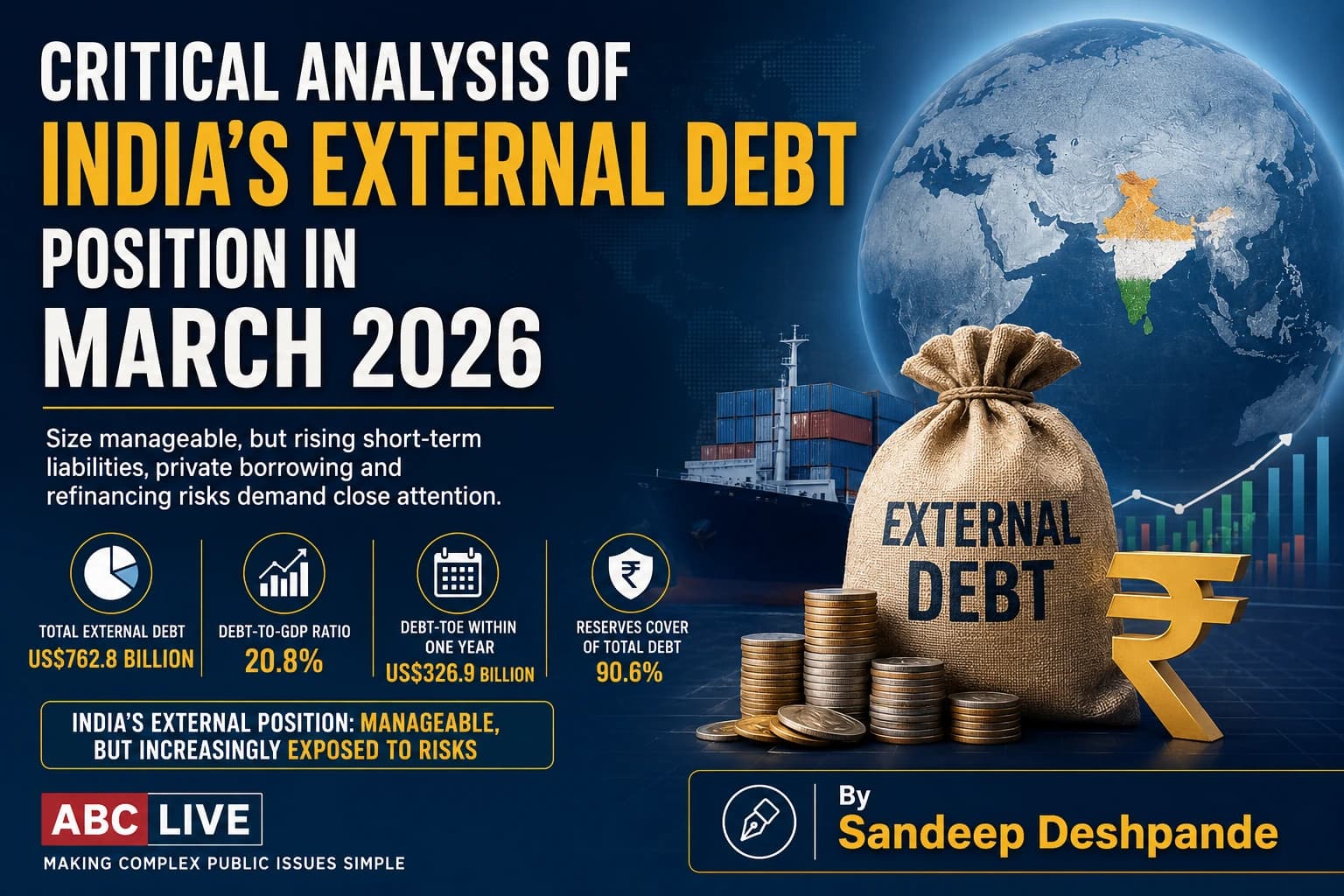
India’s external debt reached US$762.8 billion at the end of March 2026. Although the overall debt remained manageable, faster growth in short-term liabilities, private-sector concentration and a large one-year repayment exposure reduced India’s external financial safety margin.
Mumbai (ABC Live): India’s external debt stood at US$762.8 billion at the end of March 2026. Thus, it increased by US$26.3 billion, or 3.6%, over its March 2025 level.
Meanwhile, the external debt-to-GDP ratio increased from 19.8% to 20.8%. Therefore, India’s external liabilities grew faster than the economy in dollar terms during the year.
At first sight, the position remains manageable. Moreover, India holds substantial foreign exchange reserves, most of its external debt is long-term, and the debt-service ratio has improved.
However, the headline figure does not reveal the complete picture. In particular, short-term debt increased much faster than long-term debt. Furthermore, nearly US$326.9 billion may become payable or require refinancing within 12 months.
Therefore, India’s external debt position can best be described as manageable in size but increasingly exposed to refinancing, exchange-rate and private-sector risks.
Summary
India’s external debt position remained broadly stable at the end of March 2026. Nevertheless, several changes beneath the headline figure require closer attention.
First, currency valuation reduced the reported increase in external debt. Without that valuation effect, India’s external debt would have increased by US$51 billion instead of US$26.3 billion.
Second, short-term debt increased by 11%, whereas long-term debt grew by only 1.9%. Consequently, the maturity profile shifted towards liabilities that require earlier repayment or refinancing.
Third, non-government borrowers accounted for almost the entire annual increase. Therefore, the main external debt risk now lies less with direct sovereign borrowing and more with companies, banks and financial institutions.
Finally, India’s foreign exchange reserves continue to provide a strong protective buffer. Even so, reserves cannot replace effective hedging, stable export earnings, careful borrowing and sound corporate balance sheets.
Accordingly, India is not facing an external debt crisis. However, the country’s external financial position became moderately less comfortable during 2025–26.
Key Findings
- Total external debt reached US$762.8 billion.
- Consequently, external debt increased by US$26.3 billion, or 3.6%.
- Meanwhile, the debt-to-GDP ratio rose from 19.8% to 20.8%.
- Without valuation effects, external debt would have increased by US$51 billion.
- Short-term debt increased by 11%.
- By contrast, long-term debt increased by only 1.9%.
- Debt falling due within one year reached US$326.9 billion.
- Non-government entities owed US$595.3 billion.
- Meanwhile, government external debt declined slightly to US$167.5 billion.
- The debt-service ratio improved from 6.6% to 5.8%.
- Foreign exchange reserves covered 90.6% of total external debt.
- US dollar liabilities formed 55.5% of total external debt.
India’s External Debt Dashboard
| Indicator | March 2025 | March 2026 | ABC Live assessment |
|---|---|---|---|
| Total external debt | US$736.4 bn | US$762.8 bn | Manageable but rising |
| Debt-to-GDP ratio | 19.8% | 20.8% | Safety margin narrowed |
| Long-term debt | US$601.9 bn | US$613.5 bn | Slow growth |
| Short-term debt | US$134.5 bn | US$149.2 bn | Fast growth |
| Short-term share | 18.3% | 19.6% | Liquidity risk increased |
| Debt due within one year | 41.2% | 42.9% | Refinancing pressure rose |
| Reserves-to-debt ratio | 90.8% | 90.6% | Strong but slightly lower |
| Debt-service ratio | 6.6% | 5.8% | Positive development |
| Government debt | US$168.4 bn | US$167.5 bn | Slight decline |
| Non-government debt | US$568.0 bn | US$595.3 bn | Main source of increase |
Overall, the dashboard presents a mixed picture. On the one hand, government borrowing and the current debt-service burden remained under control. On the other hand, short-term liabilities and private-sector debt increased.
Therefore, India’s external debt position cannot be judged only by the total amount. Instead, policymakers must also examine maturity, borrower quality, currency exposure and refinancing needs.
What Does India’s External Debt Include?
External debt refers to money that Indian residents owe to lenders, investors, or institutions outside India.
However, the entire US$762.8 billion does not represent borrowing by the Union Government. Instead, the figure includes foreign liabilities of:
- the Central and state governments;
- Indian companies;
- banks and financial institutions;
- Indian subsidiaries of foreign companies;
- importers using overseas trade credit; and
- entities issuing bonds or taking loans abroad.
Therefore, describing the entire amount as government foreign debt would be incorrect.
Government external debt stood at US$167.5 billion. By contrast, non-government external debt reached US$595.3 billion.
Consequently, companies, banks and other non-government borrowers accounted for nearly 78% of India’s total external debt.
Is India Facing an External Debt Crisis?
India is not facing an immediate external debt crisis.
Although the debt-to-GDP ratio increased to 20.8%, it remained below several earlier levels. For example, India’s external debt-to-GDP ratio stood at 28.3% in 1991 and 23.9% in 2014.
Moreover, the debt-service ratio remained far below its level during the 1991 balance-of-payments crisis. Therefore, the present situation differs significantly from the conditions India faced three decades ago.
Nevertheless, a moderate debt-to-GDP ratio alone cannot guarantee safety. A country may still face external pressure when large repayments fall due quickly, foreign lenders refuse to renew loans or the domestic currency weakens sharply.
Therefore, India must assess not only how much it owes but also when the debt must be repaid, who borrowed the money and whether those borrowers earn foreign currency.
Why the US$26.3 Billion Increase Understates the Trend
India’s external debt officially increased by US$26.3 billion during 2025–26. However, this number includes a favourable currency valuation effect of US$24.6 billion.
Because the US dollar appreciated against the rupee and other major currencies, liabilities denominated in those currencies appeared smaller after conversion into dollars.
Without this valuation effect, India’s external debt would have increased by US$51 billion.
Therefore, the underlying increase was almost twice the reported rise. While the reported growth rate was approximately 3.6%, the valuation-adjusted increase was closer to 6.9%.
Consequently, currency movements made the annual debt increase appear more moderate than the underlying change in liabilities.
Why Currency Valuation Matters
Currency valuation gains may reverse in a later year. For example, if the US dollar weakens against the euro or yen, the dollar value of India’s non-dollar debt may increase even without fresh borrowing.
Therefore, official public communication should clearly separate:
- new borrowing;
- repayments;
- changes in deposits and trade credit; and
- changes caused by exchange-rate movements.
Otherwise, the headline debt figure may understate or overstate the actual borrowing trend.
Short-Term Debt Is the Main Warning Signal
Short-term debt by original maturity increased from US$134.5 billion to US$149.2 billion. Thus, it rose by US$14.7 billion, or approximately 11%.
Meanwhile, long-term debt increased from US$601.9 billion to US$613.5 billion. Therefore, long-term debt grew by only US$11.6 billion, or 1.9%.
Consequently, more than half of the annual increase in reported external debt was attributable to short-term liabilities.
Short-term borrowing is not automatically harmful. For instance, companies regularly use overseas trade credit to import fuel, machinery, electronics, industrial parts and raw materials.
However, short-term borrowing creates refinancing risk. Borrowers must either repay the amount quickly or persuade foreign lenders to renew the credit.
During normal market conditions, refinancing may remain easy. Nevertheless, during war, financial panic, rising global interest rates or capital flight, lenders may reduce their exposure to emerging markets.
Consequently, several Indian borrowers could demand US dollars simultaneously. As a result, such demand could weaken the rupee and require intervention by the Reserve Bank of India.
Why US$326.9 Billion Matters More Than US$149.2 Billion
The US$149.2 billion figure measures debt that was short-term at the time it was originally borrowed.
However, it does not include long-term loans that will mature during the next 12 months. Therefore, analysts must also examine debt according to residual maturity.
Residual maturity includes:
- debt originally borrowed for one year or less;
- instalments of long-term loans payable within one year;
- deposits that may become payable;
- maturing bonds; and
- other foreign liabilities due within 12 months.
On this basis, US$326.9 billion could fall due or require refinancing within one year.
Thus, near-term external obligations represented 42.9% of India’s total external debt. Moreover, they equalled 47.3% of foreign exchange reserves.
This figure does not mean that the Government of India must repay US$326.9 billion immediately. Instead, companies, banks and other borrowers will repay or refinance most of the amount.
Nevertheless, the figure represents a large refinancing requirement. Therefore, residual maturity provides a more realistic picture of short-term external pressure than original maturity alone.
Private Borrowers Created Almost the Entire Increase
Government external debt decreased from US$168.4 billion to US$167.5 billion.
Meanwhile, non-government external debt increased from US$568 billion to US$595.3 billion. Therefore, non-government borrowers added approximately US$27.3 billion, while government debt declined by US$0.9 billion.
Consequently, private companies, banks and financial institutions accounted for virtually the entire annual increase.
This finding changes the nature of the policy debate. India’s immediate external debt risk does not arise mainly from excessive sovereign foreign borrowing. Instead, it arises from the foreign liabilities of companies and financial institutions.
Sector-Wise External Debt
| Borrower | March 2026 | Share |
| Non-financial companies | US$277.9 bn | 36.4% |
| Banks and deposit-taking institutions | US$202.1 bn | 26.5% |
| General government | US$167.5 bn | 22.0% |
| Other financial institutions | US$78.0 bn | 10.2% |
| Intercompany lending | US$37.2 bn | 4.9% |
Non-financial corporations held the largest share of external debt. Moreover, their foreign liabilities increased by US$16.8 billion during the year.
Meanwhile, other financial corporations added US$8.4 billion. In addition, intercompany lending increased by US$2.2 billion.
Therefore, regulators must examine which companies borrowed abroad, whether they generate foreign currency and whether they have protected themselves against exchange-rate changes.
Why Private Debt Can Become a Public Problem
Private external debt does not directly impose a repayment obligation on the government. However, corporate financial distress can still affect the wider economy.
For example, a heavily indebted company may reduce investment, delay projects, default on domestic bank loans or seek restructuring.
Consequently, Indian banks, employees, suppliers and investors may suffer losses. Moreover, if several large companies face a dollar shortage, the RBI may need to provide liquidity or stabilise the foreign exchange market.
Therefore, private foreign debt can create indirect public costs even when the government has not guaranteed the borrowing.
Currency Risk Remains Significant
US dollar-denominated debt formed 55.5% of India’s total external debt. Meanwhile, rupee-denominated liabilities formed 29.4%.
Yen, Special Drawing Rights and euro debt accounted for most of the remaining share.
Dollar debt creates a direct exchange-rate risk for borrowers whose income is mainly in rupees.
For example, suppose a company borrows US$100 million when one dollar costs ?85. In that case, its rupee liability would equal ?850 crore.
However, if the rupee weakens to ?95 per dollar, the same US$100 million would cost ?950 crore to repay. Consequently, the company’s repayment burden would increase by ?100 crore even though the dollar loan remained unchanged.
Which Borrowers Face Lower Currency Risk?
Exporters may face lower currency risk because they earn dollars, euros or other foreign currencies. Therefore, information technology, pharmaceutical and export-manufacturing companies may benefit from a natural hedge.
By contrast, infrastructure, real estate, power and domestic-service companies may earn mainly in rupees. Consequently, they face greater risk unless they purchase financial hedges.
The official debt release provides sector-wise and currency-wise information. Nevertheless, it does not clearly disclose:
- fully hedged corporate debt;
- partly hedged debt;
- unhedged liabilities;
- natural foreign currency hedges;
- sector-wise repayment schedules; or
- concentration among the largest borrowers.
Therefore, the available data explain the size of the exposure but not its full quality.
Foreign Exchange Reserves Provide a Strong Buffer
India’s foreign exchange reserves provided substantial protection at the end of March 2026.
Accordingly, reserves covered 90.6% of total external debt. Moreover, reserves were more than twice the debt falling due within one year.
Therefore, India has a strong defence against temporary capital outflows, import shocks and foreign exchange market stress.
The RBI Annual Report provides wider official information on India’s reserve position, monetary conditions and external-sector developments.
However, foreign exchange reserves are not funds kept solely for repaying external debt. Instead, they also support:
- essential imports;
- energy purchases;
- exchange-rate stability;
- market confidence;
- trade settlement; and
- emergency financial liquidity.
Therefore, the entire reserve stock cannot be treated as freely available for repaying private foreign debt.
Moreover, reserve strength should not encourage careless borrowing. Instead, India must combine adequate reserves with prudent debt management and stronger foreign currency earnings.
The Debt-Service Ratio Improved
India’s debt-service ratio declined from 6.6% to 5.8%.
This ratio measures principal and interest payments against current external receipts. Therefore, a lower ratio means India used a smaller share of its foreign earnings to service external debt during the year.
India’s services exports, remittances and other external receipts strengthen its repayment capacity. Moreover, the 5.8% debt-service ratio remained far below the 35.3% recorded in 1991.
However, the debt-service ratio records payments already made. By contrast, residual maturity identifies obligations that may arise in the coming year.
Consequently, policymakers must read the lower debt-service ratio together with the higher residual-maturity ratio. At the same time, one indicator shows current repayment strength, the other points to future refinancing exposure.
Loans and Trade Credit Drove the Debt Structure
Loans remained the largest external debt instrument at US$264.9 billion.
Meanwhile, currency and deposits totalled US$170.4 billion, while trade credit and advances totalled US$144.9 billion.
In addition, debt securities stood at US$123 billion. Intercompany lending reached US$37.2 billion.
Instrument-Wise Change
| Instrument | March 2025 | March 2026 | Change |
| Loans | US$250.6 bn | US$264.9 bn | +US$14.3 bn |
| Trade credit | US$131.2 bn | US$144.9 bn | +US$13.7 bn |
| Currency and deposits | US$167.6 bn | US$170.4 bn | +US$2.8 bn |
| Intercompany lending | US$35.0 bn | US$37.2 bn | +US$2.2 bn |
| Debt securities | US$130.1 bn | US$123.0 bn | ?US$7.1 bn |
Loans and trade credit together explain most of the annual increase. Therefore, external debt growth appears closely connected with business financing and imports.
Trade credit allows an Indian buyer to receive goods immediately and pay a foreign supplier later. Consequently, it supports normal commercial activity.
However, heavy reliance on trade credit can become risky during an oil price shock, supply chain disruption, or a decline in supplier confidence.
For example, foreign suppliers may shorten payment periods precisely when Indian importers need more financing. Therefore, trade credit risk must be part of India’s broader external debt assessment.
The Declining Share of Concessional Debt Deserves Attention
Concessional debt represented 6.7% of total external debt in March 2026. Previously, it stood at 6.9% in March 2025 and at much higher levels during earlier decades.
This decline partly reflects India’s development and broader access to commercial finance. Therefore, a lower concessional share does not automatically indicate financial weakness.
However, commercial debt normally carries market-linked interest rates and stricter repayment conditions. Moreover, borrowers must refinance commercial debt when it matures.
Consequently, India’s external debt position now depends more heavily on global interest rates, market confidence and access to foreign credit.
Historical Comparison
| Year | External debt | Debt-to-GDP | Debt service |
| 1991 | US$83.8 bn | 28.3% | 35.3% |
| 2001 | US$101.3 bn | 22.1% | 16.6% |
| 2014 | US$446.2 bn | 23.9% | 5.9% |
| 2020 | US$558.3 bn | 20.9% | 6.5% |
| 2024 | US$668.9 bn | 19.2% | 6.7% |
| 2025 | US$736.4 bn | 19.8% | 6.6% |
| 2026 | US$762.8 bn | 20.8% | 5.8% |
India’s present external position remains much stronger than it was in 1991. In particular, the debt-service burden is far lower, while foreign exchange reserves are substantially higher.
However, the debt-to-GDP ratio increased from 19.2% in 2024 to 19.8% in 2025 and then to 20.8% in 2026.
Therefore, although India’s structural external position remains sound, the recent direction has become less favourable.
External Debt Risk Dashboard
| Risk | Level | Reason |
| Sovereign repayment risk | Low | Government debt is only 22% of total |
| Overall debt sustainability | Low to moderate | Debt-to-GDP remains manageable |
| Short-term liquidity risk | Moderate and rising | Short-term debt grew by 11% |
| Refinancing risk | Moderate | US$326.9 billion falls due within one year |
| Currency risk | Moderate | Dollar debt forms 55.5% |
| Corporate risk | Moderate | Companies drove the increase |
| Banking risk | Moderate | Banks hold 26.5% of total debt |
| Reserve adequacy | Strong | Reserves cover 90.6% of debt |
| Interest-rate risk | Moderate | Commercial debt dominates |
| Data-transparency risk | Moderate | Detailed hedging data remain limited |
What Could Trigger External Debt Stress?
Sharp Rupee Depreciation
A weaker rupee would increase the domestic cost of unhedged dollar, euro and yen liabilities.
Therefore, companies that earn mainly in rupees could face sudden repayment pressure. Moreover, higher repayment costs could reduce their investment and profitability.
Higher Global Interest Rates
Higher international interest rates would increase refinancing costs. Furthermore, borrowers renewing debt during tight market conditions may pay much more than they paid under their original loans.
Therefore, a global interest-rate shock could weaken otherwise healthy corporate balance sheets.
Oil and Commodity Price Shock
India imports large quantities of energy and industrial inputs. Consequently, higher import prices could increase both foreign exchange demand and short-term trade credit.
Moreover, an energy-price shock could widen the current account deficit. Therefore, India’s external debt risk remains linked with its dependence on imported energy.
Global Credit Freeze
During a global financial shock, foreign banks and investors may refuse to roll over existing debt.
Consequently, Indian borrowers may need to repay obligations from domestic resources or buy foreign currency in stressed markets.
Therefore, a temporary global credit freeze could create liquidity pressure even when India’s long-term debt position remains sustainable.
Lower Export and Services Income
India’s repayment capacity depends partly on merchandise exports, software services, remittances and other foreign currency receipts.
Consequently, a global slowdown could weaken debt-servicing capacity. Moreover, reduced export income could increase dependence on reserves and new borrowing.
Large Capital Outflows
Foreign investors may withdraw from Indian debt and equity markets due to geopolitical conflict, higher overseas interest rates, or global risk aversion.
Therefore, capital outflows could weaken the rupee even when India’s domestic economic position remains broadly stable.
What RBI and the Government Should Do
Publish Sector-Wise Hedging Data
First, the RBI should disclose how much external debt remains fully hedged, partly hedged or unhedged.
Moreover, the data should distinguish financial hedges from natural export-income hedges. Consequently, regulators and markets would gain a clearer view of currency risk.
Give Greater Importance to Residual Maturity
Second, official communication should prominently report both original and residual maturity.
Otherwise, readers may focus only on the US$149.2 billion short-term figure and overlook the US$326.9 billion one-year repayment exposure.
Therefore, residual maturity should become a central part of every external debt assessment.
Conduct Borrower-Level Stress Tests
Third, regulators should test major borrowers against:
- a sharp rupee fall;
- higher international interest rates;
- reduced refinancing;
- lower export earnings;
- rising oil prices; and
- restrictions in international credit markets.
Consequently, regulators could identify vulnerable borrowers before market stress turns into a broader financial problem.
Monitor Rupee-Earning Foreign Borrowers
Furthermore, companies that borrow abroad but earn mainly in rupees deserve closer monitoring.
Therefore, the RBI may need stronger hedging, liquidity or disclosure requirements for such borrowers. In addition, lenders should assess whether the borrower has sufficient foreign-currency income to meet future payments.
Prefer Long-Term Capital Over Short-Term Debt
India should also attract stable foreign direct investment and long-term capital.
By contrast, repeated reliance on short-term debt creates fixed repayment and refinancing obligations.
The ABC Live report on the FEMA Borrowing and Lending Regulations 2026 explains India’s changing framework for overseas borrowing.
Link External Debt With Trade Policy
Moreover, external debt management cannot remain separate from energy, export and industrial policy.
Therefore, India needs stronger manufacturing exports, reduced dependence on critical imports and more stable foreign currency earnings.
In addition, greater domestic energy security could reduce the foreign-exchange pressure from oil and gas imports.
Avoid Overdependence on Reserves
Finally, reserves can absorb temporary financial shocks. However, they cannot permanently compensate for weak exports, repeated capital outflows or poorly managed corporate borrowing.
Therefore, reserve strength must support prudent policy rather than encourage excessive foreign debt.
ABC Live Overall Assessment
India’s external debt position at the end of March 2026 remained manageable but less comfortable than a year earlier.
On the positive side, foreign exchange reserves remained substantial, direct government debt formed a limited share, long-term liabilities continued to dominate, and the debt-service ratio improved.
However, the underlying debt structure weakened. Short-term liabilities grew much faster than long-term debt. Moreover, US$326.9 billion may be due for repayment or refinancing within one year.
At the same time, private borrowers accounted for almost the entire annual increase. Furthermore, favourable currency valuation concealed part of the underlying rise.
Therefore, the central policy conclusion is clear:
India’s external debt remains sustainable in stock terms. However, its liquidity, refinancing and private-sector risks increased during 2025–26.
Accordingly, future debt management must focus not only on how much India owes. Instead, it must also examine who owes the money, when it must be repaid, which currency the borrower uses and whether the borrower earns enough foreign exchange.
Frequently Asked Questions
What was India’s external debt in March 2026?
India’s external debt stood at US$762.8 billion at the end of March 2026. Therefore, it increased by US$26.3 billion from March 2025.
Is India’s US$762.8 billion external debt dangerous?
India’s external debt is not immediately dangerous because it equals 20.8% of GDP, reserves remain strong, and the debt-service ratio is low. However, rising short-term and private-sector liabilities require closer monitoring.
Does the Government of India owe the entire amount?
No. Government external debt was US$167.5 billion. By contrast, companies, banks, financial institutions and other non-government entities owed US$595.3 billion.
How much external debt may fall due within one year?
External debt on a residual-maturity basis stood at US$326.9 billion. Therefore, this amount may require repayment or refinancing within 12 months.
Why is short-term debt risky?
Short-term debt must be repaid or renewed quickly. Consequently, it becomes risky when foreign lenders withdraw, global interest rates rise, or the rupee weakens.
Are India’s foreign exchange reserves sufficient?
India’s reserves covered 90.6% of total external debt and more than twice the debt due within one year. Therefore, they provide a strong buffer. Nevertheless, the entire reserve stock cannot be used only for debt repayment.
Who holds the largest share of India’s external debt?
Non-financial companies held the largest share at 36.4%. Meanwhile, banks and deposit-taking institutions followed with 26.5%.
What is the biggest external debt risk for India?
The biggest emerging risk is the combination of short-term refinancing needs, private-sector borrowing, and foreign-currency exposure.
How We Verified
ABC Live reviewed the official Reserve Bank of India data on India’s external debt at the end of March 2026.
In particular, the review covered sector-wise debt, original maturity, residual maturity, currency composition, debt instruments, foreign exchange reserve coverage and historical indicators.
Furthermore, ABC Live compared the data with the RBI Annual Reports, the Ministry of Finance’s External Debt Statistics portal and the International Monetary Fund’s India country reports.
However, the March 2026 figures remain provisional. Therefore, the RBI or the Government of India may revise some numbers in later statistical releases.
Official Sources and Resources
- Reserve Bank of India — official monetary, banking and external-sector data.
- RBI Press Releases — official statistical and policy announcements.
- RBI Annual Reports — annual analysis of monetary policy, banking, reserves and the external sector.
- Department of Economic Affairs: External Debt Statistics — official quarterly and annual external debt reports.
- International Monetary Fund: India — IMF reports on India’s economy, external position and reserve adequacy.
- World Bank International Debt Statistics — international comparison of external debt indicators.
Related ABC Live Reports
- Critical Analysis of RBI Annual Report 2025–26 — analysis of reserves, trade, capital flows and financial stability.
- Critical Analysis of RBI Swap Facility for Public Sector Undertakings — analysis of foreign currency borrowing and hedging risks.
- Explained: FEMA Borrowing and Lending Regulations 2026 — explanation of India’s revised foreign borrowing framework.
- Critical Analysis of the IMF Article IV India 2025 Report — analysis of India’s reserves, investment flows and external-sector risks.
ABC Live — Making Complex Public Issues Simple.