

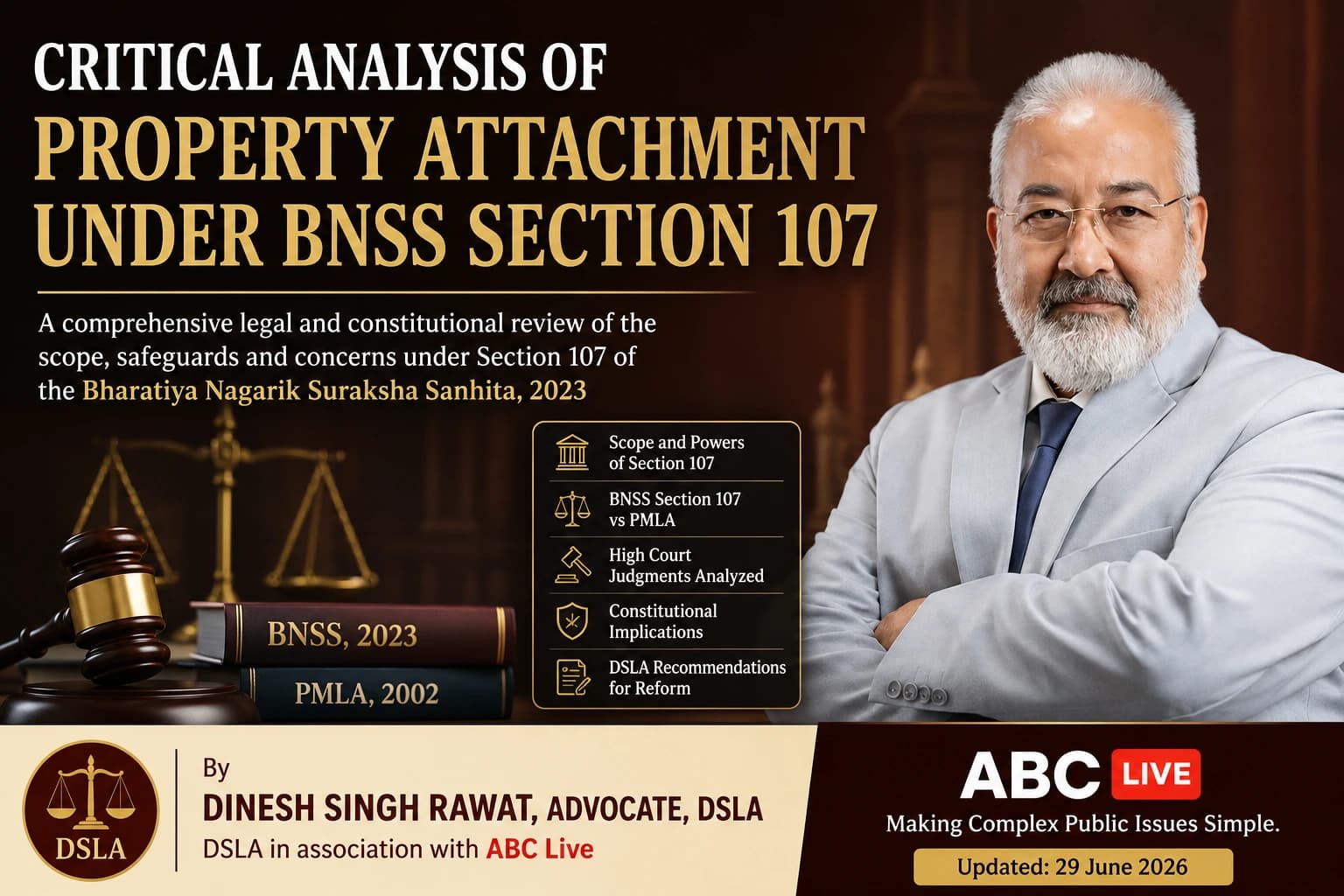
Section 107 of the Bharatiya Nagarik Suraksha Sanhita grants courts broad powers to attach property allegedly linked to a crime. Although the provision requires judicial approval, unclear definitions, short notice periods, limited review, and possible pre-conviction distribution raise serious constitutional and procedural concerns.
New Delhi (ABC Live–DSLA): Section 107 of the Bharatiya Nagarik Suraksha Sanhita, 2023, creates a general legal route for attaching property allegedly derived from criminal activity.
An investigating police officer cannot independently order attachment. The officer must first secure approval from the Superintendent or Commissioner of Police. After that approval, the officer may apply to the Court or Magistrate having jurisdiction over the alleged offence.
This judicial gateway gives Section 107 an important procedural safeguard. In comparison, the Prevention of Money Laundering Act, 2002, allows an authorised Enforcement Directorate officer to provisionally attach property before an independent Adjudicating Authority reviews the action.
Why the Safeguards Still Require Examination
The comparison changes after the initial stage. The PMLA expressly requires written reasons, supporting material, a provisional attachment period, independent adjudication and a dedicated appeal structure.
Section 107 does not reproduce many of these protections. It also applies to property allegedly obtained through criminal activity or the commission of “any offence”. Its reach may therefore extend beyond the PMLA framework, which links proceeds of crime with scheduled offences.
Recent High Court decisions have added another layer of uncertainty. The Kerala, Bombay and Delhi High Courts have largely treated Section 107 as the proper route for attaching or debt-freezing bank accounts.
By contrast, the Allahabad High Court has allowed police to place a limited lien over a specifically identified amount under Section 106, subject to strict safeguards.
The Supreme Court has already noticed the conflicting approaches. As a result, India does not yet have a settled national rule on police-directed bank account restraints in cybercrime investigations.
DSLA finds that judicial involvement offers important protection. Yet judicial approval alone cannot resolve unclear statutory standards, a short reply period, an open-ended interim order, uncertain restoration and possible distribution before final adjudication.
Key Findings
| Legal question: | DSLA finding |
|---|---|
| Can police directly attach property under Section 107? | No. Police must apply to the competent Court or Magistrate. |
| Is senior police approval necessary? | Yes. The investigating officer must obtain approval from the Superintendent or Commissioner of Police. |
| Must the officer record reasons in writing? | Section 107 uses “reason to believe”, but it does not expressly require written reasons at the investigation stage. |
| How much time does a person receive to reply? | The ordinary show-cause process allows 14 days. |
| Can the Court act without prior notice? | Yes. It may pass an ex parte interim order when notice could defeat the purpose of the attachment. |
| Does the interim order have a fixed outer limit? | No separate outer limit appears in subsection (5). |
| Does Section 107 apply only to listed serious offences? | No. Its wording refers to criminal activity or the commission of any offence. |
| Must conviction occur before distribution? | Section 107 does not expressly impose that condition. |
| Is PMLA harsher at every stage? | No. The PMLA begins with an executive attachment, whereas Section 107 requires an initial judicial order. |
| Have all High Courts adopted the same view? | No. Courts differ on whether Section 106 can support a limited lien. |
| What is the overall position? | Section 107 has a stronger entry gate but a less detailed safeguards framework. |
Why Property Attachment Matters
Property attachment is not a minor investigation measure. It can stop a company from paying employees, prevent a family from accessing savings, trigger loan defaults and damage commercial credibility.
Cybercrime investigations have made the issue more urgent. Fraudulent funds can move through several accounts within minutes. Consequently, an innocent merchant, supplier, employee, payment intermediary or customer may receive money without knowing its alleged criminal origin.
A fair legal system must distinguish between:
- an account owned or controlled by the alleged offender;
- funds directly traceable to the alleged offence;
- an innocent third-party account through which the funds passed; and
- unrelated legitimate money lying in the same account.
Blanket debit freezing often treats these categories alike. Such action may simplify investigation, but it can also shift the full cost of enforcement onto a person who is neither accused nor suspected.
The central question is not whether the State may preserve alleged criminal proceeds. It may do so under valid law. The real question is whether the State follows a lawful, proportionate and reviewable procedure.
What Section 107 of the BNSS Provides
Section 107 applies when an investigating police officer has reason to believe that property came directly or indirectly from criminal activity or the commission of an offence.
The officer must obtain approval from the Superintendent or Commissioner of Police. After receiving that approval, the officer may approach the competent Court or Magistrate.
When the Court finds reasons to believe that the property represents proceeds of crime, it may issue a 14-day show-cause notice. If another person holds the property, that person must also receive notice.
The Court must consider the explanation, the available material and the affected person’s submissions. If the person does not respond, the Court may proceed ex parte.
Subsection (5) also allows immediate interim action. The Court may pass an ex parte attachment or seizure order where advance notice could defeat its purpose.
That interim order remains effective until the Court reaches a finding under subsection (6). However, the provision does not set a separate maximum period for the interim restraint.
If the Court finds that the property represents proceeds of crime, it must direct the District Magistrate to distribute it among persons affected by the crime. The District Magistrate must complete the process within 60 days.
Any surplus or property for which authorities cannot identify a claimant may stand forfeited to the government.
Section 106 and Section 107 Serve Different Purposes
Police agencies, cybercrime portals and banks have sometimes treated seizure, lien, debit freezing and attachment as interchangeable. Legally, however, these actions may serve different purposes and produce different consequences.
Section 106 Deals with Police Seizure
Section 106 permits police to seize property suspected of being stolen or found under circumstances that give rise to suspicion of an offence.
The investigating officer must report the seizure to the jurisdictional Magistrate. This power mainly supports investigation, evidence preservation and judicial control over seized property.
Section 107 Deals with Proceeds-Based Attachment
Section 107 addresses attachment, forfeiture and restoration. It aims to prevent alleged proceeds of crime from disappearing and to preserve them for distribution or forfeiture.
Because attachment may create serious and potentially final civil consequences, Section 107 requires an order from the competent Court or Magistrate.
Courts have nevertheless disagreed on whether Section 106 may support a limited lien over a traceable amount without blocking the entire account.
High Courts Have Adopted Different Approaches
Kerala High Court: Headstar Global
In Headstar Global Pvt. Ltd. v. State of Kerala, the Kerala High Court distinguished police seizure under Section 106 from judicial attachment under Section 107.
The Court accepted that police may seize property for investigative purposes and report that action to the Magistrate. However, an agency seeking to secure alleged proceeds of crime by preventing their disposal must approach the Magistrate under Section 107.
Accordingly, police cannot indirectly achieve attachment through an administrative letter to a bank.
The Supreme Court later declined to interfere with the Delhi High Court’s decision in the special leave petition. However, the refusal of special leave under Article 136 does not automatically render every High Court observation a binding Supreme Court declaration of law.
Bombay High Court: Kartik Yogeshwar Chatur
In Kartik Yogeshwar Chatur v. Union of India, the Bombay High Court followed the distinction adopted in Headstar Global.
The Court held that an investigating agency could not use Section 106 to attach or completely freeze a bank account.
At the same time, it recognised an operational difference between freezing the entire account and placing the disputed amount under lien through the cyber-fraud reporting system.
A bank may therefore protect the identifiable disputed amount for investigation or possible refund. That process, however, does not automatically justify a blanket restriction on every transaction.
Delhi High Court: Malabar Gold
In Malabar Gold and Diamond Ltd. v. Union of India, the Delhi High Court held that Section 106 permits seizure for evidentiary purposes but does not authorise attachment or freezing of bank accounts.
According to the Court, authorities seeking to secure alleged proceeds of crime must act under Section 107 and obtain an order from the competent Magistrate.
The investigating agencies had also failed to show the petitioners’ complicity. The Court therefore directed them to defreeze the accounts while preserving their right to act again if specific evidence emerged.
It further recognised that blanket freezing may violate Articles 19(1)(g) and 21 when it paralyses an innocent business without evidence of wrongdoing.
Allahabad High Court: Limited Lien Under Section 106
The Allahabad High Court has taken a more qualified position. It has allowed a police request under Section 106 to support a lien over a specifically identified amount allegedly linked to cybercrime.
However, police cannot request suspension of the entire account. The investigating officer must provide details of the alleged offence, ordinarily attach the complaint or First Information Report and inform the jurisdictional Magistrate within 24 hours.
This approach does not permit unrestricted police freezing. Instead, it allows a limited, traceable restraint while imposing procedural duties.
Even so, it differs from the broader view adopted by the Kerala, Bombay and Delhi High Courts, which treat attachment or debit freezing as a matter for Section 107.
Why Supreme Court Clarification Is Necessary
The Supreme Court has noted conflicting views among the High Courts on freezing bank accounts in cybercrime and digital arrest cases.
It has also directed that special leave petitions arising from those conflicting decisions be placed before it.
Until the Supreme Court settles the question, police agencies, banks and lower courts may continue to apply different standards across India.
This lack of uniformity can affect both investigation and individual rights. Banks may receive conflicting instructions, while account holders may obtain different relief depending on the State in which proceedings arise.
BNSS Section 107 and PMLA: A Legal Comparison
The BNSS and the PMLA serve different purposes.
The BNSS provides India’s general criminal procedure framework. The PMLA, on the other hand, targets money laundering linked with scheduled offences.
Still, both laws allow the State to restrain property before the criminal process reaches finality. A comparison of their safeguards, therefore, remains legally relevant.
| Safeguard | BNSS Section 107 | PMLA Sections 5 and 8 |
| Offence connection | Criminal activity or commission of any offence | Criminal activity relating to a scheduled offence |
| Initiating authority | Investigating a police officer after senior approval | Director or authorised officer not below Deputy Director |
| Initial attachment | Court or Magistrate | Authorised executive officer |
| Written reasons | Not expressly required from the investigating officer | The statute expressly requires recorded reasons |
| Supporting material | No detailed statutory formula at the application stage | Belief must rest on material in the officer’s possession |
| Ordinary notice | Fourteen days | At least 30 days |
| Emergency action | The court may pass an ex parte interim order | An authorised officer may provisionally attach |
| Initial time limit | No separate outer limit for subsection (5) | Provisional attachment is generally limited to 180 days |
| Adjudication | Court or Magistrate | Separate Adjudicating Authority |
| Post-attachment complaint | No equivalent fixed deadline | An officer must file a complaint within 30 days |
| Third-party protection | Notice where another person holds the property | Express hearing protections for other and joint holders |
| Dedicated appeal | No Section 107-specific appellate structure | Appeal to the Tribunal and then the High Court |
| Outcome | Distribution and possible forfeiture | Confirmation followed by confiscation or release |
| Restoration | Operative mechanism remains unclear | Express release and restoration provisions exist |
Where Section 107 May Have Wider Reach
It Is Not Limited to Scheduled Offences
The PMLA links proceeds of crime with criminal activity connected to a scheduled offence.
Section 107 uses broader wording. It refers to property derived from criminal activity or the commission of any offence.
As a result, Section 107 may cover property connected with a wider range of allegations. That broad scope strengthens the need for clear safeguards.
The Law Does Not Expressly Require Written Police Reasons
PMLA Section 5 requires the authorised officer to record reasons in writing. Those reasons must also rest on material in the officer’s possession.
Section 107 requires the investigating officer to have reason to believe. Yet it does not expressly direct the officer to record that belief in writing before seeking senior approval.
A careful Magistrate may demand written reasons and supporting records. Even so, basic safeguards should not depend entirely on local practice or the approach of an individual judicial officer.
Senior Police Approval Has No Defined Test
Approval from the Superintendent or Commissioner appears to provide internal control. However, Section 107 does not state what the senior officer must examine.
For example, the law does not expressly require consideration of:
- whether authorities can trace the alleged proceeds;
- whether the evidence is reliable;
- whether attachment is necessary;
- whether a smaller lien would protect the investigation;
- whether the action affects an innocent third party; or
- whether the proposed restraint is proportionate.
Senior approval may therefore operate as a meaningful check in one case and a routine endorsement in another.
The Definition of “Proceeds of Crime” Remains Unclear
Section 107 repeatedly uses the expression “proceeds of crime”. Yet neither Section 107 nor Chapter VII defines that expression.
Section 111 contains a definition covering property derived directly or indirectly from criminal activity, including certain currency transfers, or the value of that property.
However, Section 111 appears in Chapter VIII and limits its definitions to that chapter.
This placement creates an interpretation problem. Courts may apply the Section 111 definition to Section 107 because both provisions deal with criminal proceeds.
On the other hand, the chapter-specific wording supports an argument that the definition does not automatically govern Section 107.
Parliament can remove this uncertainty by inserting a definition in Chapter VII or expressly extending Section 111 to Section 107.
The Fourteen-Day Notice May Be Too Short
A 14-day period may work in a simple case involving one transfer and one account.
Complex matters, however, may involve:
- layered transactions;
- several companies;
- joint ownership;
- inherited assets;
- digital assets;
- secured lending;
- foreign transfers;
- multiple bank accounts; or
- bona fide purchasers.
An affected person may struggle to collect banking, accounting and ownership records within two weeks.
PMLA Section 8, by comparison, provides at least 30 days before the Adjudicating Authority.
Section 107 should therefore allow the Court to extend the response period when the record is complex.
The Ex Parte Order Has No Clear Sunset Date
Section 107 allows immediate action when prior notice may defeat the purpose of attachment or seizure.
Such a power may be necessary because money can move within seconds. Still, subsection (5) does not prescribe:
- a maximum duration for the ex parte order;
- a deadline for the first post-attachment hearing;
- periodic judicial review;
- automatic lapse after police inaction; or
- a fixed period for disclosure of supporting material.
The order instead continues until the Court acts under subsection (6).
An interim restraint may therefore remain in force for a long period. In practice, the affected person may have to approach the Court repeatedly to seek relief.
Distribution Before Conviction Needs Closer Review
Subsections (6) and (7) create the most serious concern.
After finding that the property represents proceeds of crime, the Court must direct the District Magistrate to distribute it among affected persons.
Yet Section 107 does not expressly require:
- a prior conviction;
- completion of the criminal trial;
- a defined standard of proof;
- final resolution of third-party claims;
- a hearing for secured creditors;
- exhaustion of appellate remedies; or
- security from recipients in case restoration later becomes necessary.
The text, therefore, appears capable of supporting distribution before conviction.
Victim restitution serves an important public purpose. However, reversal may become difficult once authorities distribute the property among several recipients.
The problem becomes more serious if the accused or lawful owner later succeeds at trial, on revision, or on appeal.
The PMLA follows a more structured sequence. It separates provisional attachment, adjudicatory confirmation and final confiscation. Ordinarily, the Special Court decides confiscation after examining whether money laundering occurred.
The Restoration Mechanism Is Incomplete
The title of Section 107 refers to “attachment, forfeiture or restoration of property”.
Its operative provisions, however, focus mainly on attachment, distribution and forfeiture of surplus.
The section does not clearly explain how authorities must restore property where:
- the criminal allegation fails;
- the accused secures an acquittal;
- the property has no link with the offence;
- an appellate court reverses the attachment;
- a third party proves lawful ownership; or
- recipients must return distributed property.
Thus, the statutory title promises restoration without creating a complete operating mechanism.
Where the BNSS Offers Stronger Protection
A balanced analysis must recognise that Section 107 is not more severe at every stage.
Under PMLA Section 5, an authorised executive officer may pass the initial provisional attachment order. Independent adjudication follows later.
Under Section 107, police must first approach a Court or Magistrate. This requirement places a judicial authority between the investigation and the initial attachment.
The safeguard can work effectively when the Court:
- demands written reasons and supporting documents;
- examines the transaction trail;
- identifies the precise property or amount;
- considers innocent third-party rights;
- tests whether a narrower lien would suffice;
- records why attachment is necessary and proportionate; and
- fixes an early review date.
The main weakness, therefore, does not arise from judicial involvement. It arises from the absence of clear statutory rules directing how courts must exercise that power.
Constitutional Concerns
Article 14: Protection Against Arbitrary Action
The State must follow objective and consistent standards before restraining property.
Mechanical senior approval or a non-speaking judicial order may produce arbitrary results. The expression “reason to believe” should therefore require relevant evidence and a clear connection between the alleged offence and the identified property.
Article 19(1)(g): Freedom of Trade and Business
A complete debit freeze may stop a company from paying salaries, suppliers, taxes and lenders. It can also cause dishonoured payments and reputational loss.
When investigators dispute only a limited amount, they should provide separate and compelling reasons before freezing the entire account.
Article 21: Fair Procedure and Livelihood
Property restraint can affect livelihood, housing, healthcare and ordinary family expenditure.
Fair procedure, therefore, requires prompt notice, disclosure of grounds, a meaningful hearing and timely judicial review.
A hearing held after months of financial paralysis may offer little practical protection.
Article 300A: Constitutional Protection of Property
Article 300A permits deprivation of property only through the authority of law.
Formal statutory authority, however, does not end the constitutional examination. The order must identify the property, explain its alleged connection with crime and remain within the limits of the statute.
DSLA Proportionality Test for Bank-Account Restraints
Before allowing attachment, freezing or a lien, the Court and investigating agency should answer six questions:
| Test | Required question |
| Legal basis | Is the proposed action a seizure, limited lien or attachment? |
| Traceability | Does evidence specifically link the restrained amount to the alleged offence? |
| Necessity | Is restraint necessary to prevent transfer or disappearance? |
| Narrow tailoring | Can a lien over the disputed amount protect the investigation? |
| Third-party protection | Is the holder accused, complicit, suspicious or merely an innocent recipient? |
| Time control | When will the order expire or return for review? |
Unless the evidence shows wider complicity, authorities should prefer a specific lien over a complete debit freeze.
Risks Under the Present Framework
| Risk | Possible consequence |
| Routine senior approval | Weak internal scrutiny before the Court application |
| Undefined proceeds of crime | Different courts may apply different standards |
| Blanket account restraint | Legitimate funds become inaccessible |
| Short response period | Affected persons may not collect complex records in time |
| No interim sunset | Temporary orders may continue for long periods |
| Distribution before final trial | Restoration may become difficult |
| No dedicated appeal | Parties must rely on general legal remedies |
| Unclear creditor priority | Victims, banks and other claimants may conflict |
| Weak restoration mechanism | Lawful owners may need fresh litigation |
| Conflicting High Court rulings | Banks and investigators may follow inconsistent procedures |
DSLA Reform Roadmap
Legislature Should Amend Section 107
Parliament should expressly require:
- written reasons from the investigating officer;
- reasoned approval from the Superintendent or Commissioner;
- disclosure of material linking the property to the offence;
- precise identification of the property or amount;
- a necessity and proportionality test;
- a longer or extendable response period;
- an early hearing after every ex parte order;
- automatic expiry unless the Court extends the order;
- periodic review of continuing attachment;
- protection for bona fide third parties;
- rules governing secured creditors and competing claims;
- a dedicated appellate remedy;
- restoration after acquittal or failed proceedings; and
- compensation in clearly established cases of unlawful freezing.
Parliament Should Clarify the Definition
The law should expressly state whether the Section 111 definition applies to Section 107.
Alternatively, Parliament should add a separate definition of proceeds of crime within Chapter VII.
Distribution Should Normally Follow Final Adjudication
Authorities should ordinarily distribute property to victims only after conviction or another final judicial determination.
Where urgent interim restoration becomes necessary, the Court should apply a higher evidence threshold. It should also notify interested parties, protect appellate rights and consider taking security from recipients.
Magistrates Should Prefer Amount-Specific Orders
A Magistrate should ordinarily protect only the traceable amount.
A wider freeze should require evidence that the remaining funds also represent criminal proceeds or that the account holder knowingly participated in the offence.
Every Interim Order Should Carry a Review Date
No ex parte attachment should operate without a defined post-order hearing and review schedule.
Whenever the investigating agency seeks an extension, it should show that the restraint remains necessary.
DSLA Overall Assessment
Section 107 creates a valuable judicial gateway. Police cannot independently order attachment, and recent High Court rulings have used this requirement to restrain informal and blanket account-freezing practices.
Despite that protection, the provision remains incomplete. It may cover property connected with any offence, but it does not expressly require recorded police reasons or define the standard for senior approval.
Nor does it set a clear outer limit for an ex parte restraint. The law gives an affected person only 14 days to respond and creates no dedicated Section 107 appeal.
Its distribution mechanism also does not expressly depend on a conviction or a final determination in the criminal case.
It would therefore be inaccurate to describe Section 107 as harsher than the PMLA in every respect. The BNSS offers stronger protection at the initial stage because a Court or Magistrate must order attachment.
The PMLA, in contrast, begins with executive provisional attachment. Yet it provides a more developed statutory structure for written reasons, material-based belief, time limits, adjudication and appeals.
Ultimately, judicial practice will determine the constitutional quality of Section 107. Magistrates can protect rights by demanding evidence, identifying the exact proceedings, preferring narrow restraints and fixing review dates.
If senior approval and judicial oversight become routine formalities, however, Section 107 may legitimise a broad and weakly regulated property-restraint system.
How We Verified
DSLA and ABC Live examined:
- the official text of Sections 106, 107 and 111 of the Bharatiya Nagarik Suraksha Sanhita;
- the official text of Sections 2, 5, 8, 26 and 42 of the Prevention of Money Laundering Act;
- the Delhi High Court decision in Malabar Gold and Diamond Ltd.;
- the Delhi High Court order in Pay 10 Services Pvt. Ltd.;
- the Allahabad High Court’s safeguards for cybercrime liens;
- the Supreme Court order noting conflicting High Court views;
- subsequent Supreme Court cause-list records concerning Kartik Yogeshwar Chatur; and
- the legal research material used for this analysis.
Sources and Resources
Official Statutes
- Bharatiya Nagarik Suraksha Sanhita, 2023 — India Code
- Prevention of Money Laundering Act, 2002 — India Code
Judicial Sources
- Delhi High Court: Malabar Gold and Diamond Ltd. v. Union of India
- Delhi High Court: Pay 10 Services Pvt. Ltd. v. Union of India
- Allahabad High Court: Cybercrime Account-Freezing Safeguards
- Supreme Court Order Noting Conflicting High Court Views
Related ABC Live Reports
- Explained: RBI Digital Fraud Protection Rules 2026
- PMLA Review 2025: Supreme Court Analysis
- Explained: How BNSS Section 223 Could Delay Criminal Trials
- Critical Analysis of RBI’s Fraud Safeguards Paper
DSLA in Association with ABC Live Note
Dinesh Singh Law Associates prepared the statutory analysis, reviewed the relevant judicial decisions and assessed the constitutional and procedural implications of Sections 106 and 107 of the BNSS.
ABC Live handled the editorial presentation, public-interest framing, source verification and publication.
DSLA and ABC Live publish this analysis as part of their public duty to place important legal and constitutional concerns in the public domain for informed discussion and fair consideration.
This report provides legal research and public-interest analysis. It does not constitute legal advice in any individual attachment, seizure, forfeiture or bank-account-freezing proceeding.
Section 107 of the BNSS requires a Court or Magistrate to approve property attachment. Still, it lacks several express safeguards found in the PMLA, including written investigative reasons, a fixed provisional period, independent adjudication and a dedicated appeal structure.
ABC Live — Making Complex Public Issues Simple.