

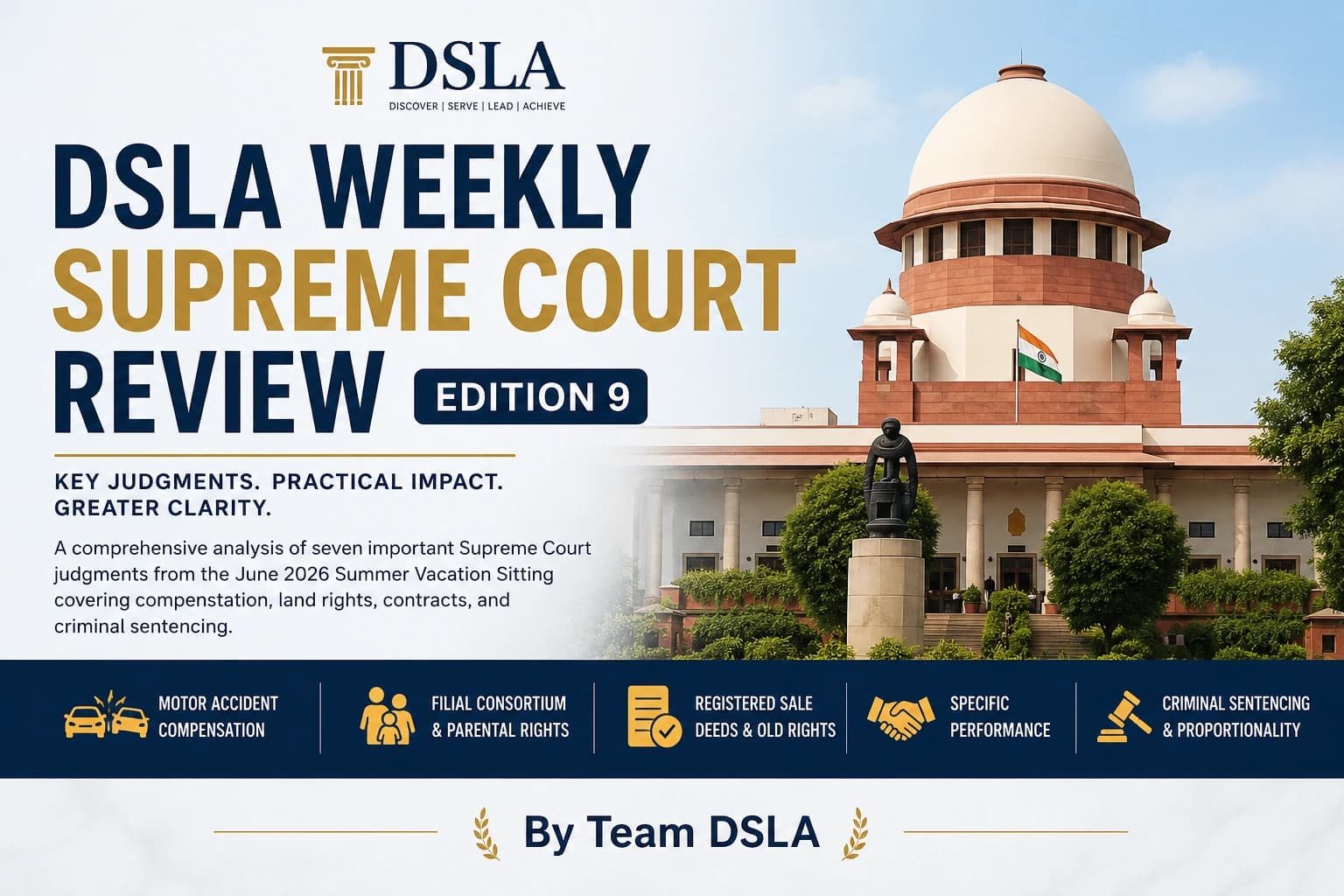
New Delhi (ABC+DSLA): DSLA Weekly Supreme Court Review Edition 9 examines seven Supreme Court judgments delivered during the summer vacation sitting between 23 June and 25 June 2026. This edition covers motor accident compensation, functional disability, land-title proof, retrospective operation of statutes, specific performance, criminal sentencing and proportionality.
First, the week matters because the Supreme Court repeatedly looked beyond technical form and examined the real effect of law on citizens. Moreover, the Court corrected compensation errors, protected registered land documents, tested sentencing fairness and reaffirmed proof-based civil remedies. Therefore, this review offers practical value for lawyers, litigants, insurers, tribunals, High Courts, land authorities and criminal courts.
However, the Court did not treat sympathy as a substitute for proof. Instead, it balanced fairness with evidence, compensation with calculation, and sentencing with proportionality. As a result, Edition 9 shows a vacation Bench that delivered judgments of high practical value even without a Constitution Bench ruling.
Summary
First, the Supreme Court strengthened motor accident compensation law in three judgments. It recognised that functional disability can differ from medical disability, especially when an injured worker loses the ability to continue his trade. Therefore, compensation must reflect real loss of earning capacity rather than only a disability certificate.
Second, the Court protected parents in a fatal accident case by adding filial consortium. Moreover, it accepted that a young student’s professional future can guide compensation where evidence supports such promise. However, it also warned that courts cannot award money on the basis of guaranteed future success where such success remains uncertain.
Third, the Court protected old registered sale deeds from casual rejection by consolidation authorities. In addition, it clarified that later changes in law cannot normally destroy accrued property rights unless the statute clearly creates retrospective effect. Therefore, the judgment strengthens certainty in land transactions.
Fourth, the Court reaffirmed that specific performance is not automatic. A buyer must prove continuous readiness and willingness through conduct and financial capacity. Consequently, later-created financial records cannot cure the absence of proof at the relevant time.
Finally, the Court maintained convictions in two criminal cases but reduced sentences. It considered long delay, age, custody already undergone, absence of criminal history and proportionality. Therefore, Edition 9 shows that punishment must remain firm but also fair.
Key Points
First, Edition 9 reviews seven Supreme Court judgments delivered during the summer vacation period. The uploaded set includes four reportable judgments and three non-reportable judgments. Therefore, the edition combines precedential rulings with practical sentencing decisions.
Second, motor accident compensation forms the strongest theme of this week. In three separate cases, the Court dealt with disability, future income, filial consortium, prosthetic costs and just compensation. As a result, this edition matters greatly for Motor Accident Claims Tribunals and insurance litigation.
Third, the Court again made a clear distinction between medical disability and functional disability. A medical certificate may record 70% disability. However, if the injured person cannot continue his occupation, the legal loss of earning capacity may reach 100%.
Fourth, the Court protected land-title certainty in Sarafat Ali. It held that a registered sale deed carries a strong presumption of validity. Moreover, it held that minor witness discrepancies cannot defeat an old registered document without strong evidence.
Fifth, the Court maintained strict standards in specific performance. The buyer must show financial capacity and consistent conduct. Therefore, mere filing of a suit does not prove readiness and willingness.
Finally, in criminal matters, the Court separated conviction from sentence. It maintained guilt where conviction did not require interference. However, it reduced punishment where continued custody no longer served the ends of justice.
Why This Review Matters
This review matters because these judgments affect ordinary litigation across India. Motor accident victims, injured workers, parents of deceased children, land purchasers, civil litigants and criminal accused can all draw practical guidance from this week’s rulings.
Moreover, the judgments show how the Supreme Court uses Article 136 to correct errors that may otherwise remain final. In some cases, the correction concerned compensation calculation. In other cases, it concerned sentence, title proof or statutory interpretation.
However, the judgments also raise a larger institutional question. If most important corrections come through special leave appeals, the Supreme Court continues to function as both a constitutional court and a final error-correction court. Therefore, DSLA’s Article 136 Dependency Index remains relevant for future reform.
DSLA Weekly Dashboard
| Indicator | Edition 9 Position |
|---|---|
| Review period | 23–25 June 2026 |
| Nature of sitting | Summer vacation |
| Judgments reviewed | 7 |
| Reportable judgments | 4 |
| Non-reportable judgments | 3 |
| Civil appeals | 5 |
| Criminal appeals | 2 |
| Motor accident cases | 3 |
| Property / land law case | 1 |
| Specific performance case | 1 |
| Criminal sentencing cases | 2 |
| Article 136 route | Dominant |
| Article 32 matter | None in uploaded set |
| Article 131 matter | None |
| Main DSLA theme | Just compensation, proof and proportionate sentencing |
Judgment-Wise Dashboard
| No. | Case | Subject | Outcome | DSLA Takeaway |
| 1 | Shankar Dutt v. United India Insurance Co. Ltd. | Motor accident disability compensation | Compensation enhanced | Functional disability may be 100% for a skilled worker. |
| 2 | M. Paramesh v. VRL Logistics Ltd. | Motor accident disability compensation | Compensation enhanced to ?40.29 lakh | A mason losing a leg may suffer total earning loss. |
| 3 | Oriental Insurance Co. Ltd. v. Kalu Ram | Motor accident death compensation | Filial consortium added | Just compensation includes parental loss and realistic future prospects. |
| 4 | Sarafat Ali v. Deputy Director of Consolidation | Land title and registered sale deed | Appeal allowed | Registered sale deeds cannot be brushed aside lightly. |
| 5 | Mohammed Khaleel v. Jayamma | Specific performance | Relief denied | Readiness and willingness must be continuous and proved. |
| 6 | Israfil @ Pappu v. State of Madhya Pradesh | Forgery and sentencing | Conviction maintained; sentence reduced | Proportionality remains central in sentencing. |
| 7 | Mathu @ Jagdish v. State of Uttarakhand | Culpable homicide and sentencing | Conviction maintained; sentence reduced | Medical evidence and long delay can affect sentence. |
Supreme Court’s Key Answers This Week
Can medical disability and functional disability be different?
Yes. The Court held that medical disability and functional disability serve different purposes. A doctor may certify physical disability, but the court must assess how that disability affects earning capacity. Therefore, in the case of a carpenter or mason, a 70% physical disability may legally result in 100% loss of earning capacity.
Can courts assess a skilled worker’s income realistically even without perfect records?
Yes. The Court accepted that workers such as carpenters and masons may not always have formal income records. However, that does not justify unrealistically low income assessment. Therefore, courts must look at the nature of work, age, skill and economic reality.
Can parents of an unmarried deceased child receive filial consortium?
Yes. The Court reaffirmed that parents suffer a separate emotional and relational loss when an unmarried child dies. Consequently, in Oriental Insurance v. Kalu Ram, the Court granted ?40,000 each to both parents under filial consortium.
Can a registered sale deed be ignored due to minor witness discrepancy?
No. The Court held that a registered sale deed carries a strong presumption of validity. Moreover, attestation does not decide the validity of a sale deed in the same way it decides some other instruments. Therefore, minor discrepancy in the description of an attesting witness cannot defeat title.
Can later amendments destroy old property rights?
Not normally. The Court held that substantive amendments affecting accrued rights usually operate prospectively unless the law clearly says otherwise. Therefore, later changes cannot automatically convert an old voidable transaction into a void one.
Is specific performance available merely because a sale agreement exists?
No. The plaintiff must prove continuous readiness and willingness. As a result, courts must look at financial capacity, conduct and delay before granting specific performance.
Can the Supreme Court reduce sentence while maintaining conviction?
Yes. The Court may maintain conviction but reduce sentence where proportionality requires it. Therefore, age, delay, custody already undergone and absence of criminal history can become relevant sentencing factors.
Critical Analysis of Each Judgment
Shankar Dutt v. United India Insurance Co. Ltd.
Subject
This judgment concerns motor accident compensation, permanent disability, skilled work, functional disability and the cost of prosthetic support. It is one of the key compensation judgments of this edition because it directly addresses how courts should assess the economic loss of an injured skilled worker.
Facts
The appellant worked as a carpenter and suffered serious injuries in a motor accident. His right leg was amputated, and the medical disability certificate assessed disability at 70%. The Tribunal and the High Court awarded compensation, but the claimant argued that the amount did not reflect his real loss of earning capacity.
The Supreme Court examined the nature of carpentry as skilled manual work. It noted that such work needs movement, balance and physical ability. Therefore, the Court looked beyond the medical certificate and assessed the real impact of the injury on livelihood.
Legal Question
The main legal question was whether compensation should be assessed on the basis of 70% medical disability or 100% functional disability. The connected question was whether a carpenter’s earning capacity could be treated as fully lost after amputation.
Supreme Court’s Answer
The Supreme Court held that functional disability must be assessed with reference to occupation. Since the claimant could no longer work as a carpenter, his functional disability had to be treated as 100%. Therefore, the Court enhanced the compensation substantially.
DSLA Critical Analysis
First, this judgment rejects the mechanical use of disability certificates in compensation cases. A medical percentage may help the court, but it cannot replace the legal assessment of earning loss. Therefore, tribunals must ask what the injured person can actually do after the accident.
Second, the judgment protects skilled workers who often lack formal pay slips or income-tax records. A carpenter, mason, driver or mechanic may earn through informal work. However, that does not mean courts should treat such work as low-value labour.
Third, the judgment recognises that amputation creates lifelong costs. Prosthetic limbs need replacement and maintenance. In addition, the injured person may require attendant help, rehabilitation and medical support. Therefore, just compensation must include future needs and not only past bills.
Judicial Worth
This judgment has very high judicial worth. It strengthens the doctrine of functional disability and gives practical protection to skilled workers. Moreover, it will guide tribunals in cases involving amputees, artisans, drivers, labourers and self-employed workers.
M. Paramesh v. VRL Logistics Ltd.
Subject
This judgment also concerns motor accident compensation and functional disability. However, it is especially important because the injured claimant worked as a mason whose right leg was amputated above the knee.
Facts
The appellant was riding a bicycle when a lorry hit him from behind. He suffered serious injuries to his head, jaw, eye and right leg. Eventually, doctors amputated his right leg above the knee, and the disability certificate assessed permanent disability at 70%.
The Tribunal awarded compensation, and the High Court enhanced it. However, the claimant approached the Supreme Court because the award still did not reflect his real loss. The Court then examined the nature of masonry work and the effect of amputation on that work.
Legal Question
The main question was whether a mason with 70% physical disability should be treated as having 100% functional disability. Another question was whether the High Court had correctly calculated future prospects and other compensation heads.
Supreme Court’s Answer
The Supreme Court held that the claimant’s functional disability should be assessed at 100%. Since masonry requires both legs, balance, movement and physical strength, the claimant could no longer pursue his earlier work. Therefore, his loss of earning capacity was total.
DSLA Critical Analysis
First, this judgment builds on the principle laid down in Raj Kumar v. Ajay Kumar. It confirms that disability assessment must be occupation-specific. Therefore, the same medical disability may have different economic effects for different persons.
Second, the Court corrected serious calculation errors. The High Court had enhanced monthly income but calculated future prospects on the wrong base. Moreover, it omitted certain heads such as nutrition, clothing and medical expenses from the final computation. As a result, the Supreme Court recalculated compensation.
Third, the Court enhanced future medical expenses for prosthetic support. This is important because permanent disability does not end with hospital discharge. Instead, it creates recurring physical, social and financial burdens.
Judicial Worth
This judgment has very high judicial worth. It is likely to become a leading precedent for manual workers who suffer limb loss. Moreover, it reminds tribunals that compensation tables must be legally sound and mathematically correct.
Oriental Insurance Company Ltd. v. Kalu Ram
Subject
This judgment concerns motor accident death compensation, contributory negligence, future professional prospects and filial consortium. It is important because the deceased was a young Chartered Accountancy final student.
Facts
The deceased was travelling in a Wagon-R at about 3 a.m. when the car collided with a truck parked on the road. The claimants argued that the truck had no parking lights, reflectors or warning signs. The deceased was only 20 years old and was pursuing Chartered Accountancy final while undergoing articleship.
The Tribunal awarded ?81.21 lakh, and the High Court affirmed the award. The insurer challenged negligence and quantum, while the parents sought enhancement. Therefore, the Supreme Court considered both sides.
Legal Question
The first question was whether the Wagon-R driver was contributorily negligent merely because the car hit the truck from behind. The second question was whether the deceased’s future income could be assessed by considering his professional prospects. The third question was whether the parents were entitled to filial consortium.
Supreme Court’s Answer
The Court rejected contributory negligence. It held that a rear-end collision does not automatically prove negligence by the rear vehicle. Since the truck was parked without warning signs at night, the truck driver was negligent.
The Court also accepted the Tribunal’s broad assessment of future income. However, it refused further speculative enhancement. Finally, it awarded ?40,000 each to both parents as filial consortium.
DSLA Critical Analysis
First, this judgment rejects a mechanical rule in rear-end collision cases. The Court looked at the total facts, especially the dangerous parking of the truck at night. Therefore, negligence was linked to real road conditions rather than a simple formula.
Second, the judgment balances promise with proof. The deceased was a Chartered Accountancy final student with good prospects. However, the Court rightly held that courts cannot assume guaranteed future success. As a result, it protected the compensation already awarded but refused speculative expansion.
Third, the Court corrected the omission of filial consortium. Parents who lose an unmarried child suffer a real non-financial loss. Therefore, the judgment strengthens the humane side of compensation law.
Judicial Worth
This judgment has very high judicial worth. It is useful for fatal accident claims involving students, young professionals and unmarried children. Moreover, it clarifies contributory negligence and filial consortium.
Sarafat Ali v. Deputy Director of Consolidation, Haridwar
Subject
This judgment concerns land law, registered sale deeds, consolidation proceedings, void and voidable transfers, and retrospective operation of statutes. It is the most important property-law ruling in this edition.
Facts
The dispute arose from a registered sale deed dated 4 June 1957. The appellants claimed rights over land based on that document. However, consolidation authorities and the High Court rejected their claim. They treated the sale deed as invalid and relied on alleged defects in proof.
The Supreme Court examined the statutory history of the U.P. Zamindari Abolition and Land Reforms Act and the U.P. Consolidation of Holdings Act. It also examined whether later amendments could be applied retrospectively to defeat old rights.
Legal Question
The first question was whether the sale deed was void because of Section 154 of the U.P. Zamindari Abolition and Land Reforms Act. The second question was whether consolidation authorities could ignore a registered sale deed. The third question was whether later amendments could retrospectively destroy accrued rights.
Supreme Court’s Answer
The Court held that the sale deed could not be treated as void. Under the earlier legal regime, such a transfer was at most voidable at the instance of the Gaon Sabha. Moreover, no ejectment suit had been filed within limitation.
The Court further held that later amendments creating new legal consequences could not apply retrospectively unless the law clearly required such effect. Finally, it held that a registered sale deed carries a strong presumption of validity and cannot be ignored because of minor discrepancies.
DSLA Critical Analysis
First, this judgment protects certainty in land transactions. Registered documents form the backbone of property rights. Therefore, courts and authorities must be slow to discard them without strong evidence.
Second, the Court drew a vital distinction between void and voidable documents. A void document can be ignored in appropriate proceedings. However, a voidable document remains legally effective until a competent court sets it aside.
Third, the Court restricted retrospective application of later laws. This is important because land rights often arise from old transactions. If later laws could automatically destroy such rights, property certainty would collapse.
Fourth, the Court treated minor witness discrepancy with caution. A sale deed from 1957 cannot fail merely because decades later an attesting witness’s village description appears inconsistent. Therefore, the judgment protects old transactions from hyper-technical attacks.
Judicial Worth
This judgment has very high judicial worth. It will help land disputes, mutation cases, consolidation proceedings and litigation involving old registered sale deeds. Moreover, it strengthens the rule of law in property transactions.
Mohammed Khaleel v. Jayamma
Subject
This judgment concerns specific performance, sale agreements, readiness and willingness, financial capacity and equitable relief. It is important for civil and property litigation.
Facts
The plaintiff sought specific performance of a sale agreement. However, the Supreme Court examined whether the plaintiff had shown continuous readiness and willingness to perform the contract. The Court also considered whether later financial documents could prove readiness at the relevant time.
The case turned on conduct as much as paperwork. Therefore, the Court assessed whether the plaintiff had acted consistently from the agreement stage until the suit and decree stage.
Legal Question
The main question was whether the plaintiff had proved continuous readiness and willingness. Another question was whether later-created financial records could prove financial capacity at the relevant time.
Supreme Court’s Answer
The Court held that specific performance cannot be granted merely because an agreement exists. The plaintiff must prove readiness and willingness throughout. Therefore, financial capacity and conduct must both support the claim.
DSLA Critical Analysis
First, this judgment reaffirms that specific performance is an equitable remedy. It does not follow automatically from a sale agreement. Therefore, courts must examine the buyer’s conduct carefully.
Second, readiness means financial capacity. Willingness means consistent conduct showing a real intent to complete the sale. If either element is missing, the remedy can fail.
Third, the judgment is important for real estate litigation. Many buyers file suits after long delay and then try to create financial proof later. However, this judgment makes clear that proof must relate to the relevant time.
Judicial Worth
This judgment has high judicial worth. It strongly reaffirms settled law and gives practical guidance for trial courts in specific performance suits.
Israfil @ Pappu @ Naimuddin Khan v. State of Madhya Pradesh
Subject
This judgment concerns forgery, use of forged documents in court proceedings, sentencing and proportionality. It is a non-reportable judgment but has clear practical value.
Facts
The appellant produced a land-rights document as surety in a bail proceeding. The Magistrate noticed irregular pagination and suspected that the document was forged. Later, the Trial Court convicted the appellant under Sections 420, 467, 468 and 471 of the Indian Penal Code.
The Trial Court imposed five years’ rigorous imprisonment on each count, with sentences running concurrently. The High Court affirmed the conviction and sentence. However, before the Supreme Court, notice was limited only to the sentence.
Legal Question
The main question was whether the sentence of five years should be reduced while maintaining conviction. The Court also considered whether proportionality applied in a case involving forged documents used in judicial proceedings.
Supreme Court’s Answer
The Supreme Court maintained the conviction but reduced the sentence to the period already undergone. It kept the fine intact and directed release if the appellant was not required in any other case.
DSLA Critical Analysis
First, the Court did not weaken the seriousness of the offence. It clearly recognised that forged documents used before a court damage the purity of justice. Therefore, such conduct cannot be treated lightly.
However, sentencing is not only about the offence. It is also about the offender, time, custody and proportionality. The incident was from 2014, and the appellant had faced criminal proceedings for more than a decade. Moreover, no material showed habitual criminal conduct.
In addition, the forged document was detected at the threshold stage and did not lead to irreversible property loss. Therefore, the Court balanced accountability with fairness and reduced the sentence.
Judicial Worth
This judgment has high practical worth. Although non-reportable, it gives useful guidance on proportional sentencing in forgery cases.
Mathu @ Jagdish v. State of Uttarakhand
Subject
This judgment concerns culpable homicide, Section 304 of the Indian Penal Code, medical evidence, eyewitness testimony and sentence reduction. It is a non-reportable judgment but important for sentencing analysis.
Facts
The case arose from a quarrel over a wristwatch. The dispute escalated into a scuffle. The deceased fell into a dry canal with a rocky bed and suffered fatal head injuries.
The appellant was convicted under Section 304 read with Section 34 of the Indian Penal Code. The High Court affirmed the conviction. However, by the time the Supreme Court decided the appeal, nearly three decades had passed since the incident.
Legal Question
The first question was whether the evidence supported the prosecution case that fatal injuries were caused by stone blows. The second question was whether the sentence should be reduced because of medical evidence, age, delay and custody already undergone.
Supreme Court’s Answer
The Court found that the injuries were more consistent with a fall into a rocky dry canal than with stones thrown by hand. However, it maintained the conviction and treated the case as falling under Section 304 Part II. Finally, it reduced the sentence to the period already undergone.
DSLA Critical Analysis
First, the judgment gives importance to medical evidence. Where eyewitness accounts are unclear, the injury pattern can help the court understand what likely happened. Therefore, post-mortem evidence played a major role.
Second, the Court considered the long passage of time. The incident occurred in 1997, and the appellant was over 60 by 2026. Moreover, he had already undergone more than one and a half years in custody.
Third, the judgment shows that sentence can be reviewed even where conviction remains intact. As a result, it adds practical value to criminal appellate practice.
Judicial Worth
This judgment has moderate to high judicial worth. Although non-reportable, it is useful for cases involving Section 304 Part II, medical evidence and delayed appeals.
Subject-Wise DSLA Analysis
Motor Accident Compensation
Motor accident compensation is the dominant theme of Edition 9. First, Shankar Dutt and M. Paramesh strengthen the doctrine of functional disability. In both cases, the Court refused to treat medical disability as the final measure of economic loss.
Moreover, these judgments give dignity to skilled and manual work. A carpenter or mason may not have formal income records, but his work has real value. Therefore, courts must avoid low and artificial income assessment.
In addition, Kalu Ram expands the humane side of compensation by recognising filial consortium. It also shows that future professional potential can be considered where evidence supports it. However, the Court warned against speculative assumptions.
Therefore, the motor accident judgments of Edition 9 move compensation law toward fairness, realism and dignity.
Property and Land Law
Sarafat Ali is the key property-law judgment of the week. It protects registered sale deeds and limits the power of authorities to treat old documents as ineffective without strong legal basis.
Moreover, the judgment prevents later laws from operating backward in a way that destroys accrued rights. This matters because land disputes often involve old transactions and old revenue records. Therefore, the ruling strengthens certainty in property law.
Contract and Specific Performance
Mohammed Khaleel reaffirms that specific performance depends on conduct, not only paperwork. A plaintiff must prove continuous readiness and willingness. Therefore, courts must examine financial capacity, delay and conduct from start to finish.
This judgment will help defendants in stale or weak specific performance suits. However, it will also guide genuine buyers to maintain proper financial records and timely conduct.
Criminal Sentencing
Israfil and Mathu show that the Supreme Court is willing to separate conviction from sentence. In both cases, the Court maintained conviction. However, it reduced sentence because proportionality required it.
Moreover, these cases show that delay, age, custody already undergone, lack of criminal history and medical evidence can matter. Therefore, sentencing must remain individualised rather than mechanical.
Article 136, Article 32 and Article 131 Review
Edition 9 again shows the dominance of Article 136. All uploaded matters reached the Supreme Court through appeal or special leave routes. Therefore, the Court’s national law-making role this week came mainly through appellate correction.
However, this does not mean Article 136 had no value. On the contrary, the Court used it to correct compensation errors, protect property rights and reduce disproportionate sentences. Therefore, the reform question is not whether Article 136 should exist. Instead, the real question is how India can structure it better.
There was no Article 32 matter in the uploaded set. There was also no Article 131 original jurisdiction matter. As a result, Edition 9 is best understood as an Article 136-driven appellate correction edition.
Article 136 Dependency Index
| Indicator | Score |
| Share of cases through SLP / appeal route | Very High |
| Original jurisdiction cases | Nil |
| Constitutional questions | Limited |
| Statutory correction role | Very High |
| Compensation correction role | Very High |
| Criminal sentence correction role | High |
| Property-rights correction role | High |
| DSLA Dependency Rating | 8.5 / 10 |
Reportable and Non-Reportable Split
| Classification | Cases |
| Reportable | Shankar Dutt; Sarafat Ali; Oriental Insurance v. Kalu Ram; M. Paramesh |
| Non-reportable | Mohammed Khaleel; Israfil; Mathu |
| Total | 7 |
Civil and Criminal Split
| Category | Number |
| Civil appeals | 5 |
| Criminal appeals | 2 |
| Total | 7 |
Bench-Wise Dashboard
| Bench | Judgments |
| Justice Prashant Kumar Mishra and Justice N.V. Anjaria | Sarafat Ali; Oriental Insurance v. Kalu Ram; M. Paramesh; Israfil |
| Justice Ujjal Bhuyan and Justice N.V. Anjaria | Shankar Dutt |
| Justice Ujjal Bhuyan and Justice Arun Palli | Mathu |
| Bench for Mohammed Khaleel | As per uploaded judgment |
Authoring Judge Dashboard
| Authoring Judge | Judgments in Uploaded Set |
| Justice Prashant Kumar Mishra | Sarafat Ali; Oriental Insurance v. Kalu Ram; M. Paramesh; Israfil |
| Justice Ujjal Bhuyan | Shankar Dutt; Mathu |
| Other authoring pattern | Mohammed Khaleel as per uploaded judgment |
Special Acts Dashboard
| Statute | Cases |
| Motor Vehicles Act, 1988 | Shankar Dutt; Oriental Insurance v. Kalu Ram; M. Paramesh |
| U.P. Zamindari Abolition and Land Reforms Act | Sarafat Ali |
| U.P. Consolidation of Holdings Act | Sarafat Ali |
| Specific Relief Act | Mohammed Khaleel |
| Indian Penal Code | Israfil; Mathu |
| Indian Evidence Act | Sarafat Ali |
New Law or Reaffirmation?
| Case | DSLA Classification |
| Shankar Dutt | Strong development of functional disability doctrine |
| M. Paramesh | Strong reaffirmation with practical expansion |
| Oriental Insurance v. Kalu Ram | Reaffirmation of just compensation and filial consortium |
| Sarafat Ali | Major clarification on void/voidable transfers and retrospective law |
| Mohammed Khaleel | Reaffirmation of readiness and willingness |
| Israfil | Sentencing proportionality reaffirmed |
| Mathu | Sentencing discretion and medical-evidence analysis reaffirmed |
DSLA Legal Trend Dashboard
| Trend | Direction |
| Functional disability | Strongly expanded |
| Skilled worker compensation | Strengthened |
| Prosthetic and rehabilitation costs | Strengthened |
| Filial consortium | Reaffirmed |
| Registered sale deed presumption | Strengthened |
| Retrospective statutory effect | Restricted |
| Specific performance | Strictly controlled |
| Criminal sentencing | Made more proportionate |
| Article 136 correction role | Strong |
| Judicial focus | Practical justice |
Practical Takeaways for Lawyers
For MACT Lawyers
First, argue functional disability separately from medical disability. A disability certificate is important, but it is not the final measure of earning loss. Therefore, lawyers must explain how the injury affects the claimant’s actual occupation.
Second, produce occupation-specific evidence. In cases involving carpenters, masons, drivers, electricians, mechanics or labourers, the court must understand the physical demands of the work. Moreover, lawyers should claim future prosthetic costs, attendant charges and loss of amenities with care.
Finally, check every compensation table for calculation errors. As M. Paramesh shows, even appellate courts can make errors in future prospects and omitted heads. Therefore, mathematical review is part of legal strategy.
For Property Lawyers
First, rely strongly on registered sale deeds. Sarafat Ali confirms that registered documents carry legal weight and cannot be dismissed casually. Therefore, lawyers should build arguments around registration, certified copies and the presumption of validity.
Second, distinguish void and voidable documents. A voidable document remains effective until a competent court sets it aside. Moreover, consolidation authorities cannot cancel every document merely by questioning its effect.
Third, challenge retrospective application of later laws where accrued rights are affected. Unless the statute clearly shows retrospective intent, old transactions should normally be judged by the law that governed them when they were made.
For Contract Lawyers
First, prove readiness with contemporaneous financial records. Bank records, payment capacity and conduct near the relevant time matter more than later-created documents. Therefore, plaintiffs must preserve evidence from the start.
Second, prove willingness through conduct. Notices, payment offers and timely action can support the claim. However, unexplained delay can weaken a suit for specific performance.
Finally, defendants should test both readiness and willingness separately. If either element fails, specific performance can be refused.
For Criminal Lawyers
First, separate conviction arguments from sentencing arguments. Even where conviction is difficult to disturb, sentence may still be reduced. Therefore, counsel should prepare a distinct sentencing brief.
Second, use delay, age, custody, medical evidence and absence of criminal history as sentencing factors. Moreover, in cases involving physical evidence, missing forensic reports should be highlighted.
Finally, sentencing must be argued as a proportionality question. Courts may maintain accountability while avoiding excessive punishment.
Sources and Resources
Supreme Court Judgments Reviewed
- Mohammed Khaleel v. Jayamma — Specific performance and readiness/willingness.
- Shankar Dutt v. United India Insurance Co. Ltd. — functional disability and motor accident compensation.
- Sarafat Ali v. Deputy Director of Consolidation, Haridwar — registered sale deed and consolidation law.
- Mathu @ Jagdish v. State of Uttarakhand — Section 304 IPC and sentencing.
- Israfil @ Pappu @ Naimuddin Khan v. State of Madhya Pradesh — forgery and proportional sentencing.
- Oriental Insurance Co. Ltd. v. Kalu Ram — future prospects and filial consortium.
- M. Paramesh v. VRL Logistics Ltd. — 100% functional disability for a mason.
ABC Live Internal Links
DSLA Overall Assessment
Practical Justice Over Rigid Formula
Overall, Edition 9 shows a Supreme Court focused on practical justice, fair proof and proportionate relief. The Court avoided rigid formulas and examined the real-world effect of injury, delay, documents and punishment. Therefore, this edition carries strong value for everyday litigation.
Motor Accident Compensation Became More Realistic
First, the Court made motor accident compensation more realistic. It looked at actual earning loss rather than only medical disability percentages. Therefore, Shankar Dutt and M. Paramesh will help injured workers whose livelihoods depend on physical skill.
Parents’ Loss Received Clear Recognition
Second, the Court protected parents in fatal accident cases. As a result, Kalu Ram strengthens filial consortium and confirms that courts must not ignore parental loss. Moreover, it recognises that young students may show real professional promise, though courts cannot assume guaranteed success.
Old Land Rights Received Protection
Third, the Court protected old land rights. Sarafat Ali confirms that courts and authorities cannot brush aside registered sale deeds lightly. In addition, it restricts the use of later laws against accrued rights.
Specific Performance Remained Proof-Based
Fourth, the Court kept contract law strict. Mohammed Khaleel reminds plaintiffs that they must prove readiness and willingness throughout. Therefore, specific performance remains an equitable and proof-based remedy.
Sentencing Stayed Proportionate
Fifth, the Court maintained criminal convictions but reduced sentences where justice required a proportionate result. In Israfil, the Court considered delay, custody and absence of criminal history. Similarly, in Mathu, it considered medical evidence, age and the long passage of time.
Accountability Stayed Balanced With Fairness
However, the Court did not weaken legal standards. Instead, it balanced accountability with fairness. Moreover, it corrected errors where lower courts used mechanical calculations or ignored relevant legal heads.
Core Message of Edition 9
Therefore, Edition 9’s main message is clear: justice cannot be mechanical. Courts must examine the real effect of injury, the real value of evidence, the real conduct of parties and the real purpose of punishment.
DSLA Final View
In conclusion, DSLA finds Edition 9 a strong summer vacation edition. It may not contain Constitution Bench rulings. Nevertheless, it carries high practical value for trial courts, tribunals, High Courts, lawyers, insurers, land litigants and criminal defence practice.
Aslo, Read DSLA Supreme Court Review Edition-8
ABC Live — Making Complex Public Issues Simple.