

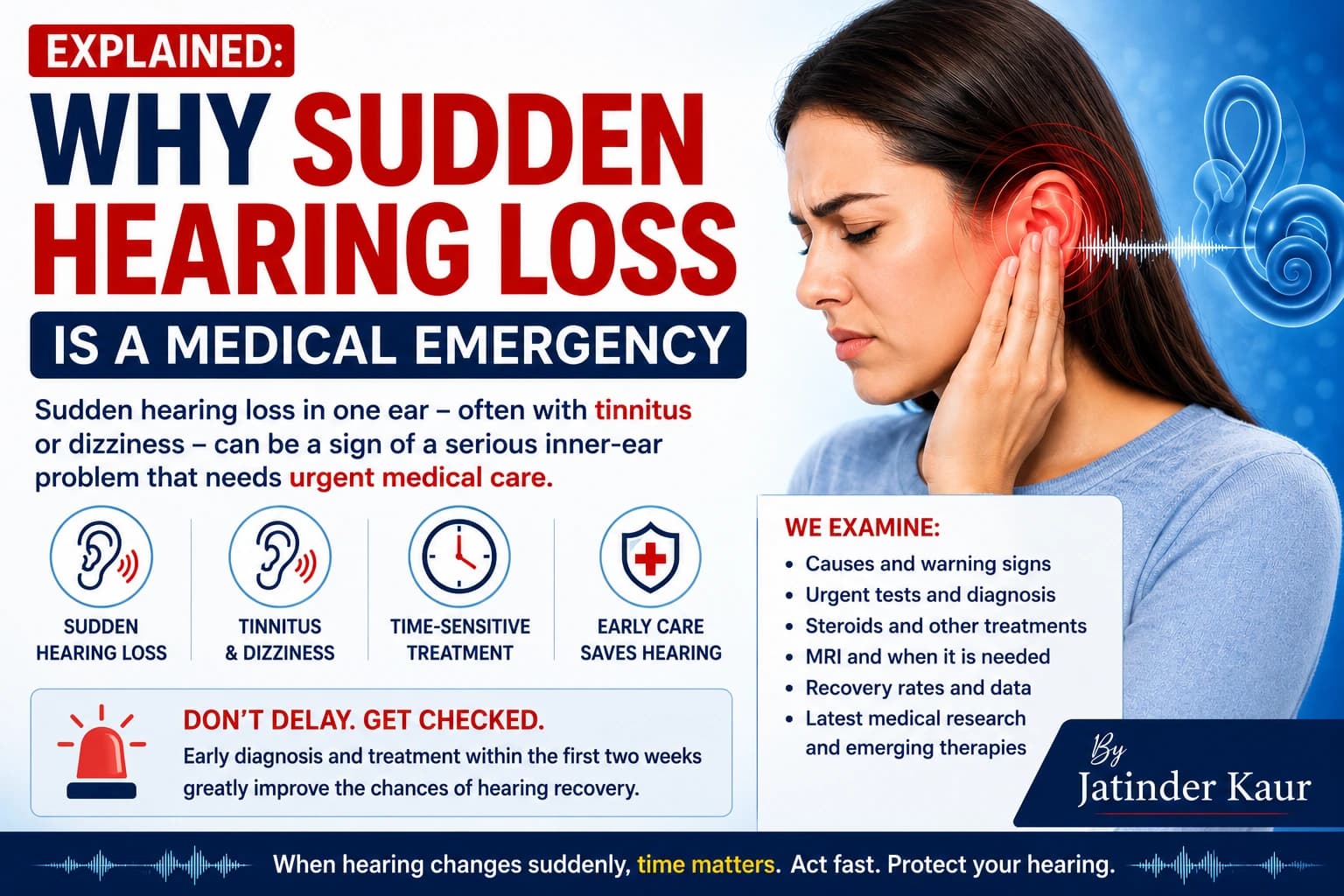
Standfirst: Sudden sensorineural hearing loss can reduce hearing in one ear within hours. Moreover, tinnitus, ear pressure or dizziness may begin at the same time. Therefore, urgent hearing tests and early treatment may decide whether useful hearing returns.
New Delhi (ABC Live): Sudden sensorineural hearing loss, commonly called SSNHL, is a rapid loss of hearing caused by a problem in the inner ear, hearing nerve or related hearing pathways. Usually, it affects only one ear. However, in rare cases, it may affect both ears.
The hearing loss may develop within seconds, several hours or up to three days. Moreover, many patients notice the problem immediately after waking. Therefore, a person may wrongly assume that the ear is blocked by wax, pressure or congestion.
Tinnitus often begins in the same ear. In addition, a patient may experience ear fullness, unclear sound, poor speech understanding, dizziness or vertigo. Nevertheless, SSNHL often causes no pain.
As a result, patients may delay seeking care. However, this delay may reduce the treatment choices available during the early stage.
The United Kingdom’s National Institute for Health and Care Excellence recommends specialist assessment within 24 hours when unexplained hearing loss develops within three days and began during the previous 30 days.
Similarly, the US National Institute on Deafness and Other Communication Disorders treats sudden deafness as a medical emergency. Therefore, patients should not wait at home to see whether the hearing returns naturally.
Key Findings
- SSNHL usually develops within 72 hours
- Doctors often define it as a loss of at least 30 decibels across three nearby frequencies
- Usually, it affects one ear
- Moreover, tinnitus, ear pressure and dizziness often occur with the hearing loss
- Doctors do not find a clear cause in about 90% of cases
- Around half of patients may regain some or all hearing naturally
- However, doctors cannot safely predict who will recover
- Therefore, urgent ear examination and hearing tests remain vital
- Doctors may offer steroids during the first two weeks
- In addition, ear injections may help after poor early recovery
- Meanwhile, hyperbaric oxygen may help selected patients when combined with steroids
- MRI can also help rule out a hearing-nerve tumour
- New research has examined NAD+, vitamin D, better MRI methods and new drug delivery
- Nevertheless, no new treatment has replaced urgent standard care
SSNHL Data Dashboard
Reported case numbers differ because researchers use different definitions and study methods. Moreover, some people recover before they reach a hearing clinic. Meanwhile, others may receive treatment for wax or infection without undergoing a full hearing test.
| Indicator | Available figure | Simple meaning |
|---|---|---|
| Speed of onset | Within 72 hours | Often sudden or noticed after waking |
| Common test definition | At least 30 dB loss | Across 3 nearby frequencies |
| Estimated yearly rate | 5–27 per 100,000 | Uncommon but serious |
| Estimated US cases | About 66,000 yearly | Wider case estimate |
| Cases with no clear cause | About 90% | Called idiopathic SSNHL |
| Natural improvement | About 50% | Some or all hearing may return |
| Usual early recovery | 1–2 weeks | Waiting is still unsafe |
| Both ears affected | Uncommon | Needs wider medical checks |
| Urgent care target | Within 24 hours | For recent unexplained loss |
The case-rate estimate comes from the American Academy of Otolaryngology–Head and Neck Surgery guideline. Meanwhile, the figures on unknown causes and natural recovery come from the NIDCD sudden deafness guide.
However, these figures describe groups rather than individual patients. Therefore, they cannot predict the outcome for one person.
What Is Sudden Sensorineural Hearing Loss?
Sudden hearing loss is a symptom rather than a final diagnosis. Therefore, a doctor must first decide whether the loss is conductive, sensorineural or mixed.
Conductive hearing loss
Conductive hearing loss occurs when sound cannot travel normally through the ear canal, eardrum or middle ear.
For example, common causes include:
- Earwax
- Middle-ear fluid
- Ear infection
- A torn eardrum
- An object in the ear canal
- A problem with the small middle-ear bones
In many cases, doctors can see or test for these causes. However, finding wax or fluid does not always rule out an inner-ear problem. Therefore, further hearing tests may still be necessary.
Sensorineural hearing loss
Sensorineural hearing loss occurs when the inner ear, its sound-sensing cells or the hearing nerve does not work normally.
The NIDCD explanation of sensorineural hearing loss links this form of loss to damage in the inner ear’s sensory cells or nerve fibres.
Unlike many middle-ear problems, SSNHL may not cause any visible change in the ear. Therefore, a normal-looking eardrum does not rule it out. Moreover, the patient may have severe hearing loss without pain.
Mixed hearing loss
Mixed hearing loss includes both conductive and sensorineural parts.
For example, a patient may have earwax and inner-ear hearing loss at the same time. Therefore, doctors should not always stop the investigation after finding a blockage.
What Does a 30-Decibel Hearing Loss Mean?
A decibel measures sound level on a special scale. Therefore, a 30-decibel fall does not mean that a person has simply lost 30% of hearing.
Instead, even a moderate drop may make speech hard to understand. This is especially true when the loss affects frequencies used in normal speech. Moreover, a person may hear sound but still fail to understand words.
| Hearing level | General group | Likely effect |
| 0–20 dB HL | Normal or near normal | Most soft sounds are heard |
| 21–40 dB HL | Mild loss | Soft speech becomes harder |
| 41–55 dB HL | Moderate loss | Normal speech may sound unclear |
| 56–70 dB HL | Moderately severe | Loud speech may be needed |
| 71–90 dB HL | Severe loss | Speech becomes very hard to follow |
| Above 90 dB HL | Profound loss | Normal speech may not be heard |
These ranges may differ slightly between hearing centres. Moreover, a pure-tone test does not show the full effect on daily life. Therefore, doctors also need to measure word understanding.
Why Tinnitus With Sudden Hearing Loss Matters
Tinnitus means hearing ringing, buzzing, humming, hissing or another sound without an outside source.
Tinnitus alone has many possible causes. However, when it starts suddenly in one ear and hearing falls at the same time, it may point to sudden inner-ear harm. Therefore, this combination needs urgent medical assessment.
The NICE tinnitus guideline calls for assessment within 24 hours when tinnitus occurs with hearing loss that began suddenly during the previous 30 days.
A major treatment trial studied 250 people with one-sided SSNHL. The table below describes that study group. Therefore, these figures should not be treated as exact rates for every patient.
| Symptom or finding | Trial figure |
| Tinnitus | 83.6% |
| Ear fullness | 69.2% |
| Dizziness or vertigo | 44.4% |
| Average hearing level in affected ear | 86.6 dB |
| Average hearing level in other ear | 17.2 dB |
| Word understanding in affected ear | 15.0% |
| Word understanding in other ear | 97.9% |
The study shows that SSNHL affects sound clarity as well as volume. For example, the affected ears in this trial understood only 15% of test words on average.
The study appeared in JAMA and compared oral steroids with steroid injections into the ear.
Common Symptoms of SSNHL
A patient may notice:
- Sudden hearing loss in one ear
- Ringing or buzzing
- Ear pressure
- Muffled sound
- Metallic or broken sound
- Echoing voices
- Trouble finding where sound comes from
- Dizziness
- Loss of balance
- A spinning feeling
- A sudden pop
- Different sound pitches in each ear
Importantly, SSNHL often causes no pain. Therefore, a painless ear problem can still be serious. Moreover, the lack of pain may wrongly reassure the patient.
When Hearing Loss May Point to a Brain or Nerve Emergency
Most people with SSNHL do not have a stroke. However, sudden hearing loss can sometimes occur with a brain, nerve or blood-flow emergency.
Therefore, a patient needs immediate emergency care when hearing loss comes with:
- Facial weakness
- Arm or leg weakness
- Slurred speech
- Double vision
- A severe new headache
- Loss of coordination
- Inability to stand or walk
- Confusion
- Severe and lasting vertigo
- New numbness
- Trouble swallowing
In such cases, doctors must check for a stroke or another nerve problem. Therefore, the patient should not assume that the condition affects only the ear. Instead, urgent brain and nerve checks may be required.
What Causes SSNHL?
Doctors find a clear cause in only a small share of cases. As a result, most patients receive a diagnosis of idiopathic SSNHL.
The word “idiopathic” does not mean that nothing happened. Instead, it means that current tests could not prove the exact cause.
Researchers have studied several possible causes. These include swelling, immune harm, poor blood flow, viral injury, cell stress and damage to the inner ear’s tiny blood vessels. However, no single cause explains every case.
A 2026 review in the European Journal of Medical Research suggests that SSNHL may involve harm to the inner ear’s linked blood-vessel and nerve system. Therefore, poor blood flow, swelling and nerve damage may form parts of the same process in some patients.
| Cause group | Examples | Common clue |
| No known cause | Idiopathic SSNHL | Most common result |
| Infection | Viral or bacterial harm | Recent illness |
| Immune cause | Body attacks inner-ear tissue | Repeat or two-sided loss |
| Injury | Head injury or loud noise | Clear event before onset |
| Inner-ear disease | Ménière’s disease | Vertigo or changing hearing |
| Drug-related | Medicines that harm hearing | New or high-dose medicine |
| Nerve or brain cause | Stroke or nerve disease | Other nerve signs |
| Hearing-nerve growth | Vestibular schwannoma | One-sided loss or tinnitus |
| Blood-flow problem | Low inner-ear blood supply | Often suspected, rarely proved |
| Inner-ear leak | Perilymph fistula | Diving, lifting or pressure change |
Could Ménière’s Disease Cause These Symptoms?
Ménière’s disease can cause hearing loss, tinnitus, ear pressure and attacks of vertigo.
However, its hearing loss often rises and falls, especially during the early stage. By contrast, SSNHL describes how quickly hearing falls rather than one single disease.
Therefore, Ménière’s disease may be one possible cause. Still, doctors need a hearing test and follow-up before making that diagnosis. Moreover, one sudden event does not prove Ménière’s disease.
Repeat attacks, strong vertigo and changing low-tone hearing may increase the chance of Ménière’s disease. Nevertheless, doctors must first treat sudden hearing loss as an urgent problem.
Could a Vestibular Schwannoma Cause the Hearing Loss?
A vestibular schwannoma is usually a non-cancerous growth on the balance and hearing nerve. It can cause one-sided hearing loss, tinnitus and poor balance.
However, it causes only a small share of sudden hearing-loss cases. Therefore, sudden tinnitus does not mean that a person probably has a tumour.
Still, doctors often advise MRI because a small nerve growth may not cause clear nerve signs. In addition, MRI may find other rare causes. Therefore, imaging forms part of the follow-up for many patients with confirmed one-sided SSNHL.
How Doctors Diagnose SSNHL
The first task is to separate a blockage or middle-ear problem from inner-ear hearing loss.
Ear examination
First, a doctor looks inside the ear.
This check may find:
- Wax
- Infection
- Fluid
- Eardrum damage
- An ear-canal blockage
- Another visible problem
However, a normal ear check does not rule out SSNHL. Therefore, a hearing test remains important. Moreover, doctors should not dismiss the patient simply because the eardrum appears normal.
Tuning-fork tests
Next, Weber and Rinne tests use a tuning fork to give a quick idea of the hearing-loss type.
However, these tests are only screening tools. Therefore, they cannot replace a full hearing test. Still, they may help doctors decide whether urgent inner-ear assessment is needed.
Pure-tone hearing test
A pure-tone hearing test measures the quietest sounds a person can hear at different pitches.
It checks sound through air and bone. As a result, it can help show whether the hearing loss is conductive, sensorineural or mixed.
The NIDCD advises prompt pure-tone testing when an ear examination does not reveal an obvious cause.
However, patients should seek care at once. They should not wait several days before contacting a doctor. Instead, the hearing test should follow urgent medical review.
Speech testing
Speech testing checks how well a person understands words.
This test matters because a patient may hear that someone is speaking but may not understand what was said. Therefore, hearing recovery should include both sound levels and word clarity.
Moreover, a patient may show a better pure-tone result while still having poor speech understanding. Consequently, both tests remain important.
Tympanometry
Tympanometry checks the eardrum and middle-ear pressure.
It can find fluid or pressure problems. However, it does not directly test the inner ear. Therefore, a normal or abnormal tympanogram cannot replace a full hearing test.
Diagnostic Test Dashboard
| Test | Main use | Main limit |
| Ear examination | Finds wax or infection | Cannot rule out SSNHL |
| Tuning fork | Gives a quick hearing pattern | Less exact than audiometry |
| Pure-tone test | Measures loss at different pitches | Does not show the cause |
| Speech test | Checks word understanding | Results can vary |
| Tympanometry | Checks middle-ear pressure | Does not test the inner ear |
| MRI | Finds nerve or brain causes | Often normal in SSNHL |
| Brainstem hearing test | Checks the nerve pathway | May miss small growths |
| Selected blood tests | Checks a suspected illness | Broad testing often adds little |
| Bone CT scan | Checks injury or bone disease | Not a routine SSNHL test |
When Is MRI Needed?
The AAO-HNS clinical guideline says that confirmed SSNHL should be checked for a deeper nerve cause through MRI or, when needed, a brainstem hearing test.
MRI may help find:
- Vestibular schwannoma
- Another nerve growth
- Swelling
- Nerve disease
- Some blood-vessel problems
- Inner-ear changes
However, most SSNHL scans do not reveal a clear cause. Therefore, a normal MRI does not mean that the patient did not have real hearing loss.
A routine head CT scan does not show the hearing nerve as well as MRI. Therefore, doctors do not usually use it as the main scan for SSNHL.
However, a focused bone CT may help after an injury or when doctors suspect a bone problem. Thus, the choice of scan depends on the suspected cause.
Are Blood Tests Needed?
Doctors should select blood tests based on the patient’s history.
For example, blood tests may help when doctors suspect:
- An immune illness
- Syphilis or another infection
- A blood-clot problem
- Body-wide swelling
- A blood-sugar problem
- Drug harm
- Hearing loss in both ears
- Repeat hearing-loss attacks
However, there is no routine blood test that can prove common idiopathic SSNHL. In addition, no blood test can promise whether hearing will return. Therefore, large test panels without a clear reason may add little value.
The SSNHL Treatment Timeline
The urgent referral time and the wider treatment window are not the same.
Therefore, a two-week steroid window does not mean that a person should wait two weeks before seeking help. Instead, the patient should seek care immediately.
| Time from onset | Main step |
| First few hours | Seek urgent medical care |
| Within 24 hours | ENT or emergency review |
| As soon as possible | Hearing and speech tests |
| Within 2 weeks | Doctors may offer first steroid treatment |
| Between weeks 2 and 6 | Ear injections if recovery remains poor |
| Within 1 month | Selected hyperbaric oxygen with steroids |
| End of treatment | Repeat hearing test |
| Within 6 months | Further hearing and support review |
These time points come from the AAO-HNS sudden hearing-loss guideline.
However, these periods are guides rather than promises. Therefore, treatment may differ according to the patient’s health, test results and time of arrival.
Steroid Treatment
Steroids remain the main drug treatment for idiopathic SSNHL.
Doctors believe that steroids may reduce swelling and immune harm in the inner ear. However, the exact cause remains unknown in most patients. Therefore, steroids do not work for everyone.
Steroid tablets or injections into a vein
Doctors may use steroid tablets or, in some cases, steroid medicine through a vein.
The AAO-HNS guideline says that doctors may offer steroids within two weeks of onset. However, many doctors prefer to start suitable treatment as early as possible.
Whole-body steroids can cause:
- Higher blood sugar
- Higher blood pressure
- Stomach upset
- Mood changes
- Anxiety
- Poor sleep
- Fluid build-up
- Greater infection risk
Therefore, people with diabetes, high blood pressure, glaucoma, stomach ulcers or an active infection need special care.
Moreover, patients should not start high-dose steroids without a doctor. Instead, a doctor should review the risks and choose a suitable dose.
Steroid injections into the ear
An ENT doctor can place steroid medicine through the eardrum into the middle ear. The medicine then moves toward the inner ear.
The AAO-HNS guideline says that doctors should offer or arrange these injections when hearing recovery remains incomplete between two and six weeks after onset.
This approach is called salvage treatment.
Possible side effects include:
- Ear pain
- Short-term dizziness
- Infection
- Bleeding
- A lasting hole in the eardrum
A Cochrane review of steroid ear injections found that some patients may benefit when doctors use injections after the first treatment.
However, many studies used different doses and schedules. Therefore, the exact level of benefit remains unclear. Nevertheless, guidelines still support salvage injections after poor recovery.
Steroid Tablets Versus Ear Injections
A major trial compared oral prednisone with steroid injections into the ear.
| Trial measure | Oral steroid | Ear injection |
| Patients | 121 | 129 |
| Average hearing gain | 30.7 dB | 28.7 dB |
| Recovery to below 30 dB | 20.7% | 24.8% |
| Reached hearing-aid range | 66.9% | 62.0% |
| Average word-score gain | 34.2 points | 33.8 points |
The trial found that ear injections were not worse than oral treatment within the study’s set limit.
Moreover, a 2026 review of steroid treatments found that both methods improved hearing. However, neither method was clearly best for all patients.
The risks also differ. For example, tablets may affect blood sugar and blood pressure. By contrast, ear injections may cause local pain, dizziness or eardrum damage.
Therefore, doctors should consider:
- The level of hearing loss
- Time since onset
- Diabetes
- Blood pressure
- Other steroid risks
- Earlier treatment results
- Patient choice
- Access to repeat ENT visits
Consequently, the best treatment route may differ from one patient to another.
Should Doctors Use Both Forms of Steroids?
Some doctors combine tablets with ear injections, especially in severe cases.
However, the Cochrane evidence review found that it remains unclear whether using both treatments from the start gives a major extra benefit.
Therefore, combined treatment should depend on the patient’s condition. It should not become an automatic rule for everyone.
Nevertheless, an ENT specialist may choose combined treatment when the hearing loss is severe or the risk of poor recovery appears high.
Hyperbaric Oxygen Treatment
Hyperbaric oxygen treatment places a patient in a high-pressure chamber while the patient breathes medical oxygen.
The aim is to raise oxygen levels in the inner ear. Therefore, it may help when low oxygen or poor blood flow has played a role.
The AAO-HNS guideline allows hyperbaric oxygen:
- With steroids during the first two weeks
- With steroids as salvage care during the first month
However, doctors should not use it as an unproven replacement for steroids. Instead, they may use it as an add-on treatment.
What did the 2026 study review find?
A 2026 review and meta-analysis examined planned studies of hyperbaric oxygen with standard medical care.
| Study measure | Finding |
| Studies reviewed | 20 |
| Random trials | 16 |
| Studies in the pooled result | 10 |
| Pooled odds ratio | 2.61 |
| Confidence range | 1.86–3.68 |
| Statistical result | p below 0.001 |
The result linked hyperbaric oxygen plus medical care with better odds of hearing improvement.
However, this does not mean that every patient becomes 2.61 times more likely to regain normal hearing. Moreover, the studies used different oxygen pressures, session numbers and recovery rules.
Therefore, hyperbaric oxygen remains an optional add-on treatment. In addition, cost and access may limit its use.
Possible risks include:
- Ear pressure injury
- Sinus pain
- Short-term sight changes
- Fear in closed spaces
- Oxygen-related harm
- High cost
- Travel burden
Treatments That Doctors Do Not Use Routinely
The AAO-HNS guideline advises against the routine use of:
- Antiviral drugs
- Clot-breaking drugs
- Blood-vessel widening drugs
- Other blood-flow medicines
Researchers have studied viral and blood-flow causes. However, these drugs have not shown a clear and steady benefit for most patients.
Similarly, vitamins, herbs and home remedies should not delay a hearing test or ENT care. Moreover, unproved treatments may waste the most useful treatment period.
Recovery and Outlook
Recovery differs greatly from one patient to another.
The NIDCD says that about half of patients may regain some or all hearing without treatment. Often, this improvement begins within one or two weeks.
However, these figures create two problems.
First, doctors cannot know who will improve naturally. Second, natural recovery can make a weak treatment appear effective in a small study.
Therefore, patients should not wait simply because some people recover on their own. Instead, they should seek urgent care while treatment choices remain open.
Factors Linked With Recovery
| Factor | General link |
| Mild first hearing loss | Better chance of recovery |
| Very severe first loss | Lower chance of recovery |
| Early care | More treatment choices remain |
| Late care | Fewer early options remain |
| Vertigo | Often linked with poorer recovery |
| Better word scores | Better daily hearing outlook |
| Early improvement | A hopeful sign |
| Loss in both ears | Needs wider checks |
| Repeat attacks | May point to another illness |
| Older age | Sometimes linked with poorer results |
| Diabetes or blood-vessel disease | May affect recovery |
However, these are broad study patterns. Therefore, no single factor can predict the outcome for one patient.
Moreover, even patients with poor signs may regain some hearing. Consequently, doctors should avoid making firm early promises.
What Happens to Tinnitus?
Tinnitus may improve as hearing returns.
However, it can remain even after a hearing test shows clear improvement. This may happen because the brain receives less sound from the affected ear. As a result, the brain may increase its own sound signals.
Long-term help may include:
- Hearing aids
- Soft background sound
- Tinnitus advice
- Cognitive behavioural therapy
- Better sleep care
- Stress control
- Help for anxiety or low mood
- A specialist tinnitus clinic
The AAO-HNS tinnitus guideline advises prompt hearing checks for people with one-sided tinnitus or hearing trouble.
Moreover, hearing aids may reduce tinnitus by bringing more outside sound into the brain. Therefore, hearing support can improve both communication and tinnitus.
Hearing Support After Lasting Loss
When hearing does not return, support should begin early.
For example, options may include:
- Standard hearing aids
- Devices that send sound to the better ear
- Bone-conduction devices
- Remote microphones
- Communication training
- Tinnitus care
- Cochlear implants for selected patients
The best choice depends on the hearing left in the affected ear, word scores and hearing in the other ear.
Therefore, follow-up should not stop when drug treatment ends. Instead, hearing support should become part of the care plan.
New SSNHL Research in 2025 and 2026
Recent research asks more than whether steroids work.
Instead, researchers now study which type of inner-ear harm a patient has. In addition, they are testing which treatment route may suit each patient.
The new work covers four main areas:
- New add-on drugs
- Better care plans
- Better scans and blood markers
- New ways to carry drugs into the inner ear
However, most new methods remain at an early stage. Therefore, patients should not treat early research as a proven cure.
New Research Dashboard
| Research area | Main finding | Present position |
| NAD+ treatment | More hearing gain in a small trial | Still experimental |
| Vitamin D | Possible help in deficient patients | Not yet proved |
| Steroid comparison | No single route clearly best | Choice should be personal |
| Care pathway | Better results with planned care | Useful for health systems |
| Hyperbaric oxygen | Positive pooled result | Optional add-on |
| Blood-and-nerve theory | Links blood flow and swelling | Research model |
| Better inner-ear MRI | May show damage patterns | Still emerging |
| Blood markers | Some possible signs found | Not ready for routine use |
| AC102 medicine | Phase II trial | Under study |
| Exosome delivery | New way to carry drugs | Experimental |
NAD+ as an Add-On Treatment
A small 2026 trial studied injectable nicotinamide adenine dinucleotide, known as NAD+, along with normal treatment.
NAD+ helps cells make energy. In addition, it supports cell repair and may reduce harmful cell stress.
| NAD+ trial point | NAD+ group | Control group |
| Patients who completed follow-up | 18 | 20 |
| Average hearing gain | 40.21 dB | 23.06 dB |
| Treatment | NAD+ plus standard care | Standard care |
| Follow-up period | 3 months | 3 months |
The NAD+ trial reported more hearing gain in the NAD+ group.
However, only 38 patients completed the trial. In addition, the research came from one centre.
Therefore, larger and independent trials must confirm the result. NAD+ should not replace steroids or urgent ENT care. Instead, it should remain an experimental add-on.
Vitamin D Research
Researchers have also studied a possible link between low vitamin D and SSNHL.
A 2026 double-blind pilot trial studied 40 patients who had both SSNHL and low vitamin D.
All patients received normal steroid care. However, half also received vitamin D3.
The vitamin D group showed more improvement at 2,000 and 4,000 Hz. These frequencies matter for speech clarity.
| Vitamin D finding | Meaning |
| Low vitamin D appears in some SSNHL groups | This does not prove it caused the loss |
| One small trial found extra gain | A larger trial is needed |
| Other studies gave mixed results | Benefit remains unclear |
| High doses can cause harm | A doctor should guide treatment |
Therefore, doctors may correct a known vitamin D shortage. However, vitamin D should not replace urgent SSNHL care. Moreover, patients should not take high doses without medical advice.
Better Care Pathways
A 2026 study followed 373 patients through a planned treatment system.
| Care measure | Result |
| Total patients | 373 |
| Full use of the care plan | 60.3% |
| Recovery with full use | 47.7% |
| Recovery without full use | 31.3% |
The multicentre care-pathway study linked full use of the care plan with better final hearing.
However, this was not a random trial. Therefore, it cannot prove that the plan alone caused the better result.
Still, the study supports quick hearing tests, early treatment, repeat testing and clear salvage-treatment dates. Consequently, better organisation may improve care even before a new drug becomes available.
New Research on Steroid Routes
A 2026 review of random trials found that both whole-body steroids and ear-injection steroids improved hearing.
However, neither route was clearly better for every patient.
Meanwhile, a 2026 real-world study linked first treatment with whole-body steroids to better short-term results.
Still, patients who received ear injections often reached care later. Therefore, the delay may have affected the result.
Consequently, the fairest reading is that whole-body steroids remain a common first choice. However, ear injections may better suit patients who face greater whole-body risks. In addition, ear injections remain important after poor early recovery.
Therefore, doctors should not use one fixed route for every patient.
The Blood-Vessel and Nerve Theory
New research often describes the inner ear as a linked blood-vessel and nerve system.
This system includes tiny blood vessels, vessel-lining cells, support cells, nerve tissue and immune pathways.
The 2026 precision-care review suggests that harm to this linked system may connect poor blood flow, swelling and nerve injury.
However, this remains a research idea. Therefore, doctors cannot yet use it as a simple clinical test.
In the future, it may help divide SSNHL into blood-flow, immune, cell-stress and structural types. Consequently, treatment may become more personal.
Better Inner-Ear MRI
Normal MRI mainly helps doctors rule out a nerve tumour or brain disease.
However, newer MRI methods can sometimes show unusual signals inside the inner ear.
These signals may point to swelling, protein leakage, blood inside the inner ear, damage to the blood-inner-ear barrier or a rise in inner-ear fluid.
A study of advanced MRI and balance tests found links between unusual inner-ear signals, balance problems and treatment results in severe SSNHL.
However, this type of scan is not yet a standard test for choosing treatment. Therefore, larger studies are still needed.
Nevertheless, the research may help doctors identify different forms of inner-ear injury in the future.
Blood Markers and Artificial Intelligence
Researchers have studied many possible blood signs.
These include white-cell ratios, platelet ratios, C-reactive protein, fibrinogen, blood fats, blood sugar, small RNA signals and proteins carried in tiny cell packets.
In addition, researchers use computer models to combine these signs with age, vertigo, treatment delay and hearing-test shape.
However, these models have not worked well enough across many different hospitals. Therefore, they are not ready for routine care.
Moreover, a computer score should not decide whether a patient receives urgent treatment. Instead, such tools may later help doctors discuss the chance of recovery.
New Drug-Delivery Research
Researchers are also testing ways to keep medicine near the inner ear for longer.
AC102
AC102 is a new medicine under study as a single injection into the ear.
The Phase II AC102 trial compares the medicine with oral steroid treatment.
However, the final results are not yet available. Therefore, AC102 remains experimental.
Nevertheless, the trial may show whether one local dose can protect or repair inner-ear structures.
Slow-release steroids
Researchers are testing forms of steroids that stay near the inner ear for a longer time.
For example, a 2025 report on dexamethasone palmitate described a slow-release treatment in a very small patient group.
However, the study was far too small to guide routine care. Therefore, larger controlled trials remain necessary.
Exosomes and cell packets
Exosomes are tiny packets released by cells. Researchers hope that these packets may carry medicine or repair signals into the inner ear.
However, this work remains experimental. Therefore, patients should be careful about clinics that market these methods as proven cures.
Moreover, early safety studies cannot prove that a treatment restores hearing. Consequently, mature trial results are still required.
Evidence Strength Dashboard
| Claim | Present evidence |
| Sudden hearing loss needs urgent care | Strong agreement |
| A hearing test confirms the pattern | Standard care |
| Most cases have no clear cause | Strong group evidence |
| Doctors may offer early steroids | Guideline-backed |
| One steroid route is always best | Not proved |
| Salvage ear injections may help | Guideline-backed, but evidence varies |
| Hyperbaric oxygen may add benefit | Positive study reviews |
| Antiviral drugs help most patients | Not supported |
| Vitamin D treats all cases | Not supported |
| NAD+ is a standard treatment | Not established |
| MRI can rule out nerve growths | Standard role |
| Advanced MRI can guide treatment | Still under study |
| Exosomes can restore hearing | Experimental |
What the New Research Changes Today
The latest research does not replace urgent standard care. Instead, it supports five clear lessons.
First, health systems need faster hearing tests. Otherwise, a patient may lose valuable time while waiting for a routine appointment.
Second, doctors need fixed follow-up dates. As a result, they can find poor recovery while salvage treatment remains possible.
Third, treatment should match the patient. For example, steroid tablets may suit one person, while ear injections may suit another.
Fourth, new treatments need honest labels. Therefore, NAD+, vitamin D, exosomes and slow-release drugs should be called promising or experimental rather than proven cures.
Finally, long-term hearing support matters. Therefore, tinnitus care, hearing devices and emotional support should form part of the care plan.
ABC Live Analysis
SSNHL shows a basic weakness in normal healthcare: a serious inner-ear emergency can feel like a minor blocked ear.
The patient may have no pain. In addition, the eardrum may look normal. Therefore, the patient may receive treatment only for wax, allergy or sinus pressure.
However, the evidence supports a different rule. Doctors and patients should treat sudden one-sided hearing loss with tinnitus as a hearing emergency until tests show otherwise.
Moreover, the most useful public-health step may not be a new medicine. Instead, it may be a simple rule used by patients, doctors, emergency units and pharmacists:
Sudden unexplained hearing loss in one ear, especially with tinnitus, needs urgent ENT care and a formal hearing test.
Consequently, faster recognition may save more hearing than costly treatment offered too late.
Immediate Patient Checklist
A patient should record:
- The exact date and time of onset
- Which ear is affected
- Whether the loss was instant or gradual
- Whether tinnitus is present
- Ear pressure
- Dizziness or vertigo
- A recent infection
- Head injury
- Loud-noise exposure
- Air travel or diving
- New medicines
- Earlier similar attacks
- Facial or limb weakness
- Speech or balance problems
In addition, the patient should carry a full medicine list.
Moreover, the patient should tell the doctor about diabetes, high blood pressure, glaucoma, stomach ulcers, immune illness and earlier steroid side effects.
Therefore, this short record can help the doctor act faster.
How We Verified
ABC Live reviewed health guidance and medical research from:
- The National Institute on Deafness and Other Communication Disorders
- The National Institute for Health and Care Excellence
- The American Academy of Otolaryngology–Head and Neck Surgery
- Cochrane
- PubMed-listed studies
- Random treatment trials
- Study reviews and pooled data
- ClinicalTrials.gov
- Medical research published in 2025 and 2026
First, we separated medical guidelines from early research. Next, we checked whether the findings came from random trials, study reviews or small early studies.
Moreover, we did not treat one small positive study as proof of a new standard treatment. Instead, we labelled early findings as promising, uncertain or experimental.
Readers can review ABC Live’s full Research Methodology to understand the platform’s source checks and research process.
Sources and Resources
- NIDCD: Sudden Sensorineural Hearing Loss
- NICE: Sudden Onset of Hearing Loss
- NICE: Tinnitus Assessment and Management
- AAO-HNS: Sudden Hearing Loss Clinical Guideline
- AAO-HNS: Sudden Hearing Loss Guideline Summary
- Cochrane: Steroid Ear Injections
- JAMA: Oral Steroids Versus Ear Injections
- 2026 Hyperbaric Oxygen Study Review
- 2026 NAD+ Random Trial
- 2026 Vitamin D Pilot Trial
- 2026 Steroid Treatment Review
- 2026 Planned-Care Study
- 2026 Precision-Care Review
- ClinicalTrials.gov: AC102 Phase II Trial
Related ABC Live Reports
- Explained: GLP-1 Drugs for Diabetes and Obesity
- Critical Analysis of NDCT Amendments 2026
- Explained: VEGF-C Nanocarriers in Cirrhosis Treatment
- Explained: How States Perform Under the National Health Authority
- ABC Live Research Methodology
- About ABC Live
Medical Disclaimer
This report gives general medical and research information. However, it does not diagnose an individual patient.
Moreover, it does not replace an examination by an ENT doctor, hearing specialist or emergency doctor.
Therefore, anyone who develops sudden hearing loss in one ear, especially with tinnitus, should seek urgent medical care rather than try home treatment.
ABC Live — Making Complex Public Issues Simple.