

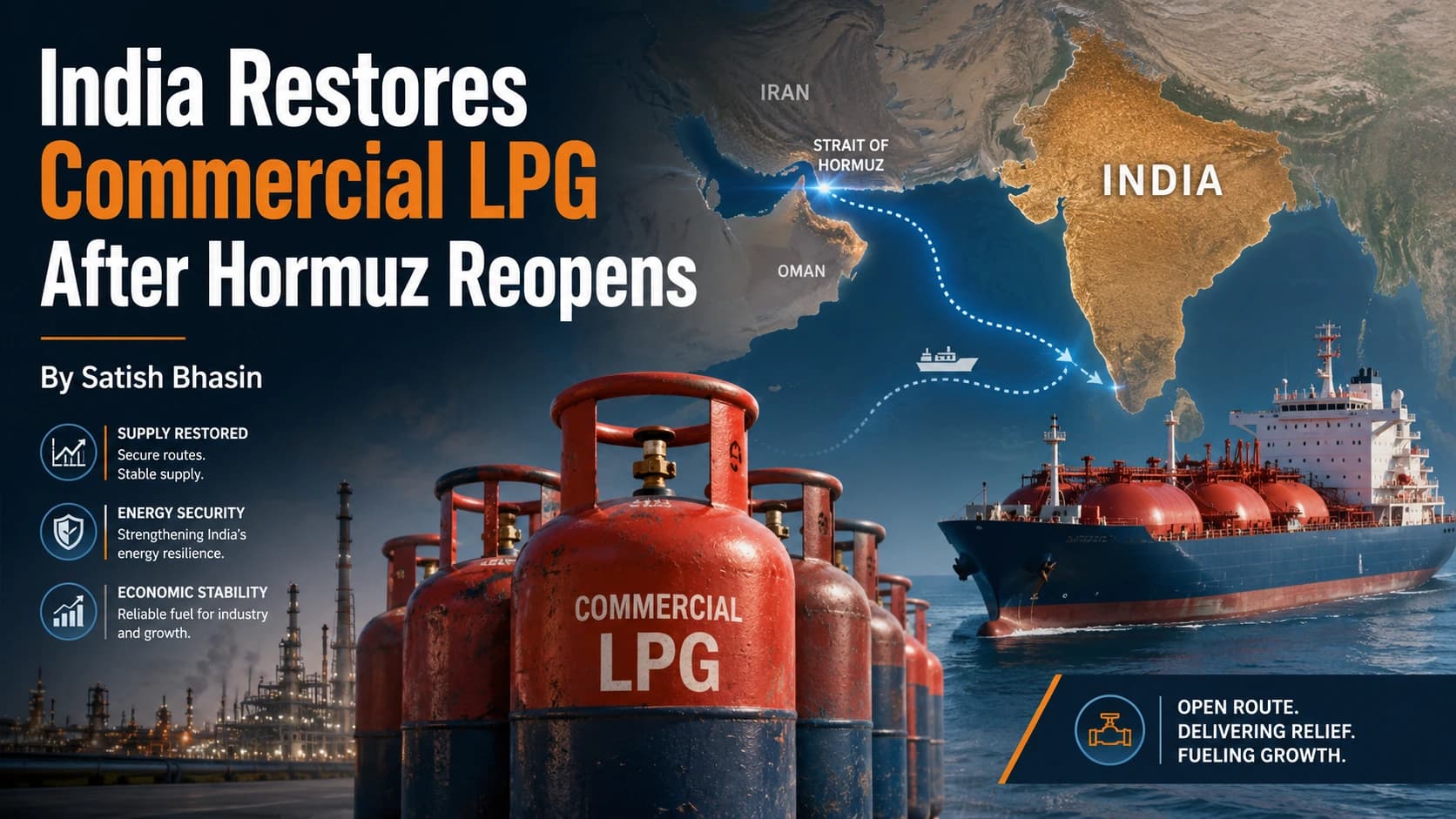
India has restored non-domestic packed LPG supplies to pre-crisis levels and partly reopened bulk LPG supply. However, the Hormuz crisis exposed deep weaknesses in storage, shipping, import diversification, industrial fuel security and India’s ability to replace LPG during a prolonged disruption.
New Delhio (ABC Live): The Government of India has removed sectoral restrictions on the supply of non-domestic packed Liquefied Petroleum Gas, or LPG. Consequently, packed commercial LPG supplies have returned to the levels prevailing before the West Asia crisis.
However, the restoration is not complete across every consumer category. Bulk LPG supply, which the government suspended at the beginning of the crisis, has generally been restored only up to 50% of pre-crisis consumption.
Moreover, the government has begun reducing the compulsory diversion of C3 and C4 refinery streams into LPG production. Therefore, petrochemical, polymer, pharmaceutical and other downstream industries should regain access to part of the feedstock diverted during the emergency.
Nevertheless, the government has retained a critical production safeguard. According to the Ministry of Petroleum and Natural Gas announcement dated 25 June 2026, aggregate indigenous LPG production must remain at no less than 40 thousand metric tonnes, or TMT, per day.
This minimum equals 40,000 tonnes a day. If maintained for a full year, it would represent approximately 14.6 million tonnes of domestic LPG production.
Therefore, the latest decision does not mark a complete return to the pre-crisis energy system. Instead, it marks a controlled transition from emergency rationing towards partial normalisation.
Key Findings
- Packed commercial LPG has returned to 100% of the pre-crisis supply level.
- Sector-based restrictions on non-domestic packed LPG have been withdrawn.
- General bulk LPG supply has been restored only up to 50%.
- Indigenous LPG production must remain at or above 40 TMT per day.
- India imports about 60% of the LPG it consumes.
- About 90% of India’s LPG imports normally pass through the Strait of Hormuz.
- Therefore, around 54% of total Indian LPG consumption is indirectly exposed to the Hormuz route.
- Domestic LPG production initially increased by about 25% during the emergency.
- Later, production reportedly rose from about 32 TMT to approximately 52 TMT per day.
- Commercial LPG supply had earlier been restored gradually to about 70% of pre-crisis levels.
- More than 215,000 tonnes of commercial LPG were sold during the restricted-supply period.
- India has contracted around 2.2 million tonnes of LPG from the United States Gulf Coast for 2026.
- PNG, electricity, biogas, compressed biogas and solar thermal systems can reduce LPG demand.
- However, no single fuel can immediately replace LPG across every household, restaurant and industrial process.
India’s LPG Crisis and Restoration Dashboard
| Indicator | Figure | Meaning |
|---|---|---|
| Packed LPG restoration | 100% | Restrictions withdrawn |
| General bulk supply | 50% | Partial industrial relief |
| Earlier commercial level | About 70% | Crisis-stage allocation |
| Production floor | 40 TMT/day | Domestic supply safeguard |
| Emergency peak output | About 52 TMT/day | Higher refinery production |
| Pre-crisis output | About 32 TMT/day | Earlier production base |
| Import dependence | About 60% | High foreign exposure |
| Imports using Hormuz | About 90% | Route concentration |
| Total Hormuz exposure | About 54% | ABC Live calculation |
| Commercial LPG sold | 215,332 MT | Crisis-period supply |
| Cylinder equivalent | 113.33 lakh | Based on 19-kg cylinders |
| US contract | 2.2 MTPA | Supply diversification |
Sources: Latest LPG restoration announcement, 11 March 2026 inter-ministerial briefing, commercial LPG sales update, April sectoral allocation decision and India–US LPG contract.
What the Government Has Changed
The latest decision affects three connected parts of India’s LPG and petrochemical supply system. First, it restores packed commercial cylinders. Second, it partly reopens bulk LPG supply. Third, it returns some refinery feedstock to non-LPG industries.
Packed Commercial LPG Fully Restored
Non-domestic packed LPG supplies have returned to their pre-crisis levels. Moreover, the government has withdrawn the sectoral restrictions that previously determined which businesses received priority.
Therefore, restaurants, hotels, caterers, hospitals, educational institutions, workshops and small manufacturing units should face fewer cylinder-allocation constraints.
This restoration particularly matters for small enterprises. Unlike large factories, such businesses usually cannot install bulk tanks, gas pipelines or complex multi-fuel systems.
Consequently, cylinder rationing affected their daily operations more directly. In some locations, it also increased the risk of informal-market premiums and the misuse of domestic LPG cylinders.
Bulk LPG Only Partly Restored
Bulk LPG has not received full restoration. Instead, the latest announcement generally permits supplies up to 50% of pre-crisis consumption.
Therefore, large industrial consumers may still need alternative fuels, production adjustments or accelerated PNG connections. Moreover, the government has not provided a timetable for restoring the remaining volume.
An additional policy question also remains. In April 2026, the government allowed several listed industrial sectors to receive up to 70% of their pre-March bulk LPG consumption, subject to an overall sectoral ceiling of 0.2 TMT per day.
Those sectors included pharmaceuticals, food, polymers, agriculture, packaging, paints, steel, metals, ceramics, foundries, forging, glass and aerosols.
However, the 25 June announcement refers to a general restoration level of 50%. It does not clearly explain whether the earlier 70% allocation for selected sectors will continue, operate separately or stand replaced.
Therefore, the Ministry should issue an operational clarification. Otherwise, industries may face uncertainty while planning production and fuel purchases.
C3-C4 Streams Partly Returned to Industry
C3 and C4 streams include hydrocarbons such as propane, propylene, butane and butylene. Refineries can use these streams to produce LPG. However, petrochemical and manufacturing industries also use them as valuable feedstocks.
During the emergency, the government ordered refineries and petrochemical complexes to direct these streams towards LPG production. Consequently, domestic LPG output rose while feedstock availability for downstream industries declined.
The government will now reduce that compulsory diversion. Therefore, petrochemical producers and other industrial users should receive additional material.
However, the Centre for High Technology will determine organisation-wise allocations. As a result, administrative control over the distribution of these streams will continue.
How India Moved from Rationing to Restoration
| Stage | Main decision | Supply effect |
| Crisis begins | Bulk LPG suspended | Industry affected |
| Initial phase | Limited commercial release | About 20% |
| Reform-linked phase | PNG reforms rewarded | Extra 10% |
| Priority phase | More sectors covered | About 50% |
| Expanded phase | Additional industries covered | About 70% |
| 25 June 2026 | Packed restrictions removed | 100% |
| 25 June 2026 | Bulk supply relaxed | Generally 50% |
Earlier policy stages are recorded in the government’s March supply update and its April industrial allocation announcement.
The phased restoration helped the government protect household supplies. However, it also produced frequently changing allocation rules.
Therefore, India should create a pre-declared emergency allocation framework before another crisis begins.
How Much Commercial LPG Was Supplied During the Crisis?
Commercial LPG did not disappear completely during the emergency. Instead, the government rationed available supplies and gradually expanded allocations.
According to a May 2026 official update, public-sector Oil Marketing Companies sold 215,332 tonnes of commercial LPG from April 2026.
This volume was equivalent to more than 113.33 lakh commercial cylinders of 19 kilograms each.
During the same period, the companies also sold more than 23.58 lakh five-kilogram Free Trade LPG cylinders. In addition, the government distributed smaller cylinders through special awareness and migrant-support arrangements.
Therefore, the crisis response combined rationing, smaller cylinders, priority allocation and higher domestic production. Nevertheless, those measures did not remove the structural dependence on imported LPG.
Why India Remains Highly Exposed to Hormuz
India imports about 60% of the LPG it consumes. Moreover, according to the government’s 11 March 2026 briefing, about 90% of those imports normally pass through the Strait of Hormuz.
Therefore, around 54% of India’s total LPG consumption may depend indirectly on the Hormuz route. This percentage is an ABC Live calculation based on the two official figures.
The exposure is more concentrated than India’s general crude-oil dependence on the same passage. Consequently, India can maintain petrol and diesel supplies while still facing a serious LPG shortage.
Moreover, LPG cargoes require specialised ships, terminals, tanks, bottling plants and road or rail distribution. Therefore, crude oil stored in strategic caverns cannot directly replace a delayed LPG cargo.
This distinction is central to the policy debate. India has strategic crude reserves, but it does not yet have a comparable and transparent strategic LPG reserve system.
ABC Live has examined the wider geopolitical and shipping risks in:
- Why and How Iran Is Using Hormuz as a Weapon
- How Long Can Oil Stockpiles Hold if Hormuz Closes?
- The Geopolitics Behind the Strait of Hormuz Blockades
- How the Hormuz Crisis Writes the New World Order’s Code
- How Hormuz Challenged Lloyd’s Marine Insurance Order
Why the 40 TMT Production Floor Matters
Before the crisis, domestic LPG production stood at around 32 TMT per day. During the emergency, refinery measures reportedly raised production to around 52 TMT per day.
The latest policy now requires production to remain at no less than 40 TMT per day.
| Production stage | LPG output |
| Pre-crisis level | About 32 TMT/day |
| Emergency peak | About 52 TMT/day |
| New minimum floor | 40 TMT/day |
Therefore, the government has reduced production from the emergency peak. However, it has not allowed output to return fully to the pre-crisis level.
The new 40 TMT floor remains about 25% above the earlier 32 TMT production level. Consequently, part of the emergency refinery response has become a continuing supply safeguard.
This arrangement protects household LPG availability. Nevertheless, it also means that petrochemical industries may not immediately regain all C3-C4 feedstock diverted during the crisis.
Does the US LPG Contract Solve the Problem?
Indian public-sector Oil Marketing Companies concluded a structured contract to import around 2.2 million tonnes of LPG from the United States Gulf Coast during 2026.
According to the official contract announcement, this quantity represents close to 10% of India’s annual LPG imports.
The agreement is strategically important because US Gulf Coast cargoes do not need to cross the Strait of Hormuz. Therefore, the contract reduces part of India’s route concentration.
However, it does not solve the wider problem. Around 90% of annual LPG imports must still come from other contracts or spot purchases.
Moreover, American cargoes involve longer sailing distances. Consequently, freight charges, vessel availability and shipping-route conditions may raise their delivered cost.
Therefore, the US contract should form one part of a broader diversification strategy rather than serve as India’s only non-Hormuz solution.
Restoration Does Not Guarantee Lower Prices
The latest announcement concerns physical availability. However, it does not announce any reduction in commercial LPG prices.
International LPG benchmarks, exchange rates, freight charges, war-risk premiums and domestic margins will continue to influence the final price.
Moreover, a cargo can become costlier even when it arrives safely. For example, insurance and charter rates can increase because of perceived risk rather than an actual physical blockade.
Therefore, supply restoration and price relief are different policy questions. Businesses may receive cylinders more regularly while continuing to pay elevated prices.
Impact on Commercial and Industrial Consumers
The restoration will affect consumer groups differently.
| Consumer | Likely effect |
| Restaurants | Better cylinder availability |
| Hotels | Lower supply uncertainty |
| Hospitals | More secure fuel access |
| Small factories | Improved planning |
| Bulk industries | Only partial relief |
| Petrochemical units | More feedstock |
| OMCs | Higher data duties |
| CGD companies | More PNG demand |
Small businesses should benefit most immediately because packed cylinders have returned to pre-crisis levels.
However, bulk consumers remain constrained. Therefore, larger factories may continue using fuel-switching arrangements or reduced production schedules.
Petrochemical industries should also benefit from the partial return of C3-C4 streams. Nevertheless, actual relief will depend on how the Centre for High Technology distributes those streams.
What Lessons Should India Learn from the Hormuz Crisis?
The crisis was not merely a temporary shortage. Instead, it served as a national energy-security stress test.
India prevented a widespread household LPG breakdown through refinery conversion, allocation controls, cargo monitoring and priority distribution. However, the crisis exposed major weaknesses that require permanent solutions.
LPG Needs Its Own Strategic Reserve
India’s strategic petroleum reserves mainly store crude oil. However, crude oil cannot immediately replace LPG because the two fuels require different processing, storage and distribution systems.
Therefore, India should establish a dedicated LPG stockholding policy.
The system could combine:
- Government-controlled LPG stocks
- Mandatory OMC inventories
- Commercial tanks available during emergencies
- Port-based LPG storage
- Regional cylinder buffers
- Temporary floating storage during high-risk periods
Moreover, the government should disclose the number of days of usable LPG demand covered by these stocks. Storage capacity alone does not show how much emergency fuel is actually available.
India Must Diversify Suppliers and Routes
India should increase long-term purchases from suppliers whose cargoes do not depend on Hormuz.
Therefore, the government and public-sector companies should examine contracts with suppliers in the United States, Atlantic Basin, Africa and other regions.
In addition, India should explore storage or cargo-swap arrangements at terminals outside the Strait.
Diversification may increase normal freight costs. However, paying a modest resilience premium may be less damaging than imposing nationwide rationing during every major Gulf crisis.
Refinery Flexibility Must Become a Formal Policy
The emergency diversion of C3-C4 streams increased domestic LPG output. Therefore, refinery flexibility proved to be one of India’s strongest crisis-management tools.
However, the shift also reduced feedstock available to petrochemical industries.
India should establish a formal refinery-switching framework defining:
- The trigger for compulsory diversion
- The minimum LPG production level
- The maximum diversion period
- Protected downstream industries
- Review intervals
- Restoration conditions
- Compensation or adjustment mechanisms
Consequently, future interventions would become faster, clearer and more predictable.
Commercial Consumers Need a Priority Code
During the crisis, commercial allocation increased in several stages. Although the approach helped manage scarce supplies, frequent changes created uncertainty.
Therefore, India should create a three-level priority framework before the next disruption.
| Priority | Consumers | Crisis treatment |
| Essential | Hospitals, hostels, public kitchens | Protected supply |
| Critical | Food, pharma, metals, key industries | Minimum allocation |
| General | Hotels, restaurants, other units | Phased supply |
The classification should remain public. Moreover, businesses should receive an online mechanism to correct inaccurate classifications.
Shipping Must Become Part of Energy Planning
Purchasing a cargo does not guarantee energy security. The cargo must also obtain a ship, insurance, port access and safe passage.
Therefore, India needs a permanent Maritime Energy Security Cell involving the petroleum, shipping, external affairs and defence authorities.
The cell should also include:
- Directorate General of Shipping
- Indian Navy
- Oil Marketing Companies
- Port authorities
- Shipping companies
- Marine insurers
- City Gas Distribution entities
In addition, the cell should conduct regular simulations of a Hormuz closure, tanker shortage, cyberattack or port disruption.
India Needs a War-Risk Insurance Strategy
A crisis can sharply increase freight and insurance costs even when some ships continue to move.
Therefore, India should examine:
- Pooled war-risk insurance
- Government-backed guarantees
- Long-term vessel charters
- Emergency freight support
- Joint cargo procurement
- Indian-controlled LPG carrier capacity
Otherwise, India may own the fuel contract but remain dependent on foreign ships and insurers during the most dangerous phase of a crisis.
Energy Security Must Include Fertiliser
Hormuz carries more than crude oil and LPG. It also matters for LNG, ammonia, sulphur and fertiliser cargoes.
Therefore, a prolonged disruption can affect household cooking, factory production and agricultural input costs at the same time.
India should consequently integrate LPG, LNG, fertiliser, petrochemical feedstock, shipping and port planning into one inter-ministerial framework.
Emergency Rules Need Transparent Triggers
India used the Essential Commodities Act to regulate production and distribution. Such intervention can be justified during a severe shortage.
However, the government should define the conditions for imposing and withdrawing controls.
| Alert | Supply condition | Response |
| Green | Normal cargo flow | Normal allocation |
| Yellow | Rising route risk | Higher stocks |
| Orange | Major import delays | Priority supply |
| Red | Severe closure | Rationing and reserve release |
Each level should include measurable indicators. Moreover, the government should state who declares the alert and how often it will be reviewed.
What Are the Practical Alternatives to LPG?
India cannot replace LPG with one fuel across every sector. Instead, it needs a multi-fuel system suited to different consumers and locations.
PNG may work in connected cities. Electricity may work for households and some commercial kitchens. Biogas may work in rural, agricultural and institutional settings. Meanwhile, biomass and electric heating may support selected industries.
Therefore, India should pursue an LPG-plus strategy rather than attempt an abrupt nationwide replacement.
LPG Alternatives Dashboard
| Alternative | Best use | Main limitation |
| PNG | Urban kitchens, industry | Pipeline dependence |
| Induction | Homes, small kitchens | Reliable power needed |
| Electric heating | Commercial and industry | High load requirement |
| Biogas | Villages and institutions | Feedstock needed |
| Compressed biogas | Industry and transport | Limited network |
| Biomass pellets | Boilers and dryers | Emission controls |
| Solar thermal | Water and process heat | Weather dependence |
| Solar cooking | Community kitchens | Daylight dependence |
| Green hydrogen | Future heavy industry | High cost |
| LPG | Portable backup | Import exposure |
Piped Natural Gas
PNG is the most direct substitute for LPG in areas covered by City Gas Distribution networks.
It eliminates cylinder transport and can provide continuous supply. Therefore, it suits urban households, hotels, hospitals, restaurants and industrial units with steady demand.
The Petroleum and Natural Gas Regulatory Board regulates and monitors India’s City Gas Distribution system.
However, PNG does not eliminate every geopolitical risk. India imports part of its gas in the form of LNG, and some LNG supplies also depend on Hormuz.
Therefore, PNG expansion must accompany supplier diversification, stronger pipelines and backup-fuel arrangements.
Induction and Electric Cooking
Electric cooking offers the strongest long-term alternative for many households and small commercial kitchens.
Available technologies include:
- Induction cooktops
- Electric pressure cookers
- Rice cookers
- Electric ovens
- Commercial induction ranges
- Electric steam systems
- Hot plates and kettles
Electric cooking avoids cylinder transport and indoor fuel combustion. Moreover, it can become progressively cleaner as renewable electricity expands.
However, reliable power supply remains essential. Commercial kitchens may also require upgraded wiring, higher sanctioned loads and three-phase connections.
Therefore, hybrid kitchens may offer the most practical transition. Electricity can handle routine cooking, while LPG remains available for high-flame or emergency requirements.
The Bureau of Energy Efficiency has examined consumer-centred approaches to India’s e-cooking transition.
Biogas
Biogas can replace part of LPG consumption in rural households, dairies, farms, hostels, religious kitchens and institutional campuses.
It can use:
- Cattle dung
- Food waste
- Agricultural waste
- Poultry waste
- Market waste
- Sewage
- Dairy residue
The Ministry of New and Renewable Energy’s Biogas Programme supports biogas for clean cooking, thermal applications and small power needs.
Moreover, the remaining slurry can serve as organic manure.
However, biogas plants need continuous feedstock, water and maintenance. Therefore, they work best where organic waste remains available throughout the year.
Compressed Biogas
Raw biogas can be purified and compressed into Compressed Biogas, or CBG.
CBG can support transport, industrial heating and gas-network injection. Moreover, it can reduce dependence on imported fossil gas.
However, production and distribution remain limited. Therefore, India should initially promote CBG around dairy clusters, municipal waste facilities, agricultural regions and industrial areas.
The MNRE BioUrja Programme supports energy recovery from urban, industrial and agricultural waste.
Electric Industrial Heating
Some industries can replace LPG with electric boilers, resistance heating, induction furnaces, infrared systems or industrial heat pumps.
Electric systems can offer accurate temperature control. Moreover, they eliminate combustion emissions at the factory site.
However, conversion may require expensive equipment and stronger electricity connections. Therefore, electrification is most suitable for processes that do not require direct flame contact.
Biomass Pellets and Briquettes
Biomass pellets can replace LPG or liquid fuels in selected boilers, dryers and food-processing operations.
They can use crop residue, sawdust, bagasse, groundnut shells and other agricultural waste.
However, poor-quality biomass combustion can increase particulate pollution. Therefore, industries must use certified fuel, efficient boilers and proper emission controls.
Solar Cooking and Solar Thermal Systems
Solar cooking can reduce LPG consumption in schools, hostels, temples and community kitchens. Similarly, solar thermal systems can provide hot water or low-temperature process heat to hotels, hospitals, dairies, laundries and food-processing units.
However, solar energy remains weather-dependent. Therefore, these systems need thermal storage or backup fuel.
Solar energy should consequently supplement LPG rather than serve as the only fuel.
Green Hydrogen
Green hydrogen may eventually support high-temperature industrial processes.
However, it remains expensive and requires specialised production, transport, storage and burners. Therefore, it is not an immediate cooking-fuel substitute.
India should initially reserve hydrogen for hard-to-electrify sectors such as steel, fertilisers, refineries and selected chemical industries.
Polluting Fuels Are Not a Sustainable Answer
During an LPG shortage, some consumers may shift to diesel, furnace oil, pet coke, coal or firewood.
However, these fuels increase pollution and carbon emissions. Moreover, oil-based alternatives remain exposed to international price shocks.
Therefore, India should not solve an LPG-security problem by creating a larger air-pollution problem.
Best Alternative by Consumer
| Consumer | Main option | Backup |
| Urban home | Induction or PNG | LPG |
| Rural home | Biogas and electricity | LPG |
| Small restaurant | PNG or induction | LPG |
| Large hotel | PNG and electric systems | LPG |
| Hospital | PNG and electricity | LPG stock |
| Community kitchen | Solar steam and biogas | LPG |
| Food processor | Electricity, PNG or biomass | LPG |
| Industrial unit | Electricity, PNG or CBG | LPG |
| Remote area | Biogas and solar | LPG |
| Dairy or farm | Biogas | Electricity |
The PNG Transition Needs Safeguards
The government has stated that consumers already shifted to PNG will remain on PNG. Moreover, other eligible consumers will progressively move towards pipeline gas.
This approach can release LPG for locations without pipeline access. However, the existence of a nearby pipeline does not guarantee an effective connection.
Therefore, the government should:
- Confirm actual connectivity before withdrawing LPG
- Compare PNG and LPG costs
- Provide reasonable transition time
- Ensure adequate gas pressure
- Establish grievance mechanisms
- Permit backup LPG where necessary
- Regulate connection charges
- Publish service-quality standards
Without such safeguards, forced conversion may impose disproportionate costs on small businesses.
The Unified Consumer Database
Oil Marketing Companies must maintain comprehensive information on commercial and industrial LPG users. In addition, the companies will create a unified sectoral database.
This system can improve forecasting, identify critical consumers and reduce duplicate allocation. Moreover, it may help detect the diversion of domestic cylinders into commercial use.
However, the government should disclose:
- What information will be collected
- Who can access the database
- How long records will remain stored
- How businesses can correct errors
- What cybersecurity rules will apply
- Whether allocation decisions will use automation
- How commercial confidentiality will be protected
Therefore, the Ministry should publish a formal data-governance framework before the database becomes permanent.
Legal and Institutional Analysis
The government issued emergency directions under the Essential Commodities Act, 1955.
The Act permits regulation of the production, supply and distribution of essential commodities in the public interest.
During a serious supply disruption, temporary intervention may therefore be justified. However, restrictions should remain necessary, proportionate and time-bound.
The restoration of packed commercial LPG follows this principle because the government withdrew broad controls after supply conditions improved.
Nevertheless, bulk LPG remains restricted, while C3-C4 feedstock distribution continues under administrative supervision.
Therefore, the Ministry should periodically review the remaining controls and publish reasons for their continuation.
What the Government Has Not Disclosed
No Detailed Import-Cargo Schedule
The government refers to the projected availability of imported LPG cargoes. However, it has not publicly disclosed the expected number of cargoes, volumes, supplier countries, arrival dates or ports.
Therefore, independent observers cannot determine how durable the improvement may be.
No Timetable for Full Bulk Restoration
Bulk LPG remains at 50% of pre-crisis consumption under the latest general relaxation.
However, the government has not stated when the remaining quantity may return.
No Clarification on the Earlier 70% Allocation
Selected sectors previously received up to 70% of their bulk LPG requirement. However, the latest announcement refers to 50%.
Therefore, the Ministry should explain how the two allocation levels interact.
No Public C3-C4 Allocation Formula
The Centre for High Technology will issue organisation-wise allocations.
However, the government has not explained how production capacity, employment, strategic importance, previous consumption or fuel-substitution options will affect the allocation.
No Commercial Price Assurance
The decision restores supply but does not promise lower prices.
Therefore, businesses should treat availability and affordability as separate challenges.
No Public Strategic LPG Stock Figure
The government has provided extensive information on crude-oil reserves. However, it has not disclosed a comparable national figure showing the usable days of dedicated LPG stocks.
This gap prevents a full assessment of India’s resilience to a renewed Hormuz disruption.
ABC Live Assessment
The restoration of packed commercial LPG is an important economic-relief measure. Moreover, it shows that India’s emergency production measures and expected imports have improved the immediate supply position.
However, the decision does not establish complete energy normalcy.
First, bulk LPG remains only partly restored. Therefore, several industrial users continue to face restrictions.
Second, the government has retained a production floor of 40 TMT per day. Consequently, part of the emergency refinery system remains active.
Third, India continues to import about 60% of its LPG. Moreover, most of those imports remain linked to the Hormuz route.
Fourth, the US LPG contract improves diversification but covers only about one-tenth of annual imports.
Fifth, the alternatives to LPG remain uneven. PNG cannot reach every consumer, electricity requires reliable grids, biogas depends on feedstock and solar systems require backup.
Therefore, the latest decision should be understood as successful crisis management rather than proof of permanent LPG security.
Policy Recommendations
Create Dedicated LPG Reserves
India should establish national and regional LPG stock obligations.
Moreover, the government should publish usable stock coverage in days rather than only storage capacity.
Diversify Imports
Public-sector companies should secure more supplies from non-Hormuz sources.
In addition, India should diversify shipping routes, loading terminals, pricing benchmarks and contract structures.
Expand Indian-Controlled Shipping
India should increase long-term chartering or ownership of specialised LPG carriers.
Consequently, foreign vessel availability would become less decisive during a crisis.
Publish an Emergency Allocation Code
The government should define essential, critical and general consumer categories before the next disruption.
Moreover, each category should receive predictable minimum supplies.
Clarify Bulk LPG Rules
The Ministry should explain whether the latest 50% level replaces or coexists with the earlier 70% sectoral allocation.
It should also publish the conditions required for full restoration.
Make C3-C4 Allocation Transparent
The Centre for High Technology should publish sectoral criteria and organisation-wise allocations.
In addition, affected industries should receive a review mechanism.
Accelerate Clean Alternatives
India should promote induction cooking, reliable PNG, biogas, CBG, solar thermal systems and industrial electrification.
However, the government should avoid compulsory transitions where infrastructure remains unreliable.
Establish a Maritime Energy Security Cell
The proposed cell should monitor ships, cargoes, insurance, ports and alternative routes.
Moreover, it should conduct regular national disruption exercises.
Publish a National Energy Disruption Dashboard
The dashboard should show:
- LPG production
- Import arrivals
- Usable stock days
- Commercial allocation
- Bulk allocation
- State-wise availability
- LNG stocks
- Vessel movements
- Freight conditions
- PNG conversion progress
Consequently, citizens, businesses and policymakers would receive a clearer picture of the actual supply situation.
Conclusion
India’s restoration of packed commercial LPG marks an important move away from emergency rationing. It should provide immediate relief to restaurants, hotels, institutions and small manufacturing units.
Moreover, the partial release of C3-C4 streams should reduce pressure on petrochemical and other downstream industries.
However, bulk LPG supply remains only partly restored. In addition, India remains heavily dependent on imported LPG and on maritime routes connected with the Strait of Hormuz.
Therefore, the government must use the present period of stability to build dedicated LPG storage, diversify suppliers, secure ships, expand clean alternatives and create transparent emergency-allocation rules.
The Hormuz crisis showed that energy security does not depend only on buying fuel. Instead, it depends on routes, ships, insurance, storage, refineries, pipelines, electricity networks and the ability of consumers to switch fuels.
India managed the immediate crisis without a nationwide household LPG breakdown. Nevertheless, the deeper structural vulnerability remains.
The next crisis may last longer. It may also affect LPG, LNG, fertilisers and industrial feedstocks at the same time.
Therefore, India must convert the temporary emergency arrangements of 2026 into a permanent national energy-resilience system.
How We Verified
ABC Live reviewed the following official records and public data:
- Government restoration announcement dated 25 June 2026
- Inter-ministerial briefing on LPG imports and Hormuz exposure
- April commercial and industrial LPG allocation decision
- Commercial LPG sales update
- India–US LPG import contract
- Petroleum and Natural Gas Regulatory Board
- PNGRB Data Bank
- Ministry of New and Renewable Energy Biogas Programme
- MNRE BioUrja Programme
- Bureau of Energy Efficiency
- Centre for High Technology
- Essential Commodities Act, 1955
Related ABC Live Reports
- Explained: India’s Energy Reality 2026
- Explained: Why and How Iran Is Using Hormuz as a Weapon
- Explained: How Long Can Oil Stockpiles Hold if Hormuz Closes?
- Explained: The Geopolitics Behind the Strait of Hormuz Blockades
- Explained: How the Hormuz Crisis Writes the New World Order’s Code
- Explained: How Hormuz Challenged Lloyd’s Marine Insurance Order
- Explained: How India Can Use Chabahar Port After the Iran War
ABC Live — Making Complex Public Issues Simple.