

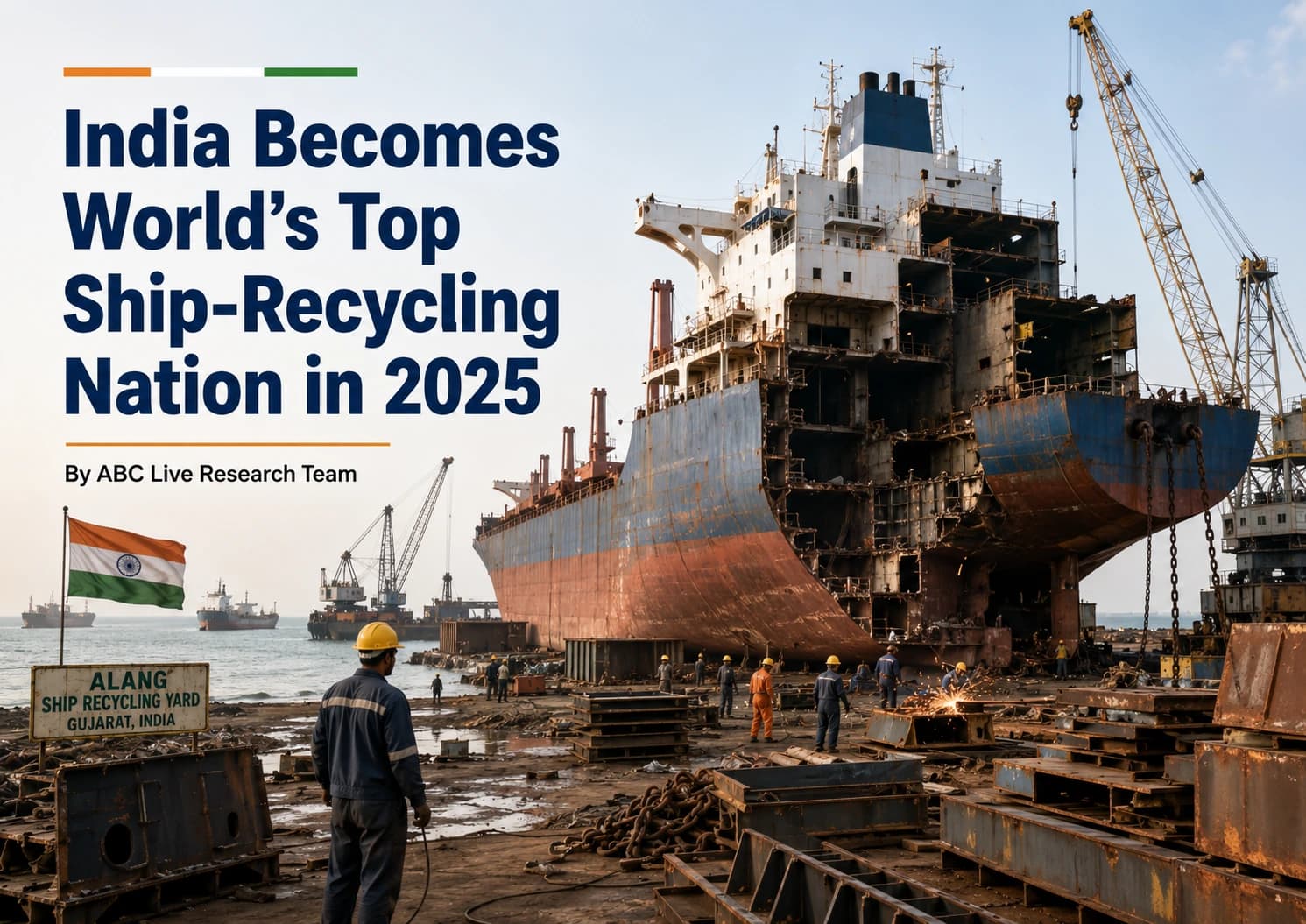
New Delhi (ABC Live): India emerged as the world’s largest ship-recycling nation by gross tonnage in 2025, according to figures released by the Press Information Bureau on 22 June 2026.
According to the Ministry of Ports, Shipping and Waterways, India recycled 2.99 million gross tonnes of ships during 2025. In comparison, the country recycled 1.86 million gross tonnes in 2024. Therefore, India’s annual recycling volume increased by nearly 60%.
Meanwhile, India’s share of global ship recycling rose from 30.1% in 2024 to 35.4% in 2025. Consequently, more than one-third of the world’s recycled ship tonnage reportedly came to India.
Moreover, the government described the result as the achievement of a major Maritime India Vision 2030 target five years ahead of schedule.
However, the achievement requires careful interpretation. India ranked first by the gross tonnage of ships recycled during 2025. Nevertheless, the ranking does not by itself prove that India also leads in worker safety, environmental protection, hazardous-waste management or high-value material recovery.
Key Points
- India reportedly recycled 2.99 million gross tonnes of ships in 2025.
- Moreover, its global share rose from 30.1% in 2024 to 35.4% in 2025.
- Consequently, India ranked first globally by recycled gross tonnage.
- In addition, recycling volume increased by nearly 60% within one year.
- Therefore, India achieved a Maritime India Vision 2030 ranking target five years early.
- Meanwhile, the Hong Kong Convention entered into force on 26 June 2025.
- However, no Indian yard appeared on the European Union’s February 2026 approved list.
- Furthermore, India plans to expand recycling capacity to about 9 million light displacement tonnes.
- Nevertheless, lasting leadership will depend on safety, waste control and regulatory trust.
What Did India Achieve in Ship Recycling in 2025?
India became the world’s largest ship-recycling country by gross tonnage during 2025.
According to the government announcement, the country recycled 2.99 million gross tonnes of ships. In contrast, India recycled 1.86 million gross tonnes in 2024. As a result, India added around 1.13 million gross tonnes of recycling activity within one year.
Moreover, India’s global share increased by 5.3 percentage points. Therefore, the country moved from holding 30.1% of the global market in 2024 to controlling 35.4% in 2025.
However, ship-recycling data can vary sharply between years. Consequently, one year’s result should not be treated as permanent market control.
India Ship-Recycling Data Dashboard
| Indicator | 2024 | 2025 |
|---|---|---|
| Recycling volume | 1.86m GT | 2.99m GT |
| Global share | 30.1% | 35.4% |
| Annual growth | — | Nearly 60% |
| Global position | Below first | First |
| Vision target | 2030 goal | Met in 2025 |
GT means gross tonnage.
The increase is substantial. Nevertheless, several market forces can change recycling volumes quickly.
For example, freight rates affect whether shipowners continue operating older vessels. Similarly, scrap prices influence how much recycling yards can offer for end-of-life ships.
Therefore, India’s first-place ranking is important, but it is not necessarily permanent.
Why India’s Ship-Recycling Rise Matters
India’s rise matters for its maritime economy, steel sector, employment market and circular-economy strategy.
First, ship recycling recovers large quantities of steel. Therefore, it can reduce the demand for freshly produced steel and lower pressure on raw-material imports.
Moreover, the steel industry remains highly carbon-intensive. Consequently, the recovery and reuse of ship steel may support India’s wider decarbonisation goals.
ABC Live examined this wider issue in Green Steel Explained: Global Rules and India’s Role.
Second, ship recycling supports jobs in dismantling, engineering, transport, steel rerolling, equipment recovery and waste treatment. As a result, the industry creates economic activity beyond the recycling yards themselves.
Third, recycling can support Indian shipbuilding. In particular, the government’s Shipbreaking Credit Note Scheme seeks to connect the dismantling of old vessels with orders for new ships built in India.
Finally, India’s growing global share gives it greater influence over international recycling standards. However, that influence will remain credible only if India combines industrial scale with safe working conditions and strong environmental enforcement.
Why India Became the World’s Largest Ship-Recycling Nation
India’s rise resulted from several factors rather than one policy alone.
First, India introduced a clearer legal framework. Second, the government supported yard modernisation. Moreover, Alang already had an established industrial network and a large market for recovered steel.
Meanwhile, the entry into force of the Hong Kong Convention increased the importance of authorised recycling facilities. Consequently, Indian yards that had upgraded their systems became better placed to receive more vessels.
However, favourable global market conditions may also have contributed. Therefore, the government should not attribute the entire rise to policy reform alone.
Recycling of Ships Act, 2019
India enacted the Recycling of Ships Act, 2019 to regulate ships and recycling facilities.
The law provides a framework for authorising recycling facilities, preparing recycling plans and managing hazardous materials. In addition, it allows authorities to inspect ships and yards and enforce safety requirements.
The law was necessary because end-of-life ships may contain asbestos, oil residue, toxic paint and heavy metals. Moreover, they may contain ozone-depleting substances and other harmful material.
Therefore, ship recycling involves much more than cutting steel. Instead, it requires hazardous-material inventories, trained workers, emergency systems and secure waste-disposal chains.
However, a strong law is only the first step. Ultimately, its effectiveness depends on inspection quality, transparency and consistent enforcement.
Hong Kong Convention Compliance
India ratified the Hong Kong International Convention for the Safe and Environmentally Sound Recycling of Ships in November 2019.
Subsequently, the Convention entered into force on 26 June 2025.
The Convention sets requirements for ships, shipowners, flag states and recycling facilities. Moreover, it requires covered ships to maintain an Inventory of Hazardous Materials.
In addition, authorised yards must prepare ship-specific recycling plans. Therefore, the Convention aims to regulate both the vessel and the facility that dismantles it.
The Indian government says it provided ?53.5 crore to modernise recycling yards. As a result, 115 facilities reportedly became compliant with the Convention-linked framework.
Consequently, India entered the Convention era with a large base of upgraded yards.
However, legal certification does not automatically guarantee safe daily operations. Therefore, authorities must continue inspecting yards, monitoring pollution and publishing accident data.
Alang’s Industrial Advantage
The Alang-Sosiya recycling cluster in Gujarat handles most of India’s ship-recycling work.
First, Alang has a long coastline and suitable tidal conditions. Moreover, the region has developed a large network of dismantling yards, transport operators and steel buyers.
In addition, traders purchase recovered furniture, engines, electrical systems and machinery. Consequently, many parts of an old vessel can be resold or reused.
This network reduces transaction costs. Therefore, Indian yards can offer competitive prices to shipowners.
However, Alang’s scale also concentrates risk. For example, accidents, toxic waste and coastal pollution can affect a large number of workers and nearby communities.
Therefore, expansion must be matched by stronger waste treatment, emergency services and environmental monitoring.
Shipbreaking Credit Note Scheme
The Shipbreaking Credit Note Scheme seeks to connect ship recycling with domestic shipbuilding.
Under the scheme, an eligible shipowner may receive a credit note equal to 40% of the fair scrap value of a vessel recycled in India.
However, the amount that may be redeemed against a new Indian-built vessel remains subject to the scheme’s prescribed limit. Broadly, the credit may cover up to 5% of the fair value of the new vessel.
Moreover, the credit note remains valid for three years.
Therefore, the scheme creates a financial bridge between dismantling an old ship and ordering a new vessel from an Indian yard.
Nevertheless, the policy’s real impact remains unclear because detailed performance data is not readily available.
Consequently, the government should publish the number of credits issued, their total value and the number redeemed. In addition, it should disclose the number of new shipbuilding orders generated through the scheme.
Without such data, the public cannot determine whether the scheme has materially supported domestic shipbuilding.
India’s Wider Maritime Strategy
India’s ship-recycling rise forms part of a broader maritime strategy covering ports, shipbuilding, ship finance, leasing and coastal infrastructure.
The Ministry of Ports, Shipping and Waterways oversees the central framework for shipping, shipbuilding, ship repair and ship recycling.
Meanwhile, India is developing ship-finance and leasing capacity through the Gujarat International Finance Tec-City International Financial Services Centre.
ABC Live examined this policy direction in Critical Analysis of IFSCA’s Framework for Ship Leasing.
However, recycling, shipbuilding, leasing, insurance and port development must operate as parts of one maritime system. Otherwise, India may lead in dismantling old ships while continuing to depend on foreign-built and foreign-financed vessels.
Therefore, recycling leadership should support wider maritime capacity rather than remain an isolated industrial achievement.
Has India Achieved Its Maritime India Vision 2030 Target?
The government’s claim is correct in a narrow and measurable sense.
India reportedly achieved the objective of becoming the world’s largest ship-recycling country by volume before 2030. Therefore, the ranking target was achieved ahead of schedule.
However, policy success should be tested at several levels.
Maritime Leadership Test
| Test | India’s position |
| First by 2025 tonnage | Achieved |
| Lead sustained over years | Not established |
| Best safety standards | Yet to be proved |
| Best green standards | Yet to be proved |
| Global regulatory access | Incomplete |
India has clearly achieved the first test. Nevertheless, it has not yet passed the remaining tests.
For example, sustainable leadership requires a low accident rate and reliable waste treatment. Moreover, it requires international regulatory trust and public performance data.
Therefore, India has achieved a major target, but it has not completed the wider transformation of the sector.
Why One Year’s Ranking Is Not Enough
Ship recycling is highly cyclical.
When freight rates are high, shipowners may keep older ships in service. In contrast, when freight earnings fall, they may sell more vessels for recycling.
Similarly, high scrap-steel prices can increase recycling activity. However, weak scrap prices may delay ship retirement.
Moreover, global conflict can increase demand for vessels and extend their operating life. Consequently, geopolitical events may reduce the number of ships available for recycling.
Environmental rules can also influence where vessels are dismantled. Therefore, annual rankings may change even when domestic policy remains unchanged.
India’s 35.4% share is therefore a major achievement. Nevertheless, it should not be presented as a guaranteed long-term share.
The European Union Approval Challenge
India is seeking the inclusion of its yards in the European List of Ship Recycling Facilities.
This approval matters because large ships flying the flag of a European Union member state must use a listed facility.
However, the European Commission’s February 2026 update contained 41 facilities, but none was located in India.
European Union Approval Dashboard
| Region | Approved yards |
| Europe | 30 |
| Türkiye | 10 |
| United States | 1 |
| India | 0 |
Therefore, India’s compliance with the Hong Kong Convention has not yet resulted in European Union approval.
However, this does not mean Indian yards have no international compliance. Instead, it shows that the Hong Kong Convention and the European Union approval process are separate systems.
Moreover, the European Union applies additional requirements to facilities outside Europe. Consequently, Indian yards must satisfy a different assessment before joining the approved list.
European approval would open access to a more tightly regulated section of the global fleet. In addition, it would provide independent recognition of India’s environmental and safety performance.
Therefore, India should treat European Union inclusion as a strategic objective.
Does Hong Kong Convention Compliance Guarantee Sustainable Recycling?
No. Convention compliance provides an important legal foundation. However, it does not automatically guarantee safe or environmentally sound operations at every yard.
Actual performance depends on daily enforcement. For example, workers need training, protective equipment and emergency support.
Similarly, yards need proper waste storage, fire systems and medical facilities. Moreover, authorities need reliable inspection and accident-reporting systems.
Pollution can also move beyond the recycling plot. For instance, asbestos or contaminated material may enter scrap markets or informal waste channels.
Therefore, authorities should track hazardous material from the ship to its final treatment.
Without such traceability, a yard may appear compliant while pollution is transferred elsewhere.
Alang Expansion: Opportunity and Risk
India plans to increase ship-recycling capacity to around 9 million light displacement tonnes through the expansion of Alang-Sosiya.
The proposed expansion could improve roads, waste treatment and worker housing. Moreover, it could strengthen medical services, emergency systems and training facilities.
Global demand may also rise. According to BIMCO’s ship-recycling outlook, more than 16,000 ships could require recycling over the next decade.
Therefore, additional capacity may be commercially useful.
However, capacity should not expand faster than demand. Otherwise, financially stressed yards may cut safety or environmental costs during weak market periods.
Consequently, the government should measure more than the number of ships dismantled. Instead, it should assess the quality, safety and environmental impact of each recycling operation.
Can India Recycle 500 to 600 Ships Annually?
The government believes India may recycle around 500 to 600 ships every year.
However, this estimate is a projection rather than a guaranteed outcome.
First, it assumes that global recycling demand grows as predicted. Second, it assumes that India retains its 35.4% market share.
Moreover, it assumes that Alang’s expansion proceeds successfully. In addition, it assumes that Bangladesh, Pakistan and Türkiye do not capture a larger share.
Therefore, India may recycle 500 to 600 ships during strong years. Nevertheless, the figure should not be presented as assured annual business.
Global Ship-Recycling Competition
India competes mainly with Bangladesh, Pakistan and Türkiye.
Global Competition Dashboard
| Country | Main strength | Main challenge |
| India | Scale and scrap market | EU approval |
| Bangladesh | Competitive pricing | Safety enforcement |
| Pakistan | Established yards | Modernisation |
| Türkiye | EU market access | Higher costs |
Traditionally, competition centres on the price offered to shipowners. However, global rules increasingly place importance on compliance and traceability.
Therefore, India should avoid competing only through low costs.
Instead, it should compete through stronger safety, faster processing and higher material recovery. Moreover, transparent inspections and reliable waste treatment can improve India’s regulatory credibility.
Ship Recycling and India’s Circular Economy
Ship recycling can support the circular economy because ships contain large quantities of reusable material.
For example, yards can recover steel plates, engines, generators and electrical systems. In addition, they may recover cables, furniture, pumps and navigational equipment.
Therefore, recycling can reduce waste and lower demand for virgin resources.
ABC Live explained the need for traceable recycling systems in Why India Needs Critical-Mineral Recycling.
Similarly, ABC Live’s report on India’s Carbon Credit Trading Scheme explained why environmental claims require measurable results.
The same principle applies to ship recycling. Although steel recovery is useful, recycling is not automatically green.
Instead, its environmental value depends on safe dismantling and responsible waste treatment. Therefore, India must measure both recovered material and environmental harm.
Worker-Safety Questions
Ship recycling remains physically dangerous.
For example, workers may face falling steel plates, fires, explosions and toxic gases. Moreover, they may work in confined spaces or handle asbestos and oil residue.
Therefore, India’s global leadership should be tested through public safety data.
The government and the Gujarat Maritime Board should publish information on fatalities, serious injuries and fire incidents. In addition, they should disclose inspection results, worker training and medical screening.
Without transparent data, the public cannot determine whether higher recycling volumes have also produced safer workplaces.
Consequently, safety reporting should become a central part of India’s ship-recycling strategy.
Environmental Risks
Ship recycling can affect land, air and coastal ecosystems.
End-of-life ships may contain asbestos, lead, mercury and oil sludge. Moreover, they may contain toxic paint, polychlorinated biphenyls and contaminated water.
Therefore, every yard needs secure systems for removal, storage, transport and final disposal.
In addition, authorities should regularly test coastal water and soil near major recycling zones.
ABC Live’s Critical Review of India’s Green Push found that environmental claims must be tested against measurable outcomes.
Similarly, Alang’s success should be judged not only by tonnage, but also by its effect on workers and the coastline.
ABC Live Responsible Ship-Recycling Test
| Test | Key question |
| Volume | Is India recycling the most tonnage? |
| Safety | Are deaths and injuries declining? |
| Environment | Is hazardous waste fully traced? |
| Value | Is more material recovered and reused? |
| Trust | Do major regulators approve Indian yards? |
India clearly passed the volume test in 2025. However, the remaining tests require stronger evidence.
Therefore, future government reports should include safety, environmental and economic-value indicators alongside tonnage.
What India Should Do Next
Secure European Union Approval
First, India should address all technical and environmental issues raised during the European assessment process.
Moreover, it should seek approval initially for its strongest yards. Consequently, a phased approach could create a credible entry into the European market.
Publish Yard-Level Data
Second, the government should create a public dashboard for every authorised facility.
For example, it should disclose accident records, inspection dates, waste generated and corrective action.
As a result, shipowners and the public could compare yard performance.
Track Hazardous Waste Digitally
Third, India should introduce digital manifests for asbestos, oil residue and contaminated material.
Therefore, authorities could follow waste from the ship to the final treatment facility.
Moreover, this system would reduce the risk of hazardous waste entering informal markets.
Improve Worker Protection
Fourth, every worker should receive formal safety training and protective equipment.
In addition, workers should receive medical screening, insurance and emergency support.
Moreover, migrant workers should have access to safe housing and grievance systems.
Link Recycling With Green Steel
Fifth, India should identify how much recovered ship steel enters documented steel-production channels.
Furthermore, the government should estimate the emissions saved through steel reuse.
Consequently, the industry could support its circular-economy claims with measurable data.
Measure the Credit-Note Scheme
Finally, the Ministry should publish annual results for the Shipbreaking Credit Note Scheme.
Otherwise, the public cannot determine whether the scheme is supporting Indian shipbuilding.
ABC Live Analysis
India’s first-place ranking is a significant maritime achievement.
First, it reflects India’s large industrial base and strong demand for scrap steel. Moreover, it reflects regulatory reforms and Alang’s commercial advantage.
The timing is also important because the Hong Kong Convention entered into force in June 2025. Consequently, upgraded facilities gained greater relevance in the global market.
However, the government announcement combines output data with wider claims about sustainability.
India recycled the largest gross tonnage in 2025. Therefore, it can correctly describe itself as the world’s largest ship-recycling nation by that measure.
Nevertheless, the next stage will be harder.
India must sustain its share while improving safety and waste control. Moreover, it must publish better data and gain wider regulatory recognition.
The real policy test is not only whether India can dismantle more ships. Instead, it is whether India can recover more value while causing less pollution and fewer injuries.
Final Verdict
India became the world’s leading ship-recycling nation by gross tonnage in 2025.
Moreover, its reported 35.4% global share marks a major rise from 2024. Therefore, India has achieved an important Maritime India Vision 2030 target ahead of schedule.
However, the achievement remains a starting point rather than the final test of leadership.
India must now convert volume leadership into long-term leadership in safety, environmental protection and material recovery.
In addition, India must strengthen transparency and secure wider access to regulated global markets.
Therefore, Alang’s expansion should proceed with strict oversight, modern waste systems and public performance reporting.
India is number one by recycled tonnage. However, the next challenge is to become number one in responsible ship recycling.
How We Verified
ABC Live reviewed the Government of India’s announcement dated 22 June 2026.
Moreover, ABC Live compared its claims with information published by the United Nations Conference on Trade and Development, International Maritime Organization, Ministry of Ports, Shipping and Waterways, India Code, European Commission and BIMCO.
The Ministry attributes the 2025 recycling volume and global market-share figures to UNCTAD.
However, the exact underlying 2025 country-level table was not independently visible on UNCTAD’s publicly indexed data pages when this report was prepared.
Therefore, ABC Live presents the 2.99 million gross tonnes and 35.4% global-share figures as officially reported data attributed to UNCTAD.
Sources and Resources
- Press Information Bureau
- UNCTAD Data Hub: Shipbuilding and Ship Recycling
- UNCTAD Ship-Recycling Data Viewer
- International Maritime Organization: Hong Kong Convention
- IMO: Hong Kong Convention Enters into Force
- India Code: Recycling of Ships Act, 2019
- Ministry of Ports, Shipping and Waterways
- Shipbuilding Financial Assistance and Credit-Note Guidelines
- European Commission: Ship Recycling
- European Commission: February 2026 Facilities Update
- BIMCO: Ship-Recycling Outlook
Related ABC Live Reports
- Critical Analysis of IFSCA’s Framework for Ship Leasing
- Green Steel Explained: Global Rules and India’s Role
- Explained: Why India Needs Critical-Mineral Recycling
- Explained: India’s Carbon Credit Trading Scheme
- A Critical Review of India’s Green Push Under Modi
- Critical Analysis of India’s Green Credit Programme
- Explained: Will Bharat Steel 2026 Deliver Measurable Results?
The Peepal Note
Ship recycling can support the circular economy because it recovers steel, machinery and reusable equipment.
However, its environmental value depends on safe dismantling and full hazardous-waste traceability.
Moreover, authorities must protect workers and monitor coastal ecosystems.
Therefore, India’s leadership should be measured not only through tonnage, but also through safety, environmental outcomes and public transparency.
ABC Live — Making Complex Public Issues Simple.