

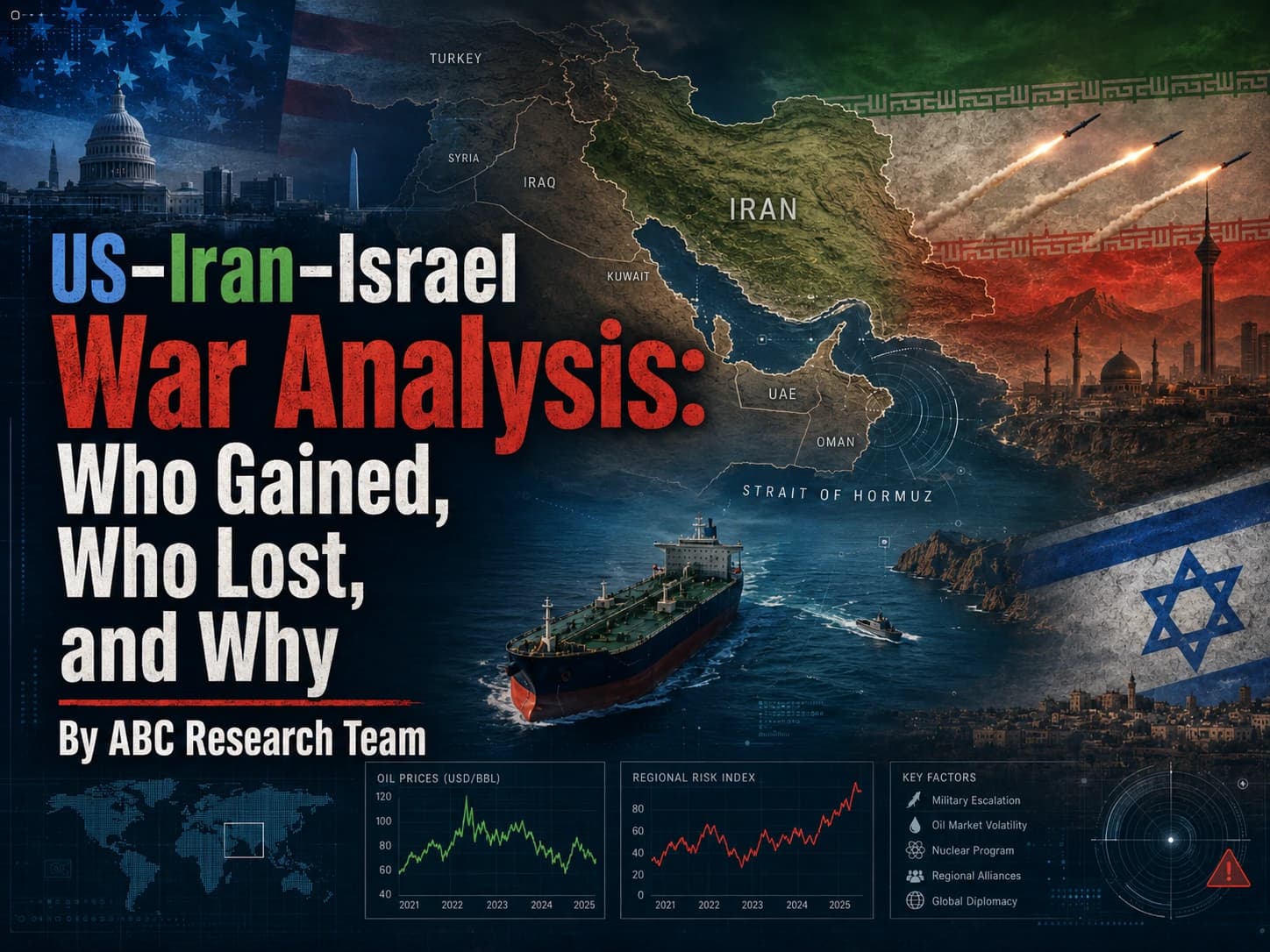
New Delhi (ABC Live): The US–Iran–Israel war produced a clear imbalance in physical destruction but no equally clear political winner. The United States and Israel demonstrated overwhelming advantages in intelligence, air power, surveillance and long-range precision strikes. Iran suffered extensive damage to its military infrastructure, air-defence systems, missile capacity, naval assets and civilian economy. Nevertheless, the Iranian state survived, Tehran remained part of the diplomatic process, and the future of its nuclear programme remained unsettled.
Therefore, the war cannot be judged only by counting damaged facilities or missiles fired. A state wins strategically when military force delivers the political result for which it entered the conflict. Washington and Israel weakened Iran substantially, but they did not remove it from the regional balance or secure an unconditional settlement. Iran lost the conventional military confrontation, yet it retained enough disruptive power to prevent its defeat from becoming political capitulation.
The conflict also changed the wider region. Gulf states discovered that American military protection could not remove their economic and infrastructure vulnerability. Meanwhile, Pakistan and Qatar gained importance as intermediaries. China benefited from the diversion of American attention, although the disruption of Gulf energy supplies also threatened Chinese economic interests.
Key Findings
| Actor | Principal gain | Principal loss | Overall result |
|---|---|---|---|
| United States | Military dominance | No complete political settlement | Tactical winner |
| Iran | State survival | Severe national damage | Political survivor |
| Israel | Iran weakened | Threat not eliminated | Partial winner |
| Gulf states | Greater diplomatic role | Energy and security exposure | Net short-term loss |
| China | US distraction | Energy vulnerability | Mixed outcome |
| Global economy | No clear gain | Historic energy disruption | Major loser |
Why ABC Live Is Publishing This Report Now
The movement from large-scale military operations towards a fragile settlement has encouraged all sides to declare success. Washington and Israel highlight the damage inflicted on Iran. Tehran, however, points to the survival of the state, continued nuclear negotiations and the inclusion of Hormuz in the diplomatic bargain.
Earlier ABC Live reporting examined the objectives behind Trump’s claimed strategic scope of the US–Israel–Iran war. ABC Live also explained how Iran’s active-deterrence strategy relied on missiles, drones, regional networks and economic disruption rather than conventional equality.
Those earlier assessments now allow a more precise test. The central question is not which side destroyed more. Instead, it is whether the stronger military coalition imposed the political and regional order it originally sought.
Military Victory, Strategic Victory and Political Victory
The war must be assessed at three distinct levels. At the tactical level, the United States and Israel clearly prevailed. Their forces penetrated Iranian airspace, attacked military-support infrastructure and exposed major weaknesses in Iran’s air defence and command protection.
However, tactical success does not automatically create strategic victory. Iran retained its government, a degree of retaliatory capacity and the scientific knowledge required to rebuild parts of its military and nuclear infrastructure. Moreover, Tehran remained essential to any arrangement involving Hormuz, sanctions, nuclear inspections and regional armed groups.
Political victory requires the stronger side to determine the terms on which the war ends. That did not occur completely. Instead, the conflict moved towards reciprocal bargaining in which Iran offered restraint and maritime access while Washington considered sanctions, oil exports and a negotiated nuclear framework.
The United States Gained Military Dominance
The United States confirmed that it remained the strongest external military power in the Middle East. Its aircraft, naval platforms, satellites, intelligence networks and precision weapons allowed it to attack critical targets across Iran. Furthermore, American forces could support Israel while defending bases, shipping routes and allied territory.
This capability produced real strategic effects. Iran lost military infrastructure and had to disperse or conceal surviving systems. Consequently, Tehran faced a weaker conventional position and a much larger reconstruction burden.
American pressure also accelerated negotiations. Iran had strong reasons to seek relief from continued attacks, economic isolation and maritime disruption. Therefore, the campaign cannot be dismissed as militarily ineffective.
The United States Failed to Secure Complete Compellence
However, Washington did not obtain complete political obedience. Iran’s governing system did not collapse, while demands concerning ballistic missiles, regional networks and nuclear capabilities remained under negotiation. Moreover, the United States could not restore commercial confidence in Hormuz simply by placing more naval power around the waterway.
This outcome exposed what may be called America’s conversion problem. The United States could convert weapons, intelligence and money into destroyed targets. However, it could not automatically convert destroyed targets into a stable and self-sustaining political order.
ABC Live previously examined this divergence in Why Israel and the US See the Iran War Differently. Washington had to consider energy markets, regional bases, China and the costs of a prolonged conflict. Israel, by contrast, remained more focused on the permanent degradation of Iran.
The War Also Created an American Sustainability Problem
A prolonged high-intensity campaign imposes costs that extend far beyond the immediate financial bill. Long-range missiles, air-defence interceptors, aircraft flying hours and naval deployments all draw on finite inventories and maintenance capacity. Therefore, each additional phase of the Iran conflict carried an opportunity cost for other theatres.
That question matters because the United States considers China its principal long-term strategic competitor. American planners have sought to reduce the military burden of the Middle East so that more advanced systems can support the Indo-Pacific. However, the Iran war pulled ships, aircraft, interceptors and political attention back towards the Gulf.
Therefore, a short campaign that constrains Iran may support Washington’s China strategy. In contrast, a recurring war would weaken it. China benefits whenever Iran forces the United States to consume resources that might otherwise support deterrence in the Pacific.
Iran Suffered the Greatest Material Losses
Iran was the conflict’s largest physical loser. United Nations reporting documented extensive damage to homes, hospitals, emergency facilities, medical infrastructure and other civilian assets. Moreover, the attacks damaged military and economic systems that Iran will require years and substantial capital to rebuild.
These losses create long-term opportunity costs. Money spent rebuilding missile facilities, air defences and damaged infrastructure cannot simultaneously support employment, healthcare, public services and economic development. Therefore, the war may continue to affect Iranian society long after the principal combat phase ends.
Iran’s defensive weakness also became visible. Tehran could not reliably protect every high-value military or civilian installation against coordinated US-Israeli operations. Consequently, Iran cannot credibly present the war as a conventional military victory.
Iran Prevented Military Defeat From Becoming Political Surrender
Nevertheless, Iran achieved its minimum strategic objective. The state survived, the government continued functioning, and Tehran remained a recognised party to the settlement. This survival prevented Washington and Israel from determining Iran’s future without Iranian participation.
Iran’s strategy did not require conventional parity. Instead, Tehran sought to make a complete American or Israeli victory too expensive and economically disruptive. It expanded the conflict’s consequences through missiles, drones, regional pressure and threats to energy flows.
Therefore, Iran’s achievement was narrower than victory but more important than mere survival. It prevented the stronger coalition from transforming overwhelming military superiority into unconditional political mastery.
Hormuz Was Iran’s Most Powerful Strategic Instrument
The Strait of Hormuz became Iran’s strongest source of leverage. In 2024, about 20 million barrels of oil per day moved through the waterway, equal to roughly one-fifth of global petroleum-liquids consumption. In addition, approximately one-fifth of global liquefied natural gas trade passed through the same chokepoint.
Iran did not need to defeat the US Navy to affect these flows. It only needed to create enough danger and uncertainty to influence tanker operators, insurers and crews. Consequently, military access and commercially safe navigation became two different questions.
ABC Live explained this distinction in Why and How Iran Is Using Hormuz as a Weapon. Even selective disruption could increase freight costs, insurance premiums and energy prices. Therefore, Iran converted geography into bargaining power after losing much of its conventional military freedom.
Hormuz Created Disruption Control, Not Complete Control
Iran did not acquire uncontested legal or military control of the Strait. American and allied forces continued to operate in the region, while some commercial vessels continued moving. Therefore, it would be inaccurate to describe Hormuz as entirely controlled by Tehran.
However, Iran achieved a narrower form of disruption control. It demonstrated that it could slow traffic, raise commercial risk and make normal shipping dependent on de-escalation. This distinction explains why the reopening of Hormuz became central to negotiations.
The wider geopolitical impact was examined in ABC Live’s analysis of the Strait of Hormuz blockades. The crisis connected the Iran war to Asian energy dependence, Gulf security and the global distribution of maritime power.
The Energy Data Internationalised the War
The Hormuz crisis affected countries far beyond the battlefield. China, India, Japan and South Korea received most of the crude oil and condensate transported through the Strait. Meanwhile, China, India and South Korea were also the largest destinations for Hormuz liquefied natural gas.
The International Energy Agency described the disruption as the largest supply interruption in the history of the global oil market. Furthermore, the effective closure of the Strait removed close to one-fifth of global liquefied natural gas supply from the market.
Therefore, Iran succeeded in transferring part of the war’s economic cost to Asian importers, global shipping companies and energy consumers. These countries did not need to support Tehran politically to demand de-escalation. Their own economic interests created pressure for an agreement.
Israel Gained Time but Not Permanent Security
Israel achieved important military objectives. It weakened Iranian systems that supported missile operations, air defence and strategic infrastructure. In addition, Israel demonstrated an ability to conduct deep operations against a much larger state with American support.
However, Israel’s strategic objective extended beyond temporary degradation. It wanted to ensure that Iran could not rebuild nuclear, missile or regional capabilities capable of threatening Israel. That outcome has not yet been secured.
Iran retained nuclear knowledge, state institutions and political relationships across the region. Moreover, a US-backed agreement may eventually limit Israel’s freedom to launch new attacks if Washington believes those operations threaten energy stability and diplomacy.
Therefore, Israel gained strategic time rather than permanent security. It weakened Iran, but it did not remove the Iranian challenge from the regional system.
Gulf States Became Frontline Stakeholders
The Gulf states did not control the decisions that started the war, yet they carried a large part of its economic and security risk. Their ports, oil facilities, gas exports and shipping routes became exposed. Moreover, states hosting American bases faced the possibility of Iranian retaliation.
This experience revealed the limits of the previous Gulf security model. American forces provided warning, interception and deterrence, but they could not guarantee uninterrupted commercial activity. In addition, hosting those forces could turn a country into a target.
ABC Live’s report on how the Hormuz crisis is rewriting the new world order examined this transformation. Gulf governments may now combine American protection with direct engagement, regional crisis-management mechanisms and economic incentives for Iran.
Pakistan and Qatar Gained Diplomatic Influence
Pakistan and Qatar gained process power because Washington and Tehran needed credible intermediaries. Their value arose from access, communication and the ability to frame politically acceptable compromises. Therefore, their influence did not depend on possessing overwhelming military or economic power.
However, mediation also carries limits. Intermediaries can help prevent misunderstandings, but they cannot force the principal combatants to honour agreements. Their influence remains strongest while direct US-Iran relations remain fragile.
Even so, both countries emerged as important diplomatic actors. Their role demonstrated that access and credibility can create strategic influence even for states that are not principal combatants.
China Was a Conditional Beneficiary
China benefited from American military distraction. A long Gulf conflict can consume US missiles, naval availability, aircraft hours and political attention. Therefore, Beijing gains indirectly whenever Washington must maintain a large military commitment outside the Indo-Pacific.
However, China also depends heavily on energy moving through Hormuz. Consequently, a prolonged maritime crisis damages Chinese industry and increases transport and energy costs. Beijing benefits from American distraction but not from indefinite Gulf disruption.
China’s preferred outcome is therefore likely an Iran that survives, contests US influence and remains economically close to Beijing, while Hormuz stays open. The China dimension reinforces the report’s central conclusion: the conflict created different winners at different levels rather than one overall victor.
The Nuclear Outcome Remains the Decisive Test
The nuclear question remains unresolved. Military attacks can destroy buildings, centrifuges and supporting infrastructure, but they cannot erase technical knowledge. Therefore, physical destruction can delay a programme without permanently ending it.
A credible final agreement must address enriched material, enrichment levels, centrifuge capacity, inspection rights and rebuilding restrictions. It must also establish consequences for violations. Until these terms become clear, neither Washington nor Tehran can claim final nuclear success.
If Iran accepts strict and enforceable restrictions, the United States may eventually secure its principal strategic objective. However, if Tehran retains meaningful enrichment capacity while obtaining sanctions relief and investment, Iran may argue that it survived without surrendering its core position.
Who Actually Changed Whose Behaviour?
The United States changed Iranian behaviour by imposing military and economic costs that accelerated negotiations. Iran changed American behaviour by making continued war expensive and threatening regional energy stability. Israel changed Iran’s military capabilities, while Washington may eventually limit Israeli operations to protect a negotiated settlement.
Iran also changed Gulf behaviour. Regional states that previously relied mainly on American containment increasingly had reasons to maintain direct communication with Tehran. Therefore, no actor achieved one-way compellence.
The conflict ended its principal phase because all sides changed part of their behaviour. This was an enforced bargain rather than a decisive victory.
Final Assessment
The United States and Israel won the conventional military confrontation. Iran suffered the greatest physical, economic and human losses. Therefore, Iran cannot be described as the overall winner.
However, Washington and Israel did not obtain unconditional political control. Iran’s government survived, the nuclear issue remained unsettled and Tehran’s cooperation remained necessary for restoring energy flows and regional stability.
The most accurate conclusion is that the United States achieved military supremacy without complete political mastery. Iran suffered military defeat without political capitulation. Israel gained time without permanent security, while Gulf states lost confidence in the previous regional order.
The war weakened Iran’s manufactured power, including its missiles, radars and military facilities. Nevertheless, it could not remove Iran’s structural power, which comes from geography, energy routes and its ability to obstruct regional stability.
Related ABC Live Reports
For further context, readers may consult ABC Live’s reports on Iran’s active-deterrence strategy, the objectives of the US–Israel campaign, differences between Israel and the United States, the two-week US-Iran ceasefire and the wider risk of global escalation.
ABC Live — Making Complex Public Issues Simple.