

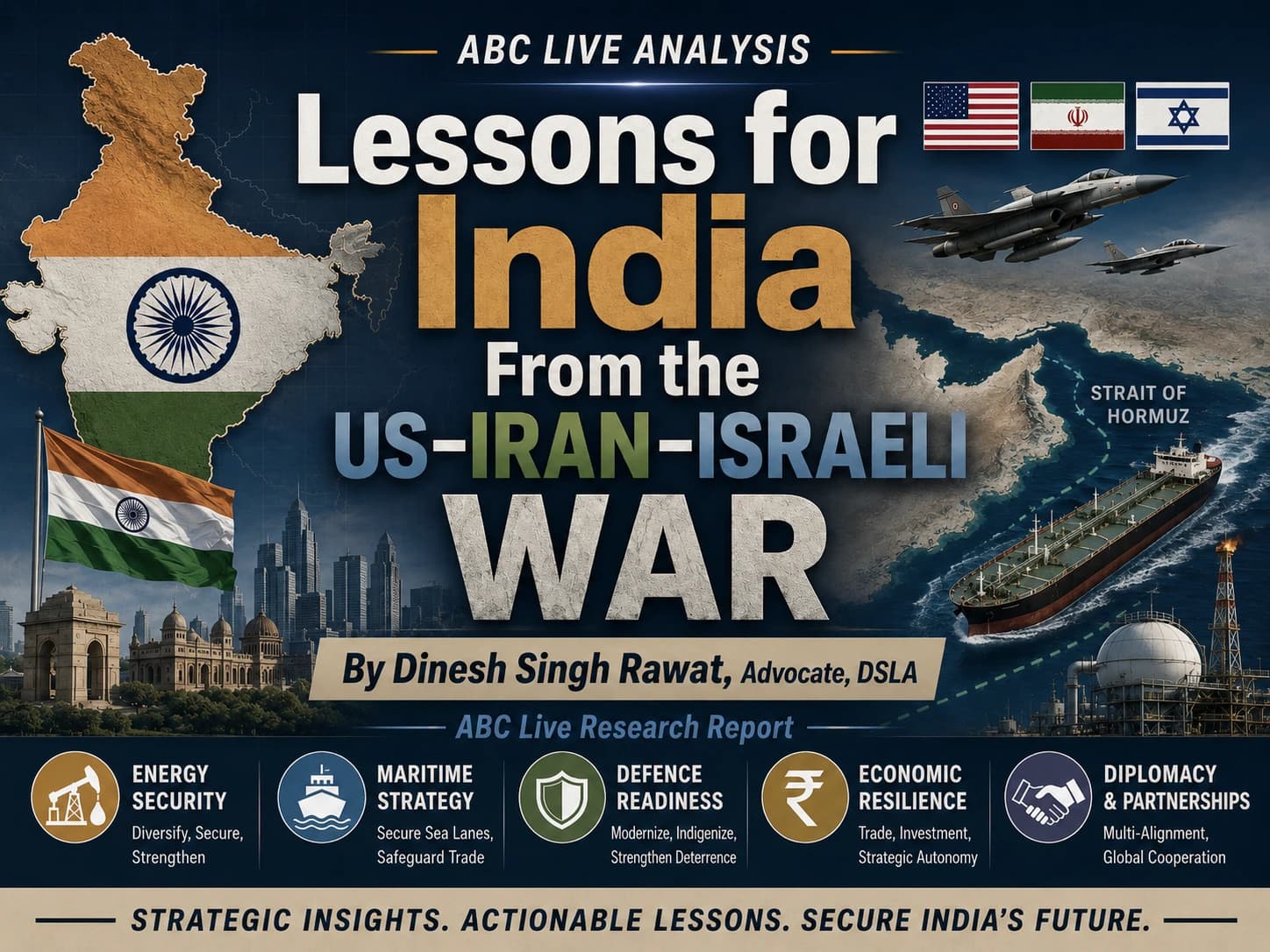
New Delhi (ABC Live): The US–Iran–Israel war offers India lessons that extend far beyond West Asia. The conflict demonstrated that modern war can disrupt oil, gas, shipping, insurance, supply chains and financial payments even when the affected state is not directly involved in combat. Therefore, India must view Gulf instability as a national security issue rather than merely a foreign policy concern.
India remains deeply connected to Gulf energy routes and hosts major economic relationships with regional states. Millions of Indian citizens also live and work in Gulf countries. Consequently, conflict in the region can affect India through energy prices, inflation, remittances, shipping, and citizen safety.
The war also showed that advanced militaries can consume weapons and interceptors faster than industry can replace them. India must therefore assess how long its forces can sustain high-intensity operations without foreign resupply. Strategic autonomy will remain incomplete unless India can secure energy supplies, produce critical defence components, and protect maritime trade during a prolonged crisis.
Key Lessons
| Area | Present vulnerability | Required response |
|---|---|---|
| Energy | High import exposure | Larger and diverse reserves |
| Shipping | Dependence on foreign carriers | Expand Indian-controlled fleet |
| Defence | Imported critical components | Build supply-chain sovereignty |
| Ammunition | Rapid wartime consumption | Expand stocks and production |
| Gulf diaspora | Millions exposed | Permanent crisis system |
| China-Pakistan | Connected pressure | Multi-theatre planning |
| Diplomacy | Competing partnerships | Preserve strategic autonomy |
Why ABC Live Is Publishing This Report Now
India cannot treat the Iran conflict as a distant regional war. Hormuz carried around 20 million barrels of oil per day in 2024 and about one-fifth of global liquefied natural gas trade. Asian markets received most of these supplies, which makes India particularly exposed to price and availability shocks.
ABC Live previously examined this vulnerability in Why and How Iran Is Using Hormuz as a Weapon. The report showed how disruption can affect Indian inflation, LPG availability, LNG prices and maritime insurance.
Meanwhile, India’s Energy Reality 2026 examined the structural challenge created by rising consumption and import dependence. Together, these reports show why the war in Iran should serve as a practical stress test for India’s national resilience.
Energy Security Must Become Defence Planning
India’s first lesson concerns the connection between energy and military security. A country cannot sustain its armed forces, transport system, industries and food supply without reliable energy. Therefore, oil and gas disruption can weaken national power even without an attack on Indian territory.
A major Gulf crisis can increase transport costs, fertiliser prices, electricity expenses and the government’s subsidy burden. It can also widen the trade deficit and place pressure on the rupee. Consequently, energy planning must become part of national security and war-gaming exercises.
ABC Live’s report on India’s energy future from 2025 to 2070 argued that India must balance affordability, reliability, domestic production, renewable energy and geopolitical risk. The Iran war reinforces that conclusion.
India Needs Larger and More Diverse Energy Reserves
Indian Strategic Petroleum Reserves Limited operates roughly five million metric tonnes of strategic crude-oil storage at Visakhapatnam, Mangalore and Padur. Padur alone has a capacity of 2.5 million metric tonnes, while Visakhapatnam holds 1.33 million metric tonnes.
These reserves provide an important emergency cushion. However, a prolonged closure of Hormuz could outlast that cushion, especially if commercial stocks fall or shipping recovery remains slow. Therefore, India should combine government reserves with mandatory commercial stocks and refinery-level inventories.
Moreover, crude oil cannot be the only focus. India also requires emergency planning for liquefied petroleum gas, liquefied natural gas, diesel, aviation fuel and essential refinery feedstocks. A country may possess crude reserves yet still face household or transport shortages if its terminals and distribution networks fail.
Supplier Diversification Is Not Route Diversification
India has expanded the range of countries from which it purchases oil. Nevertheless, several suppliers may still rely on the same maritime passage. Therefore, purchasing from many Gulf producers does not remove dependence on Hormuz.
India should diversify its supply routes by strengthening relationships with Russia, Africa, Latin America, the United States, and other producers outside the Gulf. However, this diversification should include shipping companies, ports, insurers, currencies and payment mechanisms.
The central principle is that ten suppliers who use a single vulnerable waterway do not create ten independent supply systems. Genuine energy security requires several complete logistics chains.
India Needs Greater Control Over Strategic Shipping
The war demonstrated that an energy contract does not guarantee delivery. Shipowners may avoid dangerous routes, insurers may withdraw cover and crews may refuse high-risk voyages. Therefore, essential cargoes may remain unavailable even when a supplier is willing to sell.
India needs a larger Indian-controlled tanker fleet, government-supported war-risk insurance and stronger coordination between commercial operators and the Indian Navy. Such capability would reduce dependence on decisions taken by foreign shipping companies during a crisis.
However, this expansion requires long-term policy support. India must address taxation, financing, port charges, crewing, and insurance costs if Indian-flagged vessels are to compete effectively in peace and remain available in war.
The Indian Navy Must Protect Economic Flows
The Navy’s future role must extend beyond conventional combat. During a Gulf crisis, it may need to escort tankers and rescue crews, conduct maritime surveillance, clear mines, and support civilian evacuation. Therefore, protecting trade may become as important as defeating an opposing fleet.
India should expand its mine-countermeasure capability because mines can disrupt shipping long after active fighting ends. It also needs maritime patrol aircraft, unmanned surveillance systems, helicopters, replenishment ships and secure communication with merchant vessels.
ABC Live’s analysis of the geopolitics behind the Hormuz blockades showed that maritime chokepoints now sit at the centre of energy security and great-power rivalry. Consequently, India’s maritime strategy must protect both military freedom and economic continuity.
Ammunition Endurance May Decide Future Wars
The Iran war showed that modern operations can consume precision weapons and air-defence interceptors rapidly. India must therefore calculate the duration for which its forces can sustain high-intensity combat rather than merely count the platforms available on the first day.
A serious conflict could require sustained supplies of artillery ammunition, drones, air-defence missiles, anti-ship weapons, precision-guided munitions, aircraft spares and fuel. Moreover, foreign suppliers may prioritise their own armed forces once a wider crisis begins.
India should therefore conduct realistic consumption assessments for 30-, 60-, 90-, and 180-day war scenarios. These exercises must include the capacity of factories, transport networks, storage depots and private suppliers to continue operating under attack.
Defence Production Has Grown Substantially
India’s annual defence production reached a record ?1.78 lakh crore in the financial year 2025–26. This represented a 15.6% increase over the previous year and more than double the output recorded in 2020–21. Defence exports also reached a record ?38,424 crore.
Moreover, the private sector contributed about 24% of total defence output, or roughly ?42,000 crore. This indicates that India’s defence-industrial base is becoming broader and more capable.
However, annual production value alone does not measure wartime endurance. India must determine whether domestic industry can quickly replace the specific missiles, seekers, sensors, engines and electronic systems consumed during combat.
Self-Reliance Must Extend Below Final Assembly
A platform assembled in India may still depend on imported propulsion systems, radar modules, semiconductors, seekers, specialised alloys, or optical systems. These hidden dependencies can stop an entire production line during war.
Therefore, the next phase of self-reliance must focus on components, raw materials and manufacturing tools. India should identify every imported item whose absence could turn off a strategic weapons programme.
ABC Live’s report on India’s electronics manufacturing and mineral security explained why rare earths, copper and critical minerals now sit at the centre of national security. Similarly, India’s need for critical-mineral recycling shows how domestic recovery systems can reduce exposure to foreign processing.
India Needs Layered and Affordable Air Defence
The war demonstrated the difficulty of defending against simultaneous attacks involving drones, cruise missiles, ballistic missiles and decoys. India faces a similar threat environment because China and Pakistan both possess diverse missile and drone systems.
India must therefore protect military bases, ports, nuclear installations, refineries, power stations, communication networks and major cities. However, using an expensive interceptor against every cheap drone would be economically unsustainable.
A layered network should combine electronic warfare, anti-drone guns, short-range missiles, medium-range systems, and ballistic missile defence. Each threat should be met with the least expensive system capable of reliably defeating it.
Dispersal and Counter-Intelligence Are Battlefield Requirements
Iran’s experience showed that expensive weapons remain vulnerable when their locations, communication systems or supporting networks are compromised. Therefore, India must invest in hardened shelters, mobile launch systems, alternate command centres, dispersed depots and emergency runways.
At the same time, counter-intelligence must cover personnel, contractors, software networks and private suppliers. Future attacks may depend on cyber access, commercial data, compromised insiders and satellite surveillance long before the first missile is fired.
Therefore, strategic installations must be protected through both physical defence and secure information systems. Survivability must be designed into the entire military and industrial network.
India Must Prepare for Connected China-Pakistan Pressure
India could face a crisis with Pakistan while China increases military pressure along the Line of Actual Control, in the Indian Ocean or through cyber operations. These states do not need to launch a perfectly coordinated joint war. They only need to create simultaneous demands on India’s limited high-value systems.
Therefore, India cannot build a force designed solely for a single short land conflict. It needs the capacity to simultaneously protect its northern frontier, western front, maritime trade routes, and strategic infrastructure.
ABC Live’s report on the US strategy and India’s strategic future examined how China-focused American policy affects India’s supply chains and Indo-Pacific position. The war in Iran shows that India must maintain its own multi-theatre capacity rather than assume that foreign partners will remain fully available.
India Must Study What China Learns From the War
China will study how Iranian air defences were suppressed, how command systems were targeted and how drones exhausted expensive interceptors. It will also examine how maritime and economic disruption shaped negotiations.
India should assume that Beijing may apply these lessons to Indian air bases, border infrastructure, ports, satellites and command networks. Consequently, India must deny China confidence in a rapid, disabling first strike.
This requires mobile systems, redundant communications, dispersed bases and large reserves. Offensive capability matters, but the ability to survive the opening phase may determine whether deterrence remains credible.
India Should Not Choose Between Israel and Iran
India has important defence, intelligence, agricultural and technological ties with Israel. Meanwhile, Iran remains important because of its role in Gulf stability, Afghanistan, Central Asia, energy routes, and Chabahar.
Therefore, India should not treat the relationship as a binary choice. It should maintain cooperation with Israel while preserving diplomatic and economic channels with Tehran. Moreover, India can oppose nuclear proliferation without supporting an open-ended regime-change war.
Strategic autonomy requires issue-based decisions. India must work with multiple partners while refusing to let any one relationship determine its other national interests.
Chabahar Must Remain Strategic Insurance
Chabahar gives India access towards Afghanistan and Central Asia without passing through Pakistan. It also provides India with a strategic presence in a region where China is expanding infrastructure and investment.
ABC Live’s report on how India can use Chabahar after the Iran war argued that the port now matters for Gulf diplomacy, sanctions management, connectivity and strategic autonomy.
India should therefore protect Chabahar through long-term legal arrangements, insurance mechanisms and diplomatic engagement. If India retreats completely, China and Pakistan may gain greater influence over routes connecting the Gulf, Central Asia and the Indian Ocean.
Sanctions Resilience Is Part of Strategic Autonomy
Modern economic warfare can interrupt trade without destroying ships or ports. Sanctions can affect banks, insurance, currency settlement, technology and access to international markets.
India should therefore maintain lawful fallback systems involving local-currency settlement, sovereign insurance, alternative payment channels and negotiated exemptions. These mechanisms cannot completely replace the global financial system, but they can protect essential trade during political crises.
Strategic autonomy does not automatically mean opposing Western systems. It means retaining enough alternatives to avoid losing freedom of decision when external pressure increases.
Gulf Diaspora Protection Needs Permanent Planning
Official Indian data show that Saudi Arabia hosted about 27.48 lakh Indian citizens as of March 2026. Kuwait hosted roughly 10.60 lakh, while the United Arab Emirates also has one of the world’s largest Indian communities.
Therefore, a region-wide war could create a crisis involving several million Indian citizens. Complete evacuation may not be possible, so India must plan for shelter, food, communication, medical support, wage protection, and transport.
A permanent Gulf crisis mechanism should maintain updated citizen registration, emergency assembly points and agreements with airlines and shipping companies. State governments with large Gulf-linked populations should also participate in these plans.
Remittance and Employment Shocks Also Matter
A Gulf war can damage India even when Indian territory remains untouched. Workers may lose jobs, remittances may decline, and large numbers of citizens may return unexpectedly.
India should therefore prepare emergency welfare funds, employment programmes, and skill recognition systems for returning workers. Such planning is particularly important for states whose local economies depend heavily on Gulf incomes.
Human security and macroeconomic stability are closely linked. A sudden decline in remittances can affect housing, education, healthcare, and consumer demand across entire regions of India.
Civil Defence Must Return to National Planning
Modern war can target airports, ports, power grids, refineries, water systems and data centres. Therefore, military preparedness must be supported by civilian resilience.
India needs stronger warning systems, backup power, emergency medical response, secure communications, and continuity-of-government plans. These systems should undergo regular exercises rather than remain only on paper.
A military may remain capable of fighting while society loses essential services. Therefore, national resilience requires that government, infrastructure, and communities continue to function under pressure.
India Should Not Romanticise Iran’s Survival
Iran demonstrated that a weaker state can survive by imposing economic and regional costs. However, it also suffered major damage to civilian, military, and infrastructure assets.
India should not adopt survival after devastation as its model. Instead, it must prevent an adversary from believing that devastation can achieve useful political results. This requires denial, punishment and resilience at the same time.
Denial reduces the success of an attack. Punishment raises the cost to the aggressor. Resilience ensures that India continues functioning when some attacks inevitably succeed.
India Must Define Political Objectives Before Using Force
The United States and Israel destroyed many targets, yet the political outcome remained incomplete. Therefore, India must clearly define the purpose of any future military action.
Decision-makers should identify whether the objective is deterrence, punishment, territorial defence or long-term political change. They must also decide what settlement would be acceptable and how escalation would end.
Without clear political objectives, tactical victories can produce strategic exhaustion. Military operations should always serve a defined political result rather than become an end in themselves.
India’s Priority Action Plan
India should first expand strategic and commercial energy reserves, especially for LPG, LNG and petroleum products. It should also secure alternative suppliers and routes that do not depend on the Strait of Hormuz.
Second, India should audit ammunition, interceptor, and spare-parts stocks against realistic high-intensity consumption rates. Defence production must develop surge capacity and reduce dependence on imported critical components.
Third, India should strengthen the Indian-controlled tanker fleet, mine countermeasures capability, layered air defence, counterintelligence, and civil defence. Finally, it should protect Chabahar and preserve balanced relations with Israel, Iran, Gulf states and the United States.
Conclusion
The US–Iran–Israel war demonstrates that national security rests on an interconnected system. Weapons matter, but so do oil reserves, tankers, insurers, factories, payment networks and diplomatic relationships.
India has made measurable progress in defence manufacturing. However, annual production figures now need to support wartime endurance, component security, and larger ammunition stocks.
India must also recognise that Hormuz remains a structural vulnerability. Therefore, the country should not depend on a single supplier, a single maritime route, a single source of weapons, or on the assumption that the next war will remain short.
The deepest lesson is that India must become difficult to attack, difficult to blockade, difficult to pressure and difficult to isolate diplomatically and economically.
Related ABC Live Reports
Readers may also consult ABC Live’s reports on India’s Energy Reality 2026, India’s long-term energy security, the strategic use of Hormuz, Chabahar after the Iran war, India’s mineral security and the US strategy’s implications for India.
ABC Live — Making Complex Public Issues Simple.