

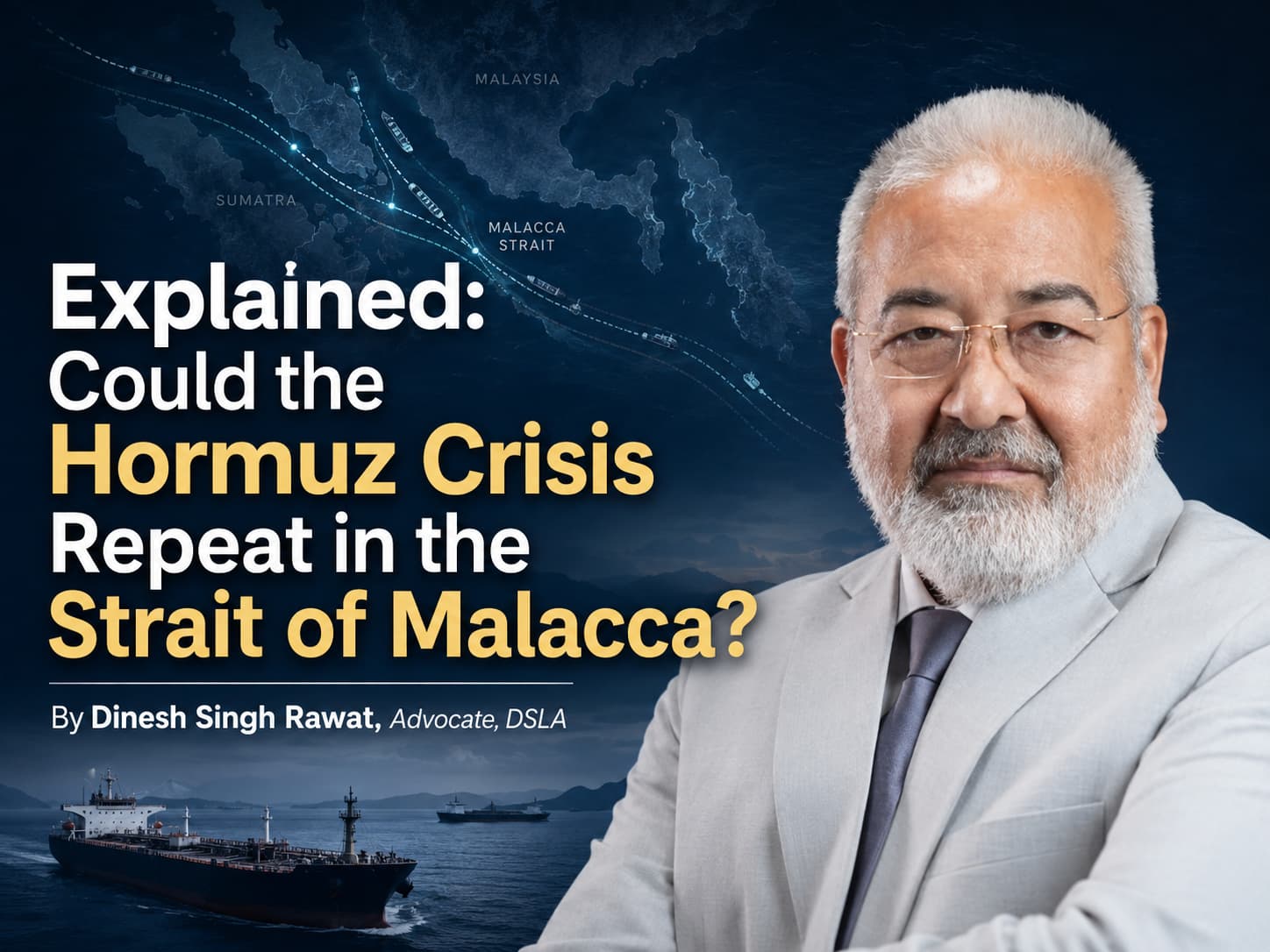
New Delhi (ABC Live): A Hormuz-style crisis could disrupt the Strait of Malacca. However, Malacca would not become an exact copy of Hormuz.
First, both straits carry enormous energy flows. Moreover, mines, attacks and military warnings could reduce commercial traffic through either route.
Second, insurers and shipping companies may react before governments announce a formal closure. Therefore, Malacca could become commercially unsafe even while some vessels continued to pass.
However, Malacca has several alternative routes. In addition, Indonesia, Malaysia and Singapore have powerful reasons to keep the waterway open.
Meanwhile, international law protects the right of transit passage through straits used for international navigation. Consequently, a permanent, airtight closure would remain difficult to achieve.
Therefore, the most realistic danger is a temporary but severe slowdown. For example, a mine incident, a cyberattack, a vessel strike, or a wider China-related conflict could sharply reduce traffic.
Key Points
- First, Malacca carries more petroleum and other liquids than Hormuz.
- However, Malacca has more bypass routes.
- Moreover, mines could delay shipping without sealing the entire strait.
- In addition, insurance fears could reduce traffic before a formal blockade.
- Meanwhile, cyberattacks could disrupt ports while sea lanes remained open.
- Nevertheless, rerouting would add distance, costs and congestion.
- Therefore, China would suffer, but other Asian economies would also face losses.
- Likewise, India could monitor Malacca’s western approaches.
- However, India could not independently control the strait.
- Finally, international law protects transit passage through Malacca.
Why ABC Live Is Publishing This Report Now
The 2026 Strait of Hormuz crisis changed the global debate about maritime chokepoints. In particular, it showed that a waterway can remain legally open while becoming commercially unsafe.
Moreover, mine attacks, vessel attacks, and security warnings can quickly affect shipping confidence. Consequently, commercial traffic may decline before naval forces physically block a route.
In addition, shipping may not return immediately after political tensions ease. After all, insurers, crews and shipowners still require credible security guarantees.
Therefore, military control alone does not decide whether trade continues. Instead, insurance, port access, crew confidence and commercial risk also shape the outcome.
For broader context, ABC Live previously explained why and how Iran used the Strait of Hormuz as a strategic weapon.
Moreover, ABC Live examined the geopolitics behind the Strait of Hormuz blockades.
Meanwhile, the Strait of Malacca deserves similar attention. After all, it carries even more petroleum and other liquids than the Strait of Hormuz.
In addition, Malacca carries containers, manufactured goods, food and raw materials. Consequently, a crisis there could affect the whole Asian economy rather than only the energy market.
China depends heavily on the route. However, Japan, South Korea, Singapore, India and Southeast Asia also depend on the same maritime system.
Therefore, a Malacca crisis could become an Asia-wide economic emergency.
What Does a Hormuz-Style Crisis Mean?
A Hormuz-style crisis does not always require a navy to physically close a waterway. Instead, several smaller threats can combine and create an effective commercial closure.
For example, the pressure may include:
- naval mines;
- attacks on selected vessels;
- missiles and drones;
- vessel seizures;
- military warnings;
- insurance restrictions;
- crew refusal;
- port closures;
- cyberattacks;
- uncertain security guarantees.
As a result, commercial ships may stop sailing even when a route remains physically passable. Therefore, economic closure can begin before military closure.
The central Hormuz lesson is simple:
A strategic sea route can close commercially before it closes militarily.
For example, one mine explosion may not block an entire strait. However, it may still force insurers, crews and shipowners to suspend voyages.
Likewise, naval escorts may protect selected vessels. Nevertheless, escorts may not restore normal commercial confidence.
Moreover, shipping companies may fear another attack even after authorities declare a route safe. Consequently, normal traffic may return slowly.
ABC Live previously examined this vulnerability in How Long Can Oil Stockpiles Hold if Hormuz Closes?.
Therefore, the Hormuz experience offers useful lessons for Malacca. However, the two waterways differ in geography, law and regional politics.
Why the Strait of Malacca Matters
The Strait of Malacca links the Indian Ocean with the South China Sea and the wider Pacific Ocean. Moreover, the main route runs between Indonesia, Malaysia and Singapore.
Therefore, the strait connects energy suppliers in the Middle East and Africa with major East Asian economies. In addition, it carries goods moving between Europe and Asia.
According to the United States Energy Information Administration’s global oil chokepoint assessment, Malacca carried 23.2 million barrels per day of petroleum and other liquids during the first half of 2025.
Petroleum Flow Through Major Straits
| Strait | Daily flow Maritime | e share |
|---|---|---|
| Malacca | 23.2m barrels | 29% |
| Hormuz | 20.9m barrels | About 26% |
Source: United States Energy Information Administration. Figures cover petroleum and other liquids during the first half of 2025.
Therefore, Malacca carried about 2.3 million barrels per day more than Hormuz. Consequently, it ranked as the largest oil-transit chokepoint by volume during that period.
However, these figures cover only petroleum and other liquids. In addition, Malacca handles a large volume of containers, coal, food and manufactured goods.
Therefore, its economic importance extends beyond oil. Moreover, any disruption would affect both energy markets and industrial supply chains.
ABC Live has already examined Malacca’s strategic importance in “Can the Kra Canal Break US Control of the Strait of Malacca?”
Hormuz and Malacca Compared
Hormuz and Malacca both concentrate enormous energy flows. However, their strategic vulnerabilities differ.
Structural Comparison
| Factor | Hormuz | Malacca |
| Main cargo | Oil and gas | Oil and goods |
| Bypass routes | Very limited | Several |
| Coastal setting | Iran and Oman | Three key states |
| Main impact | Energy shock | Economy-wide |
| China exposure | High | Very high |
| Closure risk | Higher | Lower |
First, Hormuz has very few practical alternatives. Therefore, even a partial disruption can quickly affect global energy prices.
The International Energy Agency’s Hormuz assessment explains that Saudi Arabia and the United Arab Emirates possess some bypass pipeline capacity. However, those pipelines cannot replace the full flow that normally passes through Hormuz.
By contrast, Malacca has several maritime alternatives. For example, ships can use the Sunda, Lombok or Makassar routes.
Nevertheless, those alternatives add distance, fuel use and cost. Therefore, rerouting reduces the effect of closure but does not remove the economic damage.
Consequently, Malacca may suffer Hormuz-style disruption without experiencing the same degree of physical isolation.
Could the Hormuz Pattern Repeat in Malacca?
Yes, some elements could repeat. However, an exact repetition remains unlikely.
First, mines could create fear and shipping delays. Moreover, insurers could sharply increase war-risk premiums.
Second, crew members could refuse dangerous voyages. In addition, shipping companies could reroute vessels before governments acted.
However, Malacca has several bypass routes. By contrast, Hormuz has very limited alternatives.
Moreover, three coastal states directly manage Malacca’s safety and navigation. Therefore, any crisis would require intense regional diplomacy.
What Could Repeat?
| Hormuz feature | Malacca risk |
| Mine threat | High impact |
| Insurance shock | Highly plausible |
| Crew refusal | Possible |
| Vessel attacks | Conflict-based |
| Naval escorts | Possible |
| Freight surge | Highly likely |
What Would Differ?
| Malacca feature | Main difference |
| Three coastal states | More diplomacy |
| Several bypass routes | Partial rerouting |
| Mixed cargo | Wider economic harm |
| Asian dependence | Shared losses |
| Transit rights | Legal protection |
| Wider sea area | Harder blockade |
Therefore, the most likely repetition would be commercial and psychological. By contrast, a long physical closure would remain much harder to achieve.
Possibility One: Naval Mines
Naval mines provide the clearest link between Hormuz and Malacca. After all, mines can create uncertainty without requiring a large naval force.
For example, a confirmed explosion could force authorities to stop traffic temporarily. Afterwards, naval forces would need to search for additional mines.
Moreover, commercial operators might not immediately accept official safety assurances. Consequently, shipping could remain slow even after naval clearance began.
Effects of a Mine Incident
| Mine effect | Commercial result |
| Unknown location | Large search area |
| Slow clearance | Shipping queues |
| Vessel damage | Insurance increase |
| Crew concern | Voyage refusal |
| False reports | Further delays |
Therefore, a limited-mine incident could trigger a much larger economic crisis. Moreover, false warnings could deepen the disruption.
However, mining Malacca would threaten neutral ships. In addition, it would directly endanger Indonesia, Malaysia and Singapore.
Consequently, any mining operation would trigger strong diplomatic and military responses. Moreover, the attacker might lose control over the political effects.
For example, a mine intended for one target could strike a neutral tanker. Therefore, the legal and reputational cost could exceed the military gain.
Possibility Two: Insurance-Led Slowdown
Insurance may become the fastest route to a Hormuz-style disruption. After all, commercial shipping depends on hull cover, cargo insurance, liability protection and war-risk policies.
After a major attack, insurers may raise premiums. Moreover, they may restrict normal coverage.
As a result, many companies may suspend voyages. However, governments may try to restore traffic through guarantees or compensation.
Insurance Pressure Chain
| Event | Likely response |
| Security alert | Risk review |
| Ship attack | Premium rise |
| Mine report | Cover limits |
| Crew objection | Voyage delay |
| State guarantee | Limited return |
However, insurance withdrawal would not stop every vessel. For example, state-owned ships or self-insured operators might continue.
Nevertheless, ordinary commercial traffic could fall sharply. Moreover, freight charges could rise even if the strait remained partly open.
Therefore, insurance can turn a small security event into a wider economic shock. Consequently, financial institutions become part of maritime strategy.
This possibility supports ABC Live’s broader analysis in “How China Is Preparing for US Sanctions Over Taiwan.”
Possibility Three: Selective Vessel Attacks
An attacker would not need to strike every ship. Instead, a few attacks on tankers or container vessels could create industry-wide fear.
Moreover, modern attacks may involve drones, mines or proxy actors. Therefore, the attacker’s identity may remain unclear during the first hours.
For example, governments may accuse one another before investigators confirm responsibility. Meanwhile, shipping companies may already begin rerouting.
Consequently, economic disruption may begin before political leaders agree on the facts. Moreover, early confusion could increase the risk of escalation.
Therefore, selective attacks could create a much larger effect than their physical damage alone would suggest.
Possibility Four: Cyberattacks on Ports
A Malacca crisis may begin on land rather than at sea. For example, cyberattacks could target ports, customs systems or vessel-tracking platforms.
In addition, attackers could disrupt cargo databases, fuel terminals or navigation warnings. Consequently, ships could face delays even while the sea lane remained physically open.
Singapore sits at the centre of one of the world’s most important port systems. Therefore, a serious digital attack could create regional congestion.
Cyber Disruption Dashboard
| Target | Possible result |
| Port systems | Cargo backlog |
| Vessel tracking | Navigation risk |
| Customs data | Clearance delays |
| Fuel terminals | Bunkering problems |
| Communications | Traffic confusion |
Therefore, a cyber crisis could resemble the Hormuz crisis in economic impact. However, the method would differ.
Moreover, a cyberattack could remain below the threshold of open war. Consequently, governments might struggle to choose between law enforcement, sanctions and military action.
For wider context, see ABC Live’s report on how the US–China rivalry is moving from trade to subsea cables.
Possibility Five: A China–US Conflict
The greatest danger would arise during a wider conflict involving China, Taiwan and the United States. After all, Malacca links China with major energy suppliers.
Therefore, some strategists may view the strait as a point of pressure on Chinese shipping. However, any blockade would also hurt other Asian economies.
Economies Exposed to Malacca
| Economy | Main exposure |
| China | Energy and trade |
| Japan | Imported energy |
| South Korea | Energy and industry |
| Singapore | Port and refining |
| India | East Asian trade |
| Southeast Asia | Regional supply chains |
Japan and South Korea are close US partners. Nevertheless, both rely heavily on imported energy.
Therefore, closing Malacca against China could also damage Washington’s allies. Moreover, Singapore would incur significant losses in port and refining operations.
Consequently, deliberate closure would carry major political costs. In addition, Southeast Asian states may oppose any attempt to turn the Strait of Malacca into a battlefield.
For the broader Taiwan context, see China–Taiwan Relations in a Fractured World Order.
How Likely Is Each Scenario?
The probability depends on the wider security environment. Therefore, no single forecast can cover every crisis.
Malacca Risk Assessment
| Scenario | Possibility | Impact |
| Major collision | Moderate | High |
| Port cyberattack | Moderate | High |
| Piracy surge | Limited | Medium |
| Isolated mine | Low | Very high |
| Wartime attack | Conflict-based | Extreme |
| Full blockade | Low | Extreme |
| Insurance slowdown | Plausible in war | High |
These are ABC Live analytical assessments, not official forecasts.
A peacetime military blockade remains unlikely. However, an insurance-led slowdown could occur quickly during a regional conflict.
Moreover, a collision or cyberattack may disrupt without any state planning a blockade. Therefore, regional governments must prepare for both deliberate and accidental crises.
Why Complete Repetition Is Unlikely
Malacca differs from Hormuz in several important ways. First, it has more alternative routes.
Second, three coastal states have direct responsibility in the area. Moreover, each state has strong economic reasons to restore traffic.
Third, the route serves many Asian economies. Consequently, a closure would create shared losses rather than isolate only one target.
Finally, international law protects transit passage. Therefore, a selective peacetime closure would raise serious legal questions.
Consequently, Malacca may face temporary disruption. However, a long and airtight closure would remain much more difficult.
Alternative Routes Around Malacca
Ships can bypass Malacca through the Indonesian archipelago. For example, they can use the Sunda, Lombok or Makassar routes.
However, these routes are not equal substitutes. Moreover, each option creates different problems with depth, distance, and capacity.
Alternative Routes
| Route | Main advantage | Main limit |
| Sunda | Shorter bypass | Depth limits |
| Lombok | Deep water | Longer route |
| Makassar | Large vessels | Added distance |
| Southern route | Avoids Malacca | High cost |
Larger tankers may prefer Lombok and Makassar. However, these routes require longer journeys.
Moreover, rerouting would increase fuel use and freight costs. Consequently, alternative routes could become congested.
Therefore, a disruption in Malacca would delay trade rather than stop it completely. Nevertheless, those delays could still damage factories that depend on timely deliveries.
Costs of Rerouting
Commercial Impact
| Cost area | Likely effect |
| Fuel | Higher use |
| Voyage time | Longer journey |
| Freight | Higher charges |
| Insurance | Wider cover |
| Ports | More congestion |
| Emissions | Greater output |
A shipowner would compare the cost of rerouting with the risk of using the Strait of Malacca. Therefore, different operators may choose different routes.
For example, some vessels may continue through the Strait of Malacca under state guarantees. Meanwhile, others may choose Lombok despite higher costs.
Consequently, traffic patterns could become unstable during the first phase of a crisis.
Could Malacca Be Completely Sealed?
A complete closure would require more than control of one passage. Moreover, a force would need to monitor alternative Indonesian routes.
In addition, it would need to identify ships serving China. However, that task would prove difficult.
After all, commercial ships often sail under neutral flags. Moreover, they may carry mixed cargo for several countries.
Blockade Requirements
| Requirement | Difficulty |
| Control Malacca | High |
| Watch Sunda | High |
| Watch Lombok | High |
| Identify China cargo | Very difficult |
| Stop neutral ships | Legally complex |
| Maintain operations | Resource-heavy |
Therefore, closing one strait would not immediately cut China off. Instead, a wider maritime operation would be required.
Moreover, such an operation would need large forces and broad political support. Consequently, a complete blockade would be difficult to maintain.
International Law and Transit Passage
The Strait of Malacca forms part of a route used for international navigation. Therefore, Part III of the United Nations Convention on the Law of the Sea applies to the general transit regime.
Under that framework, ships and aircraft generally enjoy transit passage. Moreover, coastal states must not impede lawful transit.
However, bordering states retain sovereignty and jurisdiction over their waters. Therefore, they may regulate safety, pollution and navigation within legal limits.
Legal Dashboard
| Legal issue | General position |
| Transit passage | Protected |
| Coastal sovereignty | Continues |
| Safety regulation | Permitted |
| Peacetime suspension | Not allowed |
| Selective closure | Legally disputed |
| Wartime blockade | Other laws apply |
Therefore, the coastal states cannot simply suspend normal transit passage during peacetime. Likewise, an outside state cannot lawfully create a selective peacetime blockade.
During war, however, additional rules would apply. For example, the law on force, neutrality, self-defence and naval warfare would become relevant.
Consequently, a Malacca blockade would create both a military and legal crisis.
Role of Indonesia, Malaysia and Singapore
Indonesia, Malaysia and Singapore remain central to every Malacca scenario. After all, they border the main route.
Moreover, the three states already cooperate on navigation and environmental protection. In addition, the International Maritime Organisation’s Cooperative Mechanism connects littoral states, user states and industry stakeholders.
Coastal-State Priorities
| State | Likely priority |
| Indonesia | Sovereignty |
| Malaysia | Safe navigation |
| Singapore | Trade continuity |
These states may oppose any attempt to turn Malacca into a battlefield. Moreover, they would need to protect ports, coastlines and marine ecosystems.
Therefore, no credible strategy can ignore their positions. Consequently, diplomacy would become as important as naval power.
Could India Play a Role?
India has an important position near Malacca’s western approaches. In particular, the Andaman and Nicobar Islands sit close to routes linking the Indian and Pacific Oceans.
Therefore, India can monitor naval and commercial activity. Moreover, it can support wider maritime awareness.
India’s Possible Roles
| Role | Practical value |
| Maritime surveillance | High |
| Intelligence sharing | High |
| Submarine tracking | High |
| Indian Ocean escorts | Possible |
| Mine clearance | Coalition-based |
| Control Malacca | Not realistic alone |
India could also support search and rescue. In addition, it could assist with patrols, logistics and convoy protection.
However, India is not a littoral state of the Strait of Malacca. Therefore, operations close to Southeast Asian territorial waters would require coordination.
Moreover, India would need a valid legal basis for interdiction. Consequently, it could support regional security but could not independently control the strait.
For wider context, see India’s Strategy in the Emerging World Order.
China’s Malacca Vulnerability
China depends heavily on maritime trade and imported energy. Therefore, a major disruption would raise Chinese transport and energy costs.
Moreover, Beijing might need to use strategic reserves. Consequently, a prolonged crisis could put pressure on industry and consumer markets.
China’s Main Vulnerabilities
| Vulnerability | Main concern |
| Imported oil | Supply delay |
| Maritime trade | Export disruption |
| Long sea routes | Escort burden |
| Neutral shipping | Control difficulty |
| Insurance | Higher costs |
| Port access | Greater uncertainty |
However, China has tried to reduce this dependence. For example, it has expanded pipelines and energy reserves.
Nevertheless, those measures cannot fully replace maritime trade. Therefore, Malacca remains a significant vulnerability.
China’s Risk-Reduction Measures
China has developed several buffers. First, it has expanded strategic petroleum reserves.
Second, it has increased energy links between Russia and Central Asia. Moreover, it has developed alternative maritime routes.
China’s Resilience Dashboard
| Measure | Likely effect |
| Oil reserves | Delays shortages |
| Land pipelines | Adds limited supply |
| Russian energy | Reduces some risk |
| Other straits | Enables rerouting |
| Larger navy | Improves escort ability |
| Overseas access | May support logistics |
However, pipelines cannot carry the same volume as major sea routes. Moreover, alternative straits may face congestion.
Therefore, Malacca remains strategically important. Nevertheless, it is not a single switch that could immediately shut down China.
What Would a Malacca Crisis Do to China?
The first effects would appear in financial and shipping markets. Afterwards, longer disruption could affect energy supply and production.
Possible Timeline for China
| Period | Likely effect |
| First day | Market shock |
| First week | Rerouting |
| Several weeks | Higher costs |
| First month | Supply pressure |
| Long crisis | Industrial effects |
Therefore, a short disruption would mainly raise costs. However, a longer crisis could create deeper supply pressure.
Moreover, prolonged uncertainty could weaken business confidence. Consequently, the damage could spread beyond oil.
What Would a Malacca Crisis Do to Asia?
The effects would spread beyond China. For example, Japan and South Korea also depend on imported energy.
Meanwhile, Singapore depends on port and refining activity. In addition, Southeast Asian economies rely on connected supply chains.
Immediate Regional Effects
| Sector | Likely effect |
| Oil | Price rise |
| Shipping | Freight increase |
| Insurance | War-risk premium |
| Ports | Cargo backlog |
| Industry | Input delays |
| Retail | Cost pressure |
Wider Economic Effects
| Sector | Possible result |
| Electronics | Parts shortages |
| Automobiles | Production delays |
| Aviation | Fuel pressure |
| Food | Higher transport cost |
| Inflation | Wider price rise |
| Growth | Regional slowdown |
Therefore, a Malacca crisis could harm the same countries needed to pressure China. Consequently, the strategic value of closure would fall.
Moreover, regional states would probably prioritise keeping the route open. After all, shared economic losses could outweigh any strategic gain.
Could the United States Close the Strait of Malacca Against China?
The United States has strong naval capabilities. However, a selective blockade would face practical and legal barriers.
First, many ships use neutral flags. Second, many vessels carry mixed cargo.
Moreover, China could respond militarily. In addition, allied economies would suffer.
Finally, alternative routes would remain available. Therefore, Washington would probably use wider sanctions and sea-control measures rather than rely on Malacca alone.
Consequently, a unilateral closure would remain both risky and difficult.
Could China Create a Crisis in the Strait of Malacca?
China has little reason to close a route on which it depends. Therefore, Beijing would normally seek to keep Malacca open.
However, during a wider war, Chinese naval forces could operate across the region. Moreover, China might escort its own shipping.
Nevertheless, any action that made Malacca unsafe could damage China’s own economy. Consequently, Beijing would be more likely to defend the route than to close it deliberately.
Hormuz–Malacca Analytical Scorecard
Five-Point Scale
| Factor | Hormuz | Malacca |
| Energy importance | 5 | 5 |
| Alternative routes | 1 | 3 |
| Mine vulnerability | 5 | 4 |
| Legal complexity | 3 | 5 |
| Regional spillover | 4 | 5 |
| Full closure risk | 4 | 2 |
A score of five means very high. These are ABC Live analytical scores.
Hormuz faces a higher risk of physical closure because alternatives remain limited. By contrast, Malacca faces greater regional spillover.
Therefore, the two straits create different strategic problems.
What Is Most Likely to Repeat?
Repetition Probability
| Hormuz feature | Malacca chance |
| Insurance shock | High |
| Shipping fear | High |
| Freight rise | High |
| Temporary delay | High |
| Mine clearance | Moderate |
| Naval convoys | Moderate |
| Complete closure | Low |
Therefore, insurance shock and shipping fear are the most likely features to repeat. By contrast, complete closure remains the least likely outcome.
Moreover, the crisis may begin through a cyberattack or isolated incident. Consequently, a declared blockade may never occur.
ABC Live Analysis
A repetition of the Hormuz crisis in Malacca remains possible. However, it would probably occur in a limited form.
Most importantly, the transferable features are commercial and psychological. For example, one attack could raise insurance costs across the region.
Consequently, shipping companies could reroute vessels. Moreover, crews could refuse dangerous voyages.
However, a complete closure would remain much harder to achieve. After all, Malacca has several alternative passages.
Moreover, Indonesia, Malaysia and Singapore have strong reasons to keep the route open. In addition, international law protects transit passage.
Therefore, the most realistic danger is a short but severe disruption. Nevertheless, its effects could spread across Asia within hours.
The deeper lesson matches ABC Live’s earlier analysis in How the Hormuz Crisis Writes the New World Order’s Code.
Future power may depend not only on controlling territory. Instead, it may depend on controlling corridors, insurance systems, ports and shipping rules.
Risks and Concerns
A Local Incident Could Escalate
A mine explosion could produce accusations before investigators confirm the attacker. Therefore, governments might react on incomplete evidence.
Moreover, an early military response could widen the crisis.
Neutral Shipping Could Suffer
Commercial vessels often sail under neutral flags. Consequently, attempts to target one economy could harm neutral owners and crews.
In addition, mixed cargoes would make selective enforcement difficult.
Rerouting Could Create New Risks
Alternative routes would reduce the impact of closure. However, congestion could shift towards other Indonesian waterways.
Therefore, a single chokepoint crisis could become a broader regional traffic crisis.
Environmental Damage Could Be Severe
A damaged tanker could release oil into a sensitive marine area. Consequently, a security crisis could become an ecological disaster.
Moreover, cleanup operations could disrupt traffic for months.
China Could Respond Elsewhere
China could respond through military, cyber or economic action elsewhere. Consequently, a Malacca confrontation might not remain confined to Southeast Asia.
What Happens Next?
Asian governments are likely to study Hormuz closely. Therefore, they may invest more in mine clearance, maritime surveillance and port cybersecurity.
Moreover, they may expand emergency insurance and energy reserves. In addition, they may prepare alternative shipping plans.
India may strengthen surveillance around the Andaman and Nicobar Islands. Meanwhile, Indonesia, Malaysia and Singapore may deepen crisis coordination.
However, the central objective should remain clear. Regional states should prepare to keep Malacca open, not prepare to close it.
Moreover, insurers, shipping companies and port operators should join that planning. After all, naval control alone cannot restore normal commerce.
ABC Live Answers
Can the Hormuz crisis repeat in Malacca?
Yes, some elements could repeat. For example, mines, attacks and insurance fears could reduce traffic.
However, an exact repetition remains unlikely because Malacca offers alternative routes and is bordered by several coastal states.
Can mines close Malacca?
Mines could temporarily interrupt traffic. However, naval forces could clear routes while ships used alternative passages.
Therefore, mines could disrupt without guaranteeing permanent closure.
Can India block China at Malacca?
India cannot independently control the strait. However, it can monitor western approaches and support regional security.
Nevertheless, a blockade would require a legal basis, regional support, and acceptance of the risks of major escalation.
Would closing Malacca defeat China?
No. Although a closure would raise China’s costs, Beijing could draw on reserves and use alternative routes.
Moreover, the closure would damage many other Asian economies. Therefore, Malacca pressure alone would not guarantee Chinese defeat.
What is the most likely Malacca crisis?
The most likely scenario is a temporary slowdown after an attack, a mine report, or a cyber incident. By contrast, a permanent military blockade remains less likely.
Sources and Methodology
ABC Live reviewed the following primary and authoritative sources:
- US Energy Information Administration: World Oil Transit Chokepoints
- International Energy Agency: Strait of Hormuz and Energy Security
- United Nations Convention on the Law of the Sea: Part III
- International Maritime Organisation: Cooperation in the Straits of Malacca and Singapore
Moreover, ABC Live reviewed its earlier reporting:
- Why and How Iran Is Using Hormuz as a Weapon
- How Long Can Oil Stockpiles Hold if Hormuz Closes?
- The Geopolitics Behind the Strait of Hormuz Blockades
- How the Hormuz Crisis Writes the New World Order’s Code
- Can the Kra Canal Break US Control of the Malacca Strait?
- China–Taiwan Relations in a Fractured World Order
- How China Is Preparing for US Sanctions Over Taiwan
Finally, the future scenarios and probability tables represent ABC Live’s analytical assessment. Therefore, they do not claim that any country has decided to mine, close or blockade the Strait of Malacca.
ABC Live — Making Complex Public Issues Simple.