

New Delhi (ABC Live):
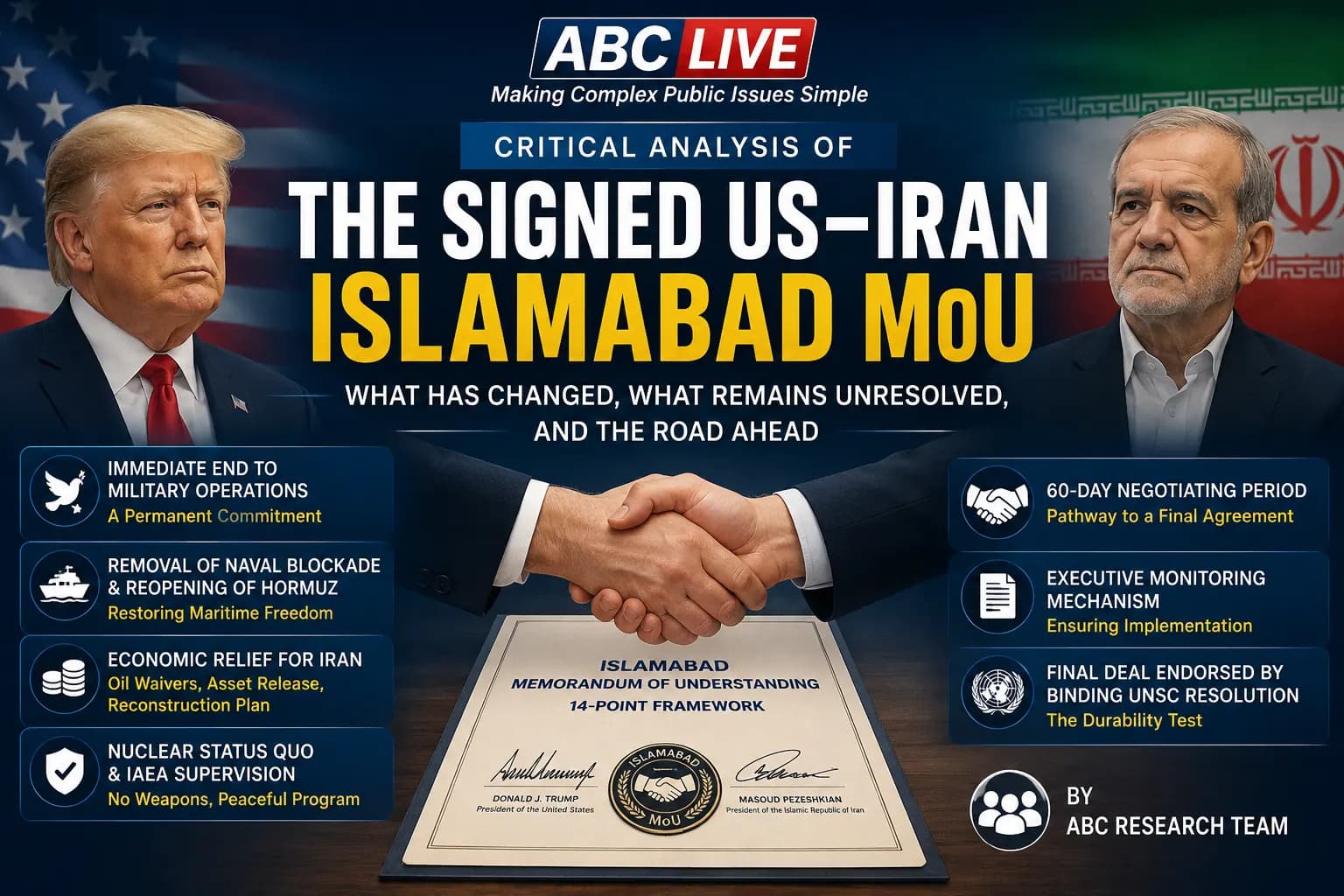
The reported digital signing of the Islamabad Memorandum of Understanding by US President Donald Trump and Iranian President Masoud Pezeshkian materially changes the political status of the 14-point document.
Earlier, ABC Live examined the text as the version publicly released by the United States. At that stage, Iran had not formally confirmed that the publicly presented wording represented the instrument accepted by both sides.
Readers may refer to ABC Live’s earlier contemporaneous analysis here: Critical Analysis of the US-Released Version of the Islamabad MoU . Subsequently, a senior US official publicly read out the complete 14-point text of the agreement. Reuters also reported that President Trump and President Pezeshkian signed the MoU on 17 June 2026. These developments substantially reduced the earlier uncertainty over Iranian acceptance of the publicly released text.
However, they do not remove the agreement’s legal and strategic gaps. Instead, they change the principal question.
The issue is no longer whether Iran accepted the US-released text. The central issue is whether both governments can implement the signed commitments and convert them into a final agreement within the prescribed 60-day period.
Summary
The digitally signed MoU carries greater political authority than the earlier unconfirmed US-released text. It now represents a jointly accepted interim framework rather than a unilateral American presentation.
Nevertheless, the signatures do not resolve the document’s central gaps.
The MoU requires the immediate termination of military operations. It also provides for the phased removal of the US naval blockade, restoration of commercial navigation, oil-export waivers and access to Iran’s frozen assets.
Meanwhile, the most difficult questions remain open. These include uranium enrichment, the future of Iran’s enriched-material stockpile, comprehensive sanctions termination, reconstruction funding, long-term administration of the Strait of Hormuz and enforcement of the final agreement.
Therefore, the MoU is neither a simple ceasefire nor a complete peace treaty.
It is an operative transitional framework whose success depends on immediate implementation, continued compliance and a final settlement.
Key Points
- The presidential signatures strengthen the MoU’s political authenticity.
- No verified substantive difference has emerged between the US-read 14-point text and the digitally signed instrument.
- The earlier ABC Live report remains a contemporaneous analysis based on the information then available.
- The MoU does not expressly create a 60-day licence for renewed war.
- Iran receives significant economic and maritime relief before final negotiations begin.
- The United States cannot deploy additional regional forces during the interim period.
- Iran must maintain the existing status of its nuclear programme.
- Nuclear enrichment and permanent sanctions termination remain unresolved.
- The executive monitoring mechanism lacks detailed powers and procedures.
- The final settlement requires endorsement through a binding United Nations Security Council resolution.
Why ABC Live Is Publishing This Report Now
ABC Live’s earlier report critically examined the 14-point text publicly presented by the United States.
At the time of that analysis, Iran had not yet formally confirmed that the publicly released wording matched the instrument jointly accepted by both governments. Therefore, ABC Live appropriately distinguished Washington’s published account from a mutually authenticated document.
The subsequent confirmation of the presidential digital signatures is a material development. Reuters reported that President Trump and President Pezeshkian signed the MoU on 17 June 2026.
Accordingly, ABC Live is publishing this follow-up report to explain what has changed, what remains unresolved and why presidential signatures alone do not ensure permanent peace.
The Earlier Analysis Remains Relevant
The earlier ABC Live report should be read as a contemporaneous analysis based on the information and official positions available at the time of publication.
At that stage, the United States had publicly released the 14-point text, while Iran had not yet formally confirmed that the released version matched the instrument accepted by both sides. Therefore, ABC Live examined the document as the US-released version of the Islamabad MoU.
The later confirmation of the presidential digital signatures adds a new stage to the diplomatic record. It strengthens the document’s political authority and reduces the earlier uncertainty over Iranian acceptance.
However, the development does not remove the substantive concerns identified in the first report.
The earlier analysis remains relevant because it:
- records the information available before joint confirmation;
- explains the initial uncertainty surrounding the publicly released wording;
- examines the strategic implications of Washington’s presentation;
- provides a basis for comparing the initial text with subsequent implementation.
Accordingly, this report should be read as a follow-up analysis. It examines how the confirmed signing changes the political context while retaining the earlier report’s legally and strategically relevant concerns.
What Has Changed After the Digital Signing?
The principal change concerns political authentication.
The document should no longer be described in current reporting only as the “US-released version.” Both presidents have reportedly signed it, while the two governments treat the MoU as an operative framework.
The signed MoU now has three distinct levels of authority:
| Level | Current position |
|---|---|
| Political authentication | Strengthened by presidential digital signatures |
| Bilateral operation | Both governments treat the MoU as effective |
| Full international enforceability | Dependent on the final agreement and Security Council action |
Therefore, the MoU carries greater authority than a press statement, leaked draft or unilateral executive account.
However, it has not yet become a complete peace treaty supported by detailed enforcement, inspection and dispute-resolution rules.
Is the Signed Text Different From the US-Released Text?
No reliable evidence has yet established a substantive difference between the 14-point text publicly read by a senior US official and the instrument reportedly signed by the presidents.
Reuters published the complete text as read by the US official. It later reported that the presidential signatures were added on 17 June 2026.
The publicly released clauses and the reported signed framework contain the same principal commitments concerning:
- termination of military operations;
- sovereignty and non-interference;
- the 60-day negotiating period;
- removal of the naval blockade;
- reopening of the Strait of Hormuz;
- the USD 300 billion reconstruction framework;
- sanctions termination;
- nuclear restrictions;
- maintenance of the interim status quo;
- oil-export waivers;
- release of frozen assets;
- an executive monitoring mechanism;
- conditions for starting final negotiations;
- Security Council endorsement.
Nevertheless, the authenticated signed document should be published in full.
Until that happens, minor differences involving dates, official designations, translation, formatting or signature pages cannot be ruled out.
Therefore, the accurate conclusion is that no substantive difference has been verified, rather than claiming that no difference can exist.
The Signed MoU Is More Than a Temporary Ceasefire
Clause 1 declares the immediate and permanent termination of military operations on all fronts, including Lebanon.
This wording is stronger than a temporary 60-day ceasefire.
The 60-day period under Clause 3 applies to negotiating and achieving the final agreement. It does not expressly limit the duration of the commitment to terminate military operations.
Therefore, the expiry of the negotiating period would not automatically authorise either side to resume war.
A renewed military operation would require an additional claimed basis, such as:
- self-defence;
- an alleged material breach;
- withdrawal from the MoU;
- collapse of the implementation process;
- or an allegation that the other party resumed hostilities.
Consequently, the MoU does not openly establish a countdown to another war.
The Strategic-Pause Theory Must Be Narrowed
ABC Live’s earlier analysis examined whether Washington accepted the MoU after underestimating Iran’s missile, drone and maritime capabilities.
ABC Live had previously examined Iran’s asymmetric strategy in its report, Explained: Iran’s Active Deterrence in the US–Israel–Iran War.
That question remains relevant.
The United States may use the negotiating period to:
- assess Iran’s surviving military capabilities;
- study its missile-and-drone operations;
- examine its post-war command structure;
- replenish depleted weapons outside the region;
- improve intelligence assessments;
- strengthen logistical readiness;
- prepare contingencies for diplomatic failure.
However, the signed text places meaningful limits on this activity.
Clause 1 prohibits renewed military operations. Clause 2 prohibits interference in internal affairs. Moreover, Clause 9 prevents the United States from deploying additional forces in the region pending the final agreement.
Therefore, Washington cannot lawfully treat the MoU as an openly declared cover for a new regional military buildup.
The more defensible analytical conclusion is:
The 60-day period may serve both diplomatic and strategic purposes. Washington may improve preparedness and develop contingency plans within its existing military footprint. However, the signed MoU neither authorises a second attack nor permits additional US regional deployments during negotiations.
Iran Receives Immediate Benefits Before Final Negotiations
Clause 13 is central to the sequencing of the agreement.
The parties will begin negotiations on the remaining provisions only after implementation starts under Clauses 1, 4, 5, 10 and 11.
Therefore, the following steps must begin first:
- termination of military operations;
- removal of the US naval blockade;
- restoration of safe commercial passage;
- issuance of US Treasury waivers for Iranian petroleum exports;
- release and usability of Iran’s frozen or restricted assets.
Iran therefore does not enter the nuclear and sanctions negotiations with only promises of future relief.
It receives front-loaded military, maritime and economic benefits.
This sequencing represents an important Iranian negotiating gain.
Immediate Commitments and Negotiated Commitments
| Immediate implementation | Matters requiring a final agreement |
| Termination of military operations | Comprehensive sanctions schedule |
| Beginning of blockade removal | Final enrichment framework |
| Restoration of commercial navigation | Enriched-stockpile mechanism |
| Petroleum-export waivers | Reconstruction-finance mechanism |
| Release of frozen assets | Permanent Hormuz administration |
| No new US sanctions | Long-term compliance rules |
| No additional US deployments | Security Council implementation |
This structure explains why the signatures do not complete the peace process.
The parties have accepted immediate de-escalation. However, they must still negotiate the permanent nuclear, financial, maritime and legal architecture.
Iran’s Economic Recovery Position Has Improved
The earlier analysis noted that Iran would face major recovery constraints because of sanctions, surveillance, damaged infrastructure and restricted access to advanced technology.
That assessment remains partly valid.
However, Clauses 6, 7, 10 and 11 substantially improve Iran’s potential economic position.
Iran may receive:
- immediate petroleum-export revenue;
- banking, insurance and transportation permissions;
- access to frozen or restricted assets;
- a pathway towards comprehensive sanctions termination;
- at least USD 300 billion in reconstruction and development planning;
- restoration of commercial maritime traffic.
Therefore, Iran may recover financially faster than initially expected.
Nevertheless, financial recovery and military-technological recovery are not the same.
Iran may gain money while continuing to face restrictions on advanced guidance systems, specialised electronics, precision machinery, military sensors, missile components and other controlled technologies.
Thus, Iran’s civilian and fiscal recovery may move faster than the restoration of its most advanced military capabilities.
The Nuclear Bargain Remains Incomplete
Iran has reaffirmed that it will not procure or develop nuclear weapons.
The parties have also agreed that the enriched-material stockpile will, at a minimum, be down-blended inside Iran under International Atomic Energy Agency supervision.
However, Iran has not yet accepted:
- zero domestic enrichment;
- dismantling of every enrichment facility;
- removal of the entire enriched-material stockpile;
- permanent closure of nuclear installations;
- a complete inspection and verification system.
The final agreement must still decide permitted enrichment levels, maximum stockpile size, centrifuge models, approved nuclear facilities, monitoring powers and the consequences of non-compliance.
Therefore, the nuclear dispute remains the most difficult part of the final negotiations.
Sanctions Termination Is Ambitious but Legally Complex
The United States has undertaken to terminate all types of sanctions against Iran according to an agreed schedule.
However, Washington cannot remove every sanction through a single executive decision.
Some US sanctions may be based on executive orders and may be waived or terminated by the President where domestic law permits. Other restrictions arise from Acts of Congress and may require statutory waivers, certification, legislative amendment or repeal.
Likewise, the United States cannot independently terminate United Nations Security Council or International Atomic Energy Agency Board of Governors resolutions.
Washington may support, sponsor and vote for their termination. Nevertheless, those institutions must act through their own procedures.
Therefore, Clause 7 creates a broad political undertaking whose implementation requires several domestic and international institutions.
Hormuz Has Reopened as an Interim Arrangement
Iran undertakes to use its best efforts to ensure safe commercial passage through the Strait of Hormuz without charge for 60 days.
ABC Live previously examined the strategic importance of Hormuz and Iran’s maritime leverage in Explained: Iran’s Active Deterrence in the US–Israel–Iran War.
The MoU also requires Iran to conduct discussions with Oman and other Gulf coastal states concerning future administration and maritime services.
This framework recognises that the future of Hormuz cannot be determined through American naval power alone. At the same time, it preserves the sovereign rights of Iran, Oman and other coastal states.
However, the MoU does not yet settle future charges, demining verification, naval encounter rules, inspection powers, foreign military presence or long-term dispute resolution.
Therefore, commercial navigation may resume while the permanent governance question remains open.
India’s Interest in the Settlement
The agreement also has direct implications for India.
A stable Strait of Hormuz can reduce shipping, insurance and energy-price risks. Meanwhile, sanctions relief could affect India’s engagement with Iran, including the future of Chabahar Port.
ABC Live has examined these issues in Explained: How India Can Use Chabahar Port After the Iran War.
Therefore, New Delhi should closely monitor:
- the scope of US sanctions waivers;
- banking permissions involving Iran;
- shipping and insurance access;
- the future Hormuz administration;
- any effect on Chabahar-related transactions;
- the role of Gulf states in Iran’s reconstruction.
The Executive Mechanism Will Determine the MoU’s Credibility
Clause 12 establishes an executive mechanism to monitor implementation of the MoU and future compliance with the final agreement.
Its importance is greater than its short wording suggests.
Nearly every major clause can produce factual disputes:
- Has the blockade actually been removed?
- Are petroleum waivers commercially effective?
- Have frozen assets become usable?
- Has Iran maintained the nuclear status quo?
- Has Washington deployed additional forces?
- Has commercial shipping returned?
- Has either side interfered in the other’s internal affairs?
The final agreement must define the mechanism’s membership, evidence-gathering powers, technical expertise, decision-making rules, corrective periods and authority to identify material breaches.
Without these details, the mechanism may become symbolic rather than effective.
The Security Council Resolution Is the Durability Test
The final agreement must receive endorsement through a binding United Nations Security Council resolution.
This step could internationalise the settlement, terminate or replace earlier UN measures, establish reporting duties and raise the legal cost of unilateral breach.
However, the United States cannot guarantee adoption alone.
A substantive Security Council resolution requires sufficient affirmative votes and no veto by another permanent member.
Therefore, China, Russia, France and the United Kingdom may influence the final settlement.
Moreover, the resolution’s wording will determine its legal force.
A resolution that merely welcomes the agreement would provide political endorsement. A resolution that clearly decides, requires and terminates specified measures would create stronger obligations.
What Each Side Receives
| United States receives | Iran receives |
| Termination of military operations | Termination of US military operations |
| Restoration of Hormuz traffic | Removal of the naval blockade |
| Iranian nuclear-weapons commitment | Recognition of peaceful nuclear needs |
| Nuclear status-quo freeze | No new US sanctions |
| IAEA-supervised down-blending | On-site treatment of nuclear material |
| Lower energy-market pressure | Immediate petroleum-export waivers |
| Negotiations on enrichment limits | Banking and insurance access |
| Executive monitoring mechanism | Release of frozen assets |
| Final Security Council framework | Comprehensive sanctions pathway |
| Continued existing regional presence | No additional US force deployments |
| Maritime stability | USD 300 billion reconstruction plan |
What Remains Valid From ABC Live’s Earlier Analysis?
Several concerns identified in the earlier report remain relevant.
First, the document contains broad commitments without detailed definitions.
Second, Washington and Tehran may interpret sovereignty, interference, status quo, proximity, sanctions termination and compliance differently.
Third, the 60-day period is short for settling nuclear, financial, maritime and regional disputes.
Fourth, both governments retain incentives to prepare for the possible failure of diplomacy.
Fifth, Iran’s missile-and-drone programmes do not appear expressly frozen under Clause 9.
Sixth, the United States retains considerable administrative influence during the early implementation of sanctions relief.
Therefore, presidential signatures strengthen the document’s authenticity but do not remove its structural weaknesses.
Revised ABC Live Analytical Thesis
The signed Islamabad MoU is more than a tactical ceasefire.
It creates an operative framework combining military de-escalation, maritime reopening, immediate economic relief and negotiations for a permanent settlement.
However, the agreement remains incomplete.
Its success depends on whether immediate commitments produce practical results rather than symbolic announcements. It also depends on whether the parties can settle enrichment, sanctions, reconstruction finance, Hormuz governance and enforcement within 60 days.
The strategic-pause hypothesis remains relevant only in a limited form.
Both sides may study weaknesses, replenish capabilities where permitted and prepare for diplomatic failure. Nevertheless, Washington has accepted restrictions on additional regional deployments and formally committed itself to ending military operations permanently.
Therefore, the principal danger is no longer that Washington released a text Iran had not accepted.
The principal danger is that an implementation dispute may allow either side to allege material breach and return to coercion.
Sources and Resources
Primary and Direct Reporting
- Reuters: The 14-point US–Iran pact as read by a US official
- Reuters: Trump and President Pezeshkian signed the MoU
- Reuters: Sequencing will be central and parties may still walk away
- Reuters: Iranian account of oil waivers, nuclear limits and asset release
- United Nations Charter
- International Atomic Energy Agency
Related ABC Live Reports
- Previous ABC Live report: Critical Analysis of the US-Released Version of the Islamabad MoU]
- Explained: Iran’s Active Deterrence in the US–Israel–Iran War
- Explained: Trump’s Claimed Strategic Scope of the US–Israel–Iran War
- Explained: How India Can Use Chabahar Port After the Iran War
Final Assessment
The presidential digital signatures materially strengthen the Islamabad MoU.
Iran has now accepted the framework, while the United States can no longer present the agreement merely as its own released version.
However, signatures alone cannot guarantee implementation.
The document provides immediate de-escalation, limits additional military pressure and establishes a pathway towards economic normalisation and nuclear regulation. At the same time, it postpones the hardest disputes to final negotiations.
Therefore, the earlier ABC Live report should be read as a contemporaneous analysis based on the information and official positions available at the time of publication.
The present follow-up records the next stage in the diplomatic process: the text has become a jointly signed bilateral framework, but its ability to deliver permanent peace remains unproven.
The MoU’s political authenticity is now stronger. Its legal detail, practical implementation and long-term durability remain the decisive tests.
ABC Live — Making Complex Public Issues Simple.