

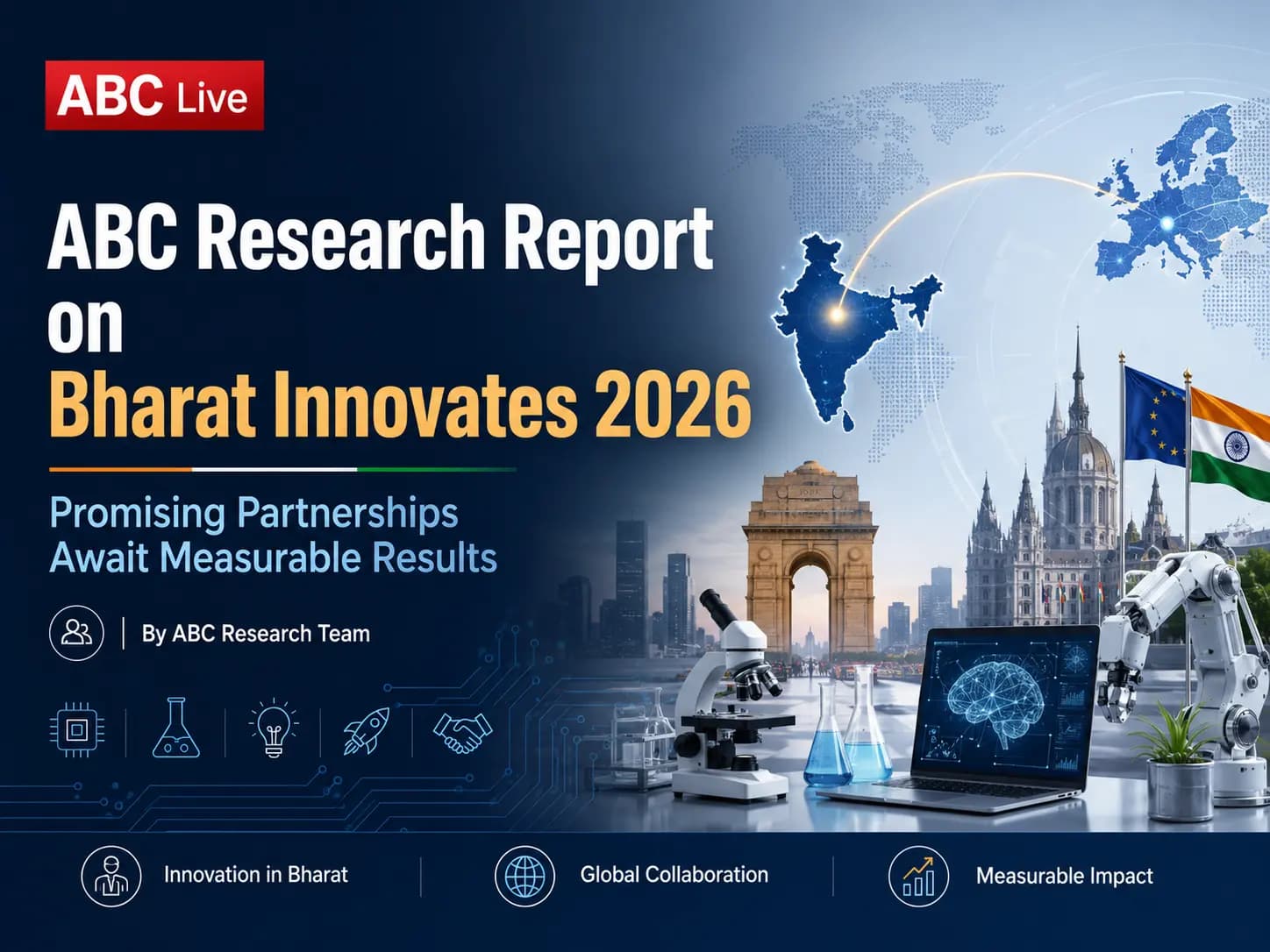
New Delhi (ABC Live): Bharat Innovates 2026 placed Indian university research, academic innovations and deep-technology ventures before an international audience of investors, corporations, universities, incubators and research institutions.
The Government of India held the maiden international edition at the Palais des Expositions de Nice, France, from 14 to 16 June 2026. Moreover, Prime Minister Narendra Modi and French President Emmanuel Macron jointly inaugurated the programme.
According to its official website, Bharat Innovates showcased 120 technology ventures, more than 15 leading institutions and 13 technology themes. Meanwhile, the Ministry of Education reported participation by more than 500 global stakeholders.
In addition, the government announced more than 30 partnerships, including Memorandums of Understanding (MoUs) and joint declarations. According to official statements, these arrangements covered incubator cooperation, corporate partnerships, university collaboration, research, commercialisation and market access.
Therefore, Bharat Innovates appears to have moved beyond a conventional exhibition. Instead, it created formal channels through which Indian innovators may work with international institutions and industries.
However, programme organisers and government releases provide most of the publicly available information. Although these sources establish what officials announced, they do not prove that investors have completed transactions, companies have started paid pilots, institutions have licensed technologies or ventures have entered overseas markets.
Consequently, ABC Research considers Bharat Innovates 2026 a promising institutional platform. Nevertheless, independent evidence must still establish its commercial and public impact.
Key Findings
- Bharat Innovates describes itself as a global accelerator rather than only a technology exhibition.
- Moreover, its website lists 120 ventures across 13 technology areas.
- According to the government, more than 15 higher-education institutions and over 500 global stakeholders joined the programme.
- In addition, the selected cohort reportedly holds more than 1,500 patents and has collectively raised more than US$1.5 billion.
- However, these patent and funding figures describe the participating cohort. Therefore, Bharat Innovates cannot claim them as outcomes of the programme.
- The Ministry of Education also claims that the event produced more than 30 partnerships.
- Specifically, the government reports 12 incubator-related agreements and 16 corporate agreements.
- Furthermore, officials reported academic partnerships involving 13 French universities, 11 Indian Institutes of Technology and the Indian Institute of Science.
- At least two MoUs involving Nothing, the Indian Institute of Technology Roorkee and the Foundation for Science, Innovation and Development at the Indian Institute of Science appear in separate official records.
- Nevertheless, the government has not released the complete texts, financial values, implementation schedules and binding duties of most agreements in one consolidated public record.
- Therefore, Bharat Innovates has demonstrated visibility, access and institutional intent. However, independent evidence must still establish its investment, industrial-adoption and commercial outcomes.
Why ABC Live Is Publishing This Report Now
ABC Live should not wait several years before examining Bharat Innovates. First, the initiative uses public institutions, diplomatic support and India’s higher-education research ecosystem. Therefore, its design, selection process, claims and intended results deserve immediate public scrutiny.
Second, early scrutiny may improve implementation. For example, independent reporting can encourage organisers to disclose agreements, publish milestones and separate promotional figures from measurable results.
However, this report does not issue a final verdict. Since the Nice edition concluded only on 16 June 2026, investors, universities and companies will need time to implement research, investment and technology-transfer plans.
Therefore, ABC Research presents an early independent assessment. In particular, it distinguishes established facts from official claims and identifies the evidence that organisers should publish later.
ABC Research Evidence Standard
ABC Research applies five evidence categories.
| Evidence category | Meaning |
|---|---|
| Verified event fact | Several identifiable public records support the fact |
| Officially stated | Bharat Innovates or the Government of India reports the claim |
| Partly corroborated | At least one named participant or separate record supports the claim |
| Outcome awaiting verification | Public evidence does not yet establish implementation or commercial results |
| Not attributable to the programme | Participants achieved the result before Bharat Innovates |
Therefore, ABC Research does not automatically treat an official announcement as independently proven impact. Instead, it assesses each claim according to the evidence presently available.
Bharat Innovates 2026 Data Dashboard
| Indicator | Reported position | What it establishes | Evidence caution |
| Event dates | 14–16 June 2026 | Duration and timing | Does not establish impact |
| Venue | Nice, France | International location | Does not establish market entry |
| Ventures showcased | 120 | Size of selected cohort | Selection does not prove commercial success |
| Higher-education institutions | More than 15 | Institutional participation | Full institution-wise data remains unavailable |
| Global stakeholders | More than 500 | Scale of attendance | The organisers do not separate meetings from transactions |
| Technology themes | 13 | Sectoral breadth | Outcomes may differ by sector |
| Patents held by cohort | More than 1,500 | Existing intellectual-property strength | Official data does not separate applications from grants |
| Collective capital raised | More than US$1.5 billion | Existing financial strength | Bharat Innovates did not necessarily generate this funding |
| Partnerships announced | More than 30 | Formal intention to cooperate | Agreement-wise details remain limited |
| Incubator-related agreements | 12 | Proposed institutional cooperation | Public evidence does not yet establish implementation |
| Corporate agreements | 16 | Potential commercial collaboration | Values and binding duties remain unclear |
Overall, the dashboard demonstrates considerable scale. However, participation figures do not establish commercial impact. Therefore, Bharat Innovates needs a separate post-event outcome dataset.
What Is Bharat Innovates 2026?
The Ministry of Education, Government of India, leads Bharat Innovates. In addition, the Office of the Principal Scientific Adviser supports the programme.
The official website describes Bharat Innovates as a national programme that identifies, mentors and showcases promising technology ventures from Indian Higher Education Institutions and Centrally Funded Technical Institutions.
More specifically, the programme seeks to connect Indian innovators with investors, corporations, universities, research institutions, incubators, accelerators, technology partners and international markets.
Prime Minister Narendra Modi announced the initiative on 17 February 2026 during the India–France Year of Innovation. Subsequently, the organisers conducted domestic activities before taking the selected cohort to France.
Meanwhile, the Indian Institute of Technology Bombay serves as the nodal institution. Several other Indian Institutes of Technology, the Indian Institute of Science, scientific agencies and government organisations also support the wider initiative.
Therefore, Bharat Innovates combines higher-education policy, research policy, industrial policy, start-up support and international technology diplomacy.
The 13 Technology Themes
The official programme identifies 13 broad technology themes.
| No. | Technology theme | Strategic or public relevance |
| 1 | Advanced computing | Artificial intelligence, quantum systems and digital capability |
| 2 | Semiconductors | Electronics, defence and supply-chain security |
| 3 | Next-generation communications | Secure and advanced connectivity |
| 4 | Space and defence | National security and strategic industry |
| 5 | Biotechnology | Health, agriculture and industrial biology |
| 6 | Healthcare and medical technology | Affordable diagnosis and treatment |
| 7 | Advanced materials | Manufacturing and strategic supply chains |
| 8 | Manufacturing and Industry 4.0 | Automation, productivity and industrial growth |
| 9 | Energy | Energy security and clean transition |
| 10 | Smart cities and mobility | Transport, urban services and resilience |
| 11 | Agriculture and food technology | Farm productivity and food security |
| 12 | Blue economy | Marine resources and coastal development |
| 13 | Disaster management | Public safety and resilience |
Thus, Bharat Innovates is not limited to consumer applications. Instead, many selected technologies require long research periods, costly infrastructure, regulatory approval and industrial testing.
Consequently, conventional short-term start-up finance may not suit them. Therefore, the programme must connect ventures with patient capital, technical facilities and long-term customers.
Cohort Credentials Are Not Programme Results
Official material states that the selected cohort collectively holds more than 1,500 patents and has raised over US$1.5 billion.
Certainly, these figures indicate that the programme selected several strong ventures. However, Bharat Innovates should not present them as results that the programme generated.
Most participants presumably secured their patents and capital before the Nice programme. Therefore, these figures represent the programme’s starting position rather than its impact.
| Measure | Cohort credential | Bharat Innovates outcome |
| Patents filed before the event | Yes | No |
| Patents granted before the event | Yes | No |
| Capital raised before selection | Yes | No |
| Existing customers | Yes | No |
| Existing overseas presence | Yes | No |
| Investment secured through the event | No | Yes |
| Pilot created through the event | No | Yes |
| Licence signed through the event | No | Yes |
| Foreign customer obtained through the event | No | Yes |
| Research partnership caused by the event | No | Yes |
Thus, this distinction is essential for fair evaluation. Instead of claiming earlier achievements, Bharat Innovates should use them as baseline data for later comparison.
The 120-Venture Cohort
The official directory includes ventures in artificial intelligence, semiconductors, robotics, healthcare, biotechnology, energy, mobility, advanced manufacturing, water systems and space technology.
However, the companies appear to have very different levels of maturity. For example, some are young ventures linked to academic incubators, whereas others have already raised substantial capital or entered commercial markets.
This diversity can demonstrate the full journey from research to enterprise. Nevertheless, it also complicates assessment.
For instance, the success of a listed or growth-stage company cannot prove that Bharat Innovates successfully commercialised an early university project. Therefore, the programme should divide participants into clearer stages.
| Venture category | Appropriate measurement |
| Academic research project | Validation, patents and licensing interest |
| Pre-incorporation innovation | Founding team and proof of concept |
| Early-stage venture | Prototype, first pilot and seed funding |
| Market-ready venture | Certification, customer trials and manufacturing |
| Growth-stage company | Revenue, exports and institutional funding |
| Mature or listed company | Market expansion and strategic partnerships |
Accordingly, organisers should publish outcomes separately for each category. Otherwise, mature companies may make the overall cohort appear more advanced than many early-stage participants actually are.
Academic Innovations Need a Different Test
Bharat Innovates also showcases academic innovations from Indian research institutions. However, many of these projects may not yet operate as companies.
For example, some projects may still need technical validation, product engineering, regulatory guidance, a founding team or a licensee. Therefore, evaluators should not judge them by the same standards as mature commercial ventures.
Instead, each academic innovation should disclose the following information.
| Required field | Why it matters |
| Technology Readiness Level | Shows the distance from laboratory to market |
| Patent status | Clarifies the intellectual-property position |
| Technology owner | Identifies the licensing authority |
| Testing completed | Indicates reliability |
| Regulatory pathway | Identifies approval barriers |
| Funding received | Shows existing public and private support |
| Partner required | Helps industry identify opportunities |
| Licensing status | Shows whether rights remain available |
| Expected production cost | Indicates commercial feasibility |
| Intended public or market use | Identifies likely value |
Without this information, a technology profile may remain scientifically interesting. However, investors and industry partners may still lack enough information to assess its commercial potential.
Bharat Innovates and India’s Wider Research Problem
Bharat Innovates addresses one important part of India’s research challenge: connecting selected technologies with investors, industries and international partners.
However, India’s wider research system faces deeper structural concerns. These include limited research spending, uneven university capacity, slow procurement, weak technology-transfer systems and poor links between laboratories and industry.
ABC Live previously examined these issues in Critical Analysis of NITI Aayog’s Report on Ease of Doing R&D.
That analysis found that India cannot build a broad innovation economy while research capacity remains concentrated in a small group of elite institutions. Moreover, it questioned whether institutional structures, including intellectual-property cells, consistently produce effective research translation.
Therefore, Bharat Innovates should not become an isolated platform that mainly benefits institutions and companies which already possess strong networks. Instead, its long-term value will depend on whether it expands research translation across state universities, medical institutions, agricultural universities and regional technical centres.
Biotechnology and Green Industrial Innovation
Bharat Innovates includes biotechnology, energy and advanced materials among its main themes. Together, these sectors can help India develop cleaner manufacturing systems and reduce dependence on resource-heavy industrial processes.
ABC Live’s report, Explained: India’s Green Biosurfactant Breakthrough, examined how Indian bioscience research could support cleaner production, pollution reduction and bio-based manufacturing.
That example shows why research commercialisation requires more than a scientific announcement. First, a laboratory discovery needs validation. Next, it requires intellectual-property support and industrial testing. Finally, it needs manufacturing capacity and customers.
Therefore, Bharat Innovates should track whether biotechnology and sustainability projects move from experimental results to safe, affordable and scalable products.
Semiconductors and Technology Sovereignty
Semiconductors form a separate Bharat Innovates theme. This focus matters because chip development requires specialised design skills, fabrication access, testing, packaging, patient capital and reliable supply chains.
ABC Live examined these challenges in Explained: How India Can Become the World’s Generic Chip Factory.
That analysis argued that India’s opportunity may lie in producing affordable and widely usable chips rather than competing only at the most advanced technological edge.
However, semiconductor ventures cannot succeed through pitching events alone. Instead, they need fabrication access, electronic design tools, testing facilities, long-term procurement and sustained investment.
Therefore, Bharat Innovates should report how many semiconductor ventures obtain fabrication, testing, procurement or manufacturing opportunities.
Defence Innovation and Strategic Manufacturing
Space and defence constitute another important Bharat Innovates theme. Unlike many civilian sectors, these fields require secure supply chains, strict testing, long procurement cycles and close engagement with government users.
ABC Live previously examined advanced defence design and international technology cooperation in Explained: How Saab’s A26 Redefines Undersea Warfare for India.
The A26 example shows that advanced defence platforms depend on modular design, systems integration, specialised manufacturing and long-term industrial partnerships.
Similarly, defence ventures showcased through Bharat Innovates cannot move from prototype to deployment through investor introductions alone. Instead, they may need security clearance, user trials, certification, government procurement and domestic manufacturing.
Therefore, defence-sector outcomes should be judged through operational trials, procurement contracts and production partnerships.
What the PIB Release Adds
The Press Information Bureau release materially strengthens the official account. It states that participants signed more than 30 innovation-focused MoUs and joint declarations during Bharat Innovates.
More specifically, the release reports 12 agreements involving Indian institutions or incubators and global incubators. In addition, it reports 16 agreements involving global corporations.
Furthermore, it refers to partnerships involving 13 French universities, 11 Indian Institutes of Technology and the Indian Institute of Science. Finally, it mentions the India–France Atal Tinkering Lab Bridge.
Consequently, these announcements indicate that the event created formal expressions of cooperation. Therefore, observers cannot fairly describe Bharat Innovates as only an exhibition.
However, an MoU normally records an intention to cooperate. Its practical value depends on its wording, resources, deadlines and implementation.
Partnership Data and the Reconciliation Question
| Partnership category | Officially reported number | Intended purpose |
| Indian institutions or incubators with global incubators | 12 | Incubation, research and start-up support |
| Agreements involving global corporations | 16 | Technology development, commercialisation and market access |
| French universities involved | 13 | Academic cooperation and exchanges |
| Indian academic partners | 11 IITs and IISc | Research, innovation and talent development |
| India–France Atal Tinkering Lab Bridge | One initiative | School-level innovation cooperation |
However, these figures should not automatically be added together. For example, several institutions may have signed one consolidated instrument.
Similarly, some categories may overlap. Alternatively, the academic partnerships may form part of the stated total of more than 30.
Since the PIB release does not fully reconcile the numbers, the Ministry of Education should publish an agreement-wise schedule. In particular, the schedule should identify:
- the names of all parties;
- the signing date;
- the type of instrument;
- the purpose;
- the duration;
- the financial commitment;
- the implementation lead;
- the milestones; and
- the expected results.
At Least Some Agreements Are Identifiable
A separate official release identifies at least two MoUs involving Nothing.
Nothing signed agreements with the Indian Institute of Technology Roorkee and the Foundation for Science, Innovation and Development at the Indian Institute of Science. According to the release, the agreements cover mentoring, start-up support and industry-academia cooperation.
Therefore, these examples partly corroborate the broader partnership claim. Nevertheless, two identifiable agreements cannot verify every announced partnership.
Consequently, a complete assessment still requires confirmation from all parties and public disclosure of implementation plans.
Why an MoU Is Not a Commercial Result
The term “partnership” may cover very different levels of commitment.
| Stage | What it establishes |
| MoU | Intention to cooperate |
| Joint declaration | Shared policy direction |
| Investor meeting | Initial engagement |
| Due diligence | A possible transaction remains under examination |
| Pilot proposal | Interest in testing |
| Pilot agreement | Planned technology test |
| Paid pilot | A customer makes a financial commitment |
| Purchase order | Confirmed commercial demand |
| Investment agreement | An investor contractually commits capital |
| Funds received | The company receives the investment |
| Licensing agreement | A rights holder grants commercial technology rights |
| Operational deployment | A customer uses the technology in practice |
Therefore, the number of MoUs cannot be treated as the number of investments, orders or commercial successes. Instead, organisers should report every stage separately.
The Two Innovation Bridges
The Bharat Innovates website presents two continuing institutional mechanisms.
Incubator and Innovation Bridge
The Incubator and Innovation Bridge focuses on ideas, prototypes, validation and market readiness. In particular, organisers propose research translation, mentoring, laboratory access, regulatory guidance and international immersion.
This model addresses a real weakness because India’s university incubators do not possess equal facilities or industry access. However, the Bridge needs funded programmes, professional teams and measurable milestones.
Otherwise, it may remain only an institutional label.
Industry Innovation Bridge
The Industry Innovation Bridge focuses on mature ventures and market-ready technologies. Therefore, organisers propose industrial pilots, corporate collaboration, technology validation, licensing, procurement, manufacturing and international expansion.
This mechanism could help technologies cross the gap between prototype and commercial deployment. However, organisers must distinguish unpaid demonstrations from paid pilots.
Repeated unpaid testing can weaken, rather than support, an early-stage venture. Consequently, the programme should treat pilot conversion as a central outcome indicator.
Investor Participation Needs a Conversion Funnel
A pre-event showcase reportedly attracted more than 90 investors whose combined Assets Under Management exceeded US$85 billion.
Certainly, this figure demonstrates interest from financially significant institutions. However, it does not mean that investors made US$85 billion available to Bharat Innovates ventures.
Instead, Assets Under Management represent all capital that those investors manage across their portfolios. Therefore, the programme should publish an investor-conversion funnel.
| Investor stage | Data required |
| Investors attending | Number |
| Founder-investor meetings | Number |
| Follow-up meetings | Number |
| Ventures entering due diligence | Number |
| Term sheets issued | Number and value |
| Investment agreements signed | Number and value |
| Funding transactions completed | Number and money received |
As a result, readers could see whether networking actually converted into capital.
The Additionality Test
The strongest independent question is:
What happened because of Bharat Innovates that would probably not have happened otherwise?
This is the test of additionality.
| Possible outcome | Evidence of additionality |
| New investment | The investor first connected through the programme |
| New pilot | A Bharat Innovates introduction led to the pilot |
| New university project | The institutions started collaboration after the event |
| New licence | An academic technology found a licensee through the programme |
| New market entry | A venture received foreign-market support through the programme |
| New certification | The programme arranged technical or regulatory assistance |
| New manufacturing agreement | Bharat Innovates helped identify the partner |
Without such evidence, the programme may showcase existing success rather than create new success. Therefore, additionality should become the central test of future evaluation.
Inclusion and Institutional Diversity
The participation of leading Indian Institutes of Technology and the Indian Institute of Science gives Bharat Innovates strong technical credibility.
However, India’s innovation ecosystem extends beyond elite centrally funded institutions. Therefore, a national programme should also track participation from state universities, agricultural universities, medical colleges and institutions in smaller cities.
In addition, it should report participation by women-led ventures, first-generation founders, northeastern institutions and regions with weaker investment networks.
Otherwise, Bharat Innovates may mainly strengthen institutions that already possess better laboratories, funding and international connections. In contrast, broader inclusion could help the programme discover innovations that remain outside established networks.
What Bharat Innovates Gets Right
It connects research with markets
First, the programme recognises that university research needs investors, customers, manufacturers and commercial partners.
It focuses on deep technology
Moreover, the selected sectors require scientific capability, specialised infrastructure and patient capital.
It includes academic research
Therefore, the programme creates opportunities before a research project becomes a formal company.
It creates continuing mechanisms
In addition, the two Bridges indicate an effort to maintain cooperation after the event.
It generated formal announcements
Consequently, the reported agreements show that the event moved beyond speeches and display booths.
It connects India with Europe
Finally, France can provide access to European universities, laboratories, corporations, investors and regulated markets.
What Remains Unproven
Public evidence does not yet establish the following outcomes:
| Unproven outcome | Evidence required |
| Investment generated by the event | Term sheets, contracts and funds received |
| Paid pilots | Customer confirmation and pilot value |
| Purchase orders | Contracts or order details |
| Technology licensing | Licence documents and rights transferred |
| Manufacturing partnerships | Production agreements |
| European market entry | Customer, registration or deployment evidence |
| Joint research | Project agreements, funding and teams |
| Student exchanges | Participation and programme records |
| Academic commercialisation | Companies formed or licences executed |
| Jobs created | Venture and payroll records |
| Public benefit | Users, patients, farmers or communities reached |
| Cost-effectiveness | Audited public cost compared with outcomes |
However, these evidence gaps do not prove failure. Instead, they identify the information that future reporting must establish.
Proposed Independent Review Timeline
| Review point | Questions to be answered |
| Within 90 days | Did organisers publish agreement lists, working groups, coordinators and milestones? |
| Within six months | Did due diligence, pilots, exchanges, research or licensing talks begin? |
| Within one year | Did investors complete transactions, institutions sign licences or companies deploy products? |
| Within two years | Did ventures expand revenue, manufacturing, exports or employment? |
| Within three years | Did Bharat Innovates create value beyond what participants would otherwise have achieved? |
Thus, researchers should evaluate Bharat Innovates in stages rather than through one immediate verdict.
Proposed Bharat Innovates Public Dashboard
| Area | Core indicator | Verification source |
| Partnerships | Active, delayed and inactive agreements | Confirmation from both parties |
| Investment | Capital committed and received | Investor and company records |
| Pilots | Started, completed and converted | Corporate customer records |
| Procurement | Orders and contract values | Buyer confirmation |
| Licensing | Agreements and revenue | Institution and licensee records |
| Research | Joint projects and funding | University records |
| Academic translation | Projects converted into ventures | Incorporation and licensing records |
| International access | New countries and customers | Sales or deployment records |
| Manufacturing | Production partnerships | Manufacturing contracts |
| Intellectual property | Patents licensed or jointly filed | Patent and licence records |
| Talent | Student and researcher exchanges | Institutional records |
| Inclusion | State and institutional distribution | Participant database |
| Employment | New technical jobs | Company records |
| Public benefit | Users or communities served | Deployment and impact records |
| Cost-effectiveness | Public cost per measurable result | Audited expenditure |
Therefore, a public dashboard would allow citizens, researchers and investors to distinguish announcements from outcomes.
ABC Research Assessment
The available evidence shows that Bharat Innovates assembled a significant and diverse deep-technology platform.
It brought together 120 ventures, leading academic institutions and more than 500 global stakeholders. Moreover, it announced partnerships across incubation, industry and higher education.
Therefore, observers cannot fairly dismiss Bharat Innovates as only a display event. However, the same data does not establish commercial success.
For instance, the participating cohort had already raised the reported US$1.5 billion before or independently of the event. Similarly, the cohort’s existing intellectual-property base accounts for the reported 1,500 patents.
Likewise, the US$85 billion figure refers to the total Assets Under Management of attending investors. Therefore, it does not represent money that investors pledged to Bharat Innovates ventures.
Meanwhile, the claim of more than 30 partnerships establishes formal intent. Yet the government has not published most agreement texts and implementation details for complete independent assessment.
Consequently, ABC Research classifies Bharat Innovates 2026 as:
A promising global accelerator with substantial institutional participation and announced partnerships, but with commercial additionality and long-term public impact still awaiting independent verification.
Policy Recommendations
Publish a complete Bharat Innovates data book
First, the Ministry of Education should release venture-wise, institution-wise and agreement-wise information in a downloadable format.
Separate prior achievements from programme results
Second, organisers should use funding, patents and customers secured before Bharat Innovates as baseline data rather than programme outcomes.
Disclose partnership summaries
Moreover, the Ministry should identify the parties, purpose, duration, implementation lead, milestones and financial commitment for every agreement.
Publish investor-conversion data
In addition, the programme should report meetings, due diligence, term sheets, investment agreements and funds received separately.
Track pilot conversion
Similarly, organisers should distinguish proposed pilots, paid pilots, completed pilots and purchase orders.
Disclose Technology Readiness Levels
Furthermore, every academic innovation and early-stage venture should carry a clear readiness classification.
Protect Indian intellectual property
At the same time, independent advisers should guide researchers and founders on patents, licensing, data, improvements and cross-border ownership rights.
Expand institutional access
Meanwhile, future cohorts should include more state universities, medical colleges, agricultural universities and regional research institutions.
Use public procurement strategically
Government departments and public-sector enterprises should also create transparent pathways for testing and purchasing suitable Indian technologies.
Disclose programme costs
In addition, the government should compare public expenditure with measurable investment, commercial and social outcomes.
Commission an independent evaluation
Finally, an external organisation should assess additionality after one, two and three years.
Conclusion
Bharat Innovates 2026 created a visible international platform for Indian deep technology and academic research.
The available data demonstrates considerable scale. Specifically, the initiative includes 120 ventures, more than 15 institutions, over 500 global stakeholders and 13 technology themes.
Moreover, the announced partnerships indicate a shift from exhibition towards structured institutional cooperation. However, scale does not equal impact.
The programme must now show whether investor meetings become investments, MoUs become active programmes, pilots become purchase orders and academic technologies become useful products.
Therefore, Bharat Innovates should now enter a transparent implementation phase.
The combined financial capacity of attending investors will not determine its success. Nor will the earlier funding of selected companies or the number of agreements announced on stage.
Instead, new capital received, technologies licensed, products deployed, markets entered and public problems solved will determine whether Bharat Innovates created real value.
The platform has opened a bridge. However, independent evidence must now show whether Indian innovations can cross it.
Research Methodology
ABC Research reviewed the Bharat Innovates official website, including its programme description, venture directory, technology themes and academic content.
In addition, ABC Research reviewed Press Information Bureau and Ministry of Education releases concerning the Nice event, participation figures and announced partnerships.
The research separates event-scale data from outcome data. Moreover, it distinguishes achievements secured before the event from results that Bharat Innovates may later generate.
ABC Research describes figures issued by the programme or government as official claims unless another identified party or public record supports them separately.
Because the maiden international edition concluded on 16 June 2026, researchers cannot yet measure long-term commercialisation outcomes. Therefore, this report offers an early independent assessment rather than a final impact evaluation.
Sources and Resources
- Bharat Innovates 2026 official website
- Press Information Bureau release on Bharat Innovates 2026
- Bharat Innovates venture and academic innovation directories
- Ministry of Education announcements concerning the programme
- Official records relating to identified institutional agreements
Related ABC Live Research
- Critical Analysis of NITI Aayog’s Report on Ease of Doing R&D — Examines research funding, university capacity, intellectual-property systems and commercialisation barriers in India.
- Explained: India’s Green Biosurfactant Breakthrough — Shows how Indian bioscience can support cleaner manufacturing and sustainable industrial innovation.
- Explained: How India Can Become the World’s Generic Chip Factory — Analyses India’s semiconductor ambitions, fabrication requirements and technology-sovereignty challenges.
- Explained: How Saab’s A26 Redefines Undersea Warfare for India — Provides a defence-sector example of advanced design, strategic manufacturing and international technology cooperation.
ABC Live — Making Complex Public Issues Simple.