

New Delhi (ABC Live): The Globalization is usually measured through trade, investment and capital flows. These figures show how closely a country connects with the world economy. However, they do not always show whether the country gains real power from those links.
They also do not show how badly the country may suffer when global trade, finance or supply chains face a crisis.
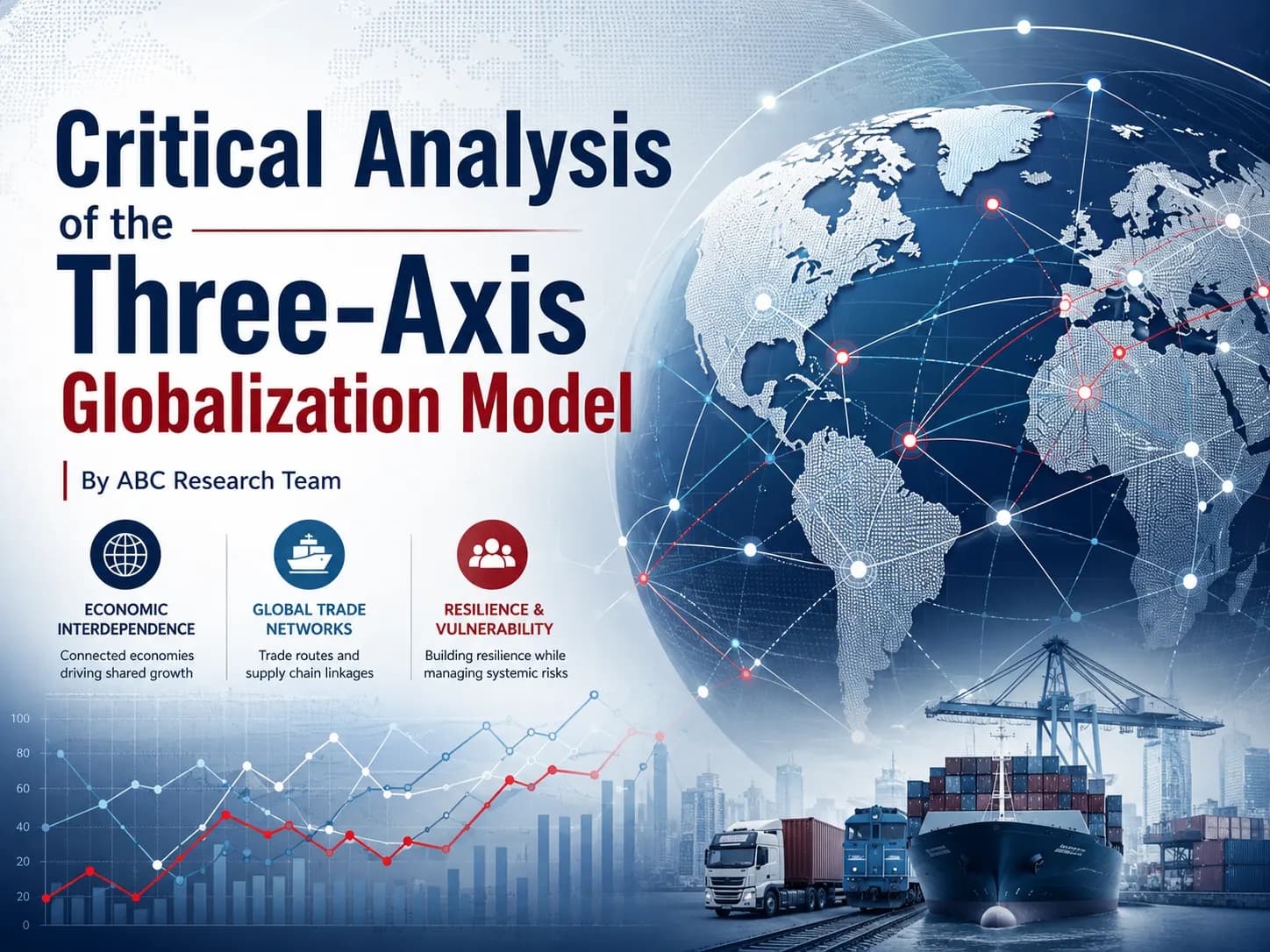
The proposed Three-Axis Globalization Model tries to solve this problem. Instead of giving every country one globalization score, it asks three separate questions.
First, how much does a country depend on global markets? Second, how much value does it gain from them? Third, how exposed is it when those global links break down?
This is a useful change. Two countries may have similar trade levels but hold very different positions. One may control technology, finance, shipping or major supply chains. Meanwhile, another may depend on imported fuel, foreign loans or low-value exports.
However, the model still has clear limits. Its broad ideas are strong, but the complete data method is not visible in the available study. Therefore, the model should be treated as a promising research tool rather than a final ranking of countries.
Key Points
- The model moves beyond simple trade openness.
- It separates dependence from vulnerability.
- It studies how much value countries retain from global trade.
- It explains why large economies can remain open but resilient.
- However, some indicators may overlap.
- The country scores need open data and clear weights.
- India’s broad position appears reasonable, but it needs sector-level proof.
- Therefore, the framework works better as a policy guide than as a final league table.
Why ABC Live Is Publishing This Report Now
Globalization has not ended. Instead, it is changing shape.
Governments now use tariffs, sanctions, export controls, state aid and industrial policy more openly. At the same time, businesses are changing suppliers, building reserve stocks and moving some production closer to major markets.
Recent work by the Organisation for Economic Co-operation and Development on global value-chain repositioning also suggests that global production networks are being changed rather than fully dismantled.
Moreover, the OECD has noted that globalization is being reconfigured through changes in foreign inputs, sourcing patterns and production networks. Therefore, the key issue is no longer whether globalization will survive. Instead, the main question is what type of globalization will emerge.
This makes the Three-Axis Globalization Model timely. It asks whether a country gains real strength from global links or merely becomes more dependent on them.
However, such a model may also shape policy. Governments could use it to support tariffs, subsidies, import controls or self-reliance plans.
Therefore, ABC Live believes that the model should be examined carefully before its rankings guide public policy.
What Is the Three-Axis Globalization Model?
Traditional measures often look at exports and imports as a share of Gross Domestic Product (GDP). This helps show how important foreign trade is to a country.
However, the figure has clear limits.
It does not show who controls patents, software, design, finance or advanced machines. It also does not show whether a country can replace key imports during a crisis.
Moreover, it does not show whether foreign investors can quickly withdraw their funds.
The Three-Axis Globalization Model tries to answer these missing questions through three separate measures.
Axis A: Reliance on Globalization
Axis A measures how much a country depends on:
- foreign demand;
- key imports; and
- foreign finance.
This is different from simple trade openness.
For example, a large country may trade heavily but still rely on a large home market. Therefore, it may redirect some goods and services within its own economy during a global shock.
By contrast, a smaller country may need foreign markets for basic growth. It may also depend on imported food, fuel, machines, technology or finance.
As a result, Axis A asks whether global links are helpful, important or essential to the country’s economic system.
Why Country Size Matters
Country size plays a major role in this measure.
Large economies such as India, China and the United States have wide home markets. Therefore, domestic demand can support part of their production when foreign demand falls.
However, small economies may have fewer choices. They may need exports to earn foreign currency and imports to meet basic needs.
Therefore, two equally open economies may not be equally dependent.
Axis B: Integration Gains
Axis B measures how much value a country gains from globalization.
These gains may come from:
- advanced technology;
- strong manufacturing;
- financial services;
- global brands;
- shipping and logistics;
- natural resources;
- intellectual property; or
- control over key supply chains.
This point matters because large export figures do not always mean large gains.
For example, one country may assemble imported parts and retain only a small part of the final value. Meanwhile, another country may control the product’s design, software, patent, finance or brand.
Therefore, the second country may gain more even if it exports fewer physical goods.
The OECD Trade in Value Added framework addresses a similar problem. It tracks where value is created across international production chains rather than counting only the final value of exports.
As a result, Axis B asks a more important question: how much value does a country keep from global trade?
Axis C: Vulnerability
Axis C measures how weak or strong a country’s position may become during a major shock.
Such shocks may include:
- economic sanctions;
- supply-chain breaks;
- financial stress;
- armed conflict;
- energy shortages;
- shipping disruption; or
- loss of access to key markets.
The model separates vulnerability from dependence. This is one of its strongest ideas.
A country may depend heavily on global trade but still control an important network position. If other countries cannot easily replace it, that country may retain strong bargaining power.
On the other hand, a country may trade less but still remain highly vulnerable. For example, it may have low reserves, heavy foreign debt or a narrow export base.
Therefore, dependence and vulnerability should not be treated as the same condition.
What the Three-Axis Globalization Model Gets Right
1. Globalization Is Not One Simple Scale
The model correctly rejects the idea that every country can be placed on one line from “less globalized” to “more globalized.”
The KOF Globalisation Index, for example, measures the economic, social and political sides of globalization. It is useful for measuring international links.
However, the Three-Axis Globalization Model asks different questions. It looks at the type of economic position a country holds within global networks.
In practice, countries join the world economy in different ways.
Some produce advanced goods. Others provide finance, shipping or digital services. Meanwhile, many countries export raw materials or low-cost manufactured goods.
Therefore, the type of integration matters as much as the level of integration.
2. Dependence Is Different from Openness
The model also makes a useful distinction between openness and need.
A country may remain open because trade supports faster growth. However, another country may remain open because it has few other choices.
For example, small states often depend on imports because they cannot produce every major good at home. By contrast, large economies usually have more room to adjust.
Therefore, the same trade-to-GDP ratio can hide very different levels of need.
This is especially important during war, sanctions, shipping disruption or a financial crisis.
3. Value Matters More Than Export Volume
The model rightly focuses on value capture.
A country may export many goods but earn little from each product. Meanwhile, another country may control the most profitable parts of the production chain.
These profitable parts may include:
- research;
- design;
- patents;
- software;
- finance;
- branding; and
- specialised machinery.
Therefore, gross export data alone cannot show who gains most from globalization.
The OECD’s Trade in Value Added database gives policymakers a clearer view of global production links. It traces how domestic and foreign value move through supply chains.
Consequently, the Three-Axis Globalization Model is right to focus on retained value rather than export size alone.
4. Network Position Can Create Power
A country’s strength may also depend on whether others can bypass it.
For example, a country may control:
- a key port;
- an important sea route;
- a payment system;
- a major energy supply;
- a chip-making centre;
- a digital platform; or
- a financial market.
As a result, its role may become hard to replace.
However, the same position can also create risk. A global hub may suffer heavily when international flows stop.
Therefore, network power can produce both gain and exposure.
This question has become more important as competition moves from normal trade into critical minerals, semiconductors, digital systems and undersea cables.
ABC Live has examined this shift in its report on how the United States–China rivalry is moving from trade to subsea cables.
5. Different Economic Models Can Produce Gains
The framework does not assume that every successful country must follow the same path.
Some states gain through manufacturing. Others gain through finance, resources, transport, law, insurance or digital services.
For example, Germany and South Korea gain heavily from manufacturing. Singapore gains through trade, logistics, finance and business services. Meanwhile, major oil exporters gain from energy resources and overseas investments.
Therefore, the model can compare different economies without forcing them into one development path.
Major Limits of the Three-Axis Globalization Model
1. The Complete Data Method Is Not Clear
The biggest problem is the lack of a complete public method in the available study.
The text explains the broad purpose of each axis. However, it does not fully show:
- every indicator used;
- the exact formula for each score;
- the weight given to each factor;
- the year of each dataset;
- the treatment of missing data;
- the list of excluded countries;
- the method used for unusual values; or
- the margin of error.
Therefore, other researchers cannot easily repeat the results.
The study states that it prefers direct ratios and logarithmic changes over some forms of relative scoring. This may improve long-term comparison.
Even so, the choice of indicators and weights can still change the country rankings.
Therefore, the model needs a complete technical note before its rankings can be fully tested.
2. Dependence and Vulnerability May Overlap
The model separates dependence from vulnerability. In theory, this is sensible.
However, some indicators may fit both axes.
For example:
- high foreign debt;
- heavy import reliance;
- weak reserves;
- dependence on one export;
- dependence on one market; and
- reliance on foreign finance
can all increase both dependence and vulnerability.
As a result, one weakness may be counted twice.
Therefore, the authors should clearly explain why each indicator belongs to one axis rather than another.
They should also publish a statistical test showing how closely the three axes are linked.
3. Integration Gains May Combine Different Factors
Axis B appears to combine technology, finance, industry, income and transport links.
However, these are not the same type of gain.
A manufacturing power creates value through factories, skills and technology. A financial centre earns through capital, law and business services. Meanwhile, a resource exporter gains through oil, gas or minerals.
A single score may therefore hide major differences.
For this reason, Axis B should provide separate sub-scores for:
- manufacturing gains;
- technology gains;
- financial gains;
- resource gains; and
- logistics gains.
This would make the model clearer and more useful.
4. Country Size May Shape the Results Too Much
The model gives strong resilience positions to India, China and the United States.
This seems reasonable because these countries have large home markets and wide production systems.
However, the model may partly be measuring size rather than resilience.
Large countries often have:
- more consumers;
- more industries;
- greater tax capacity;
- larger reserves;
- more land and resources; and
- wider internal supply routes.
Therefore, researchers should compare the three axes with GDP, population and domestic market size.
If the model closely follows these factors, it may add less new insight than expected.
5. National Scores Can Hide Sector Risks
A country may look strong overall but remain weak in key sectors.
For example, a large economy may still depend heavily on imported:
- crude oil;
- natural gas;
- semiconductors;
- defence systems;
- fertilisers;
- critical minerals;
- electronic parts; or
- advanced machines.
Therefore, one national score cannot show every risk.
A stronger model should include separate reviews of:
- energy;
- food;
- technology;
- finance;
- defence;
- shipping; and
- critical minerals.
This would help governments identify the sectors where real pressure exists.
6. Replaceability Is Hard to Measure
Axis C depends heavily on the idea of replaceability.
However, replaceability changes over time.
A supplier may be impossible to replace within three months. Yet the same supplier may be replaced within five years.
New technology, new mines, new trade routes and new factories can also change the position.
Therefore, the model should state the time period used to measure vulnerability.
Without a clear time period, country scores may become too broad.
7. Government Capacity Needs More Attention
Economic strength alone does not decide resilience.
Governments also need:
- quick decision-making;
- sound public finance;
- trusted institutions;
- emergency planning;
- working infrastructure; and
- the ability to support vulnerable citizens.
Two countries may face the same economic shock but produce very different results.
Therefore, the model should include the state’s ability to act during a crisis.
Does the Model Correctly Identify Globalization’s Winners?
The model places financial hubs, industrial powers and resource-rich states among the main winners of globalization.
This view has merit. However, the word “winner” should be used with care.
A country may earn large gains from globalization while many citizens receive little benefit.
For example, high national income may exist alongside:
- low wages;
- regional inequality;
- high housing costs;
- insecure employment;
- environmental harm; or
- wealth held by a small group.
Therefore, Axis B appears to measure gains at the national or economic level. It does not prove that those gains are shared fairly.
The model should make this difference clear.
India’s Position in the Model
The study places India between a semi-peripheral middle power and a full systemic globalization power.
This appears broadly reasonable.
India has a large home market, a wide range of industries and a strong service sector. Moreover, it has a growing digital economy and a strategic location in the Indian Ocean.
These strengths give India room to absorb some external shocks.
ABC Live has also examined India’s wider position in its report on India’s strategy in the emerging world order.
However, India still depends on foreign supplies in several important areas.
These include:
- crude oil;
- advanced electronics;
- semiconductors;
- critical minerals;
- some defence systems;
- shipping services; and
- foreign investment flows.
Therefore, India may be strong at the national level but still exposed in key sectors.
India’s Main Structural Strengths
India benefits from:
- a large consumer market;
- a wide workforce;
- strong information technology services;
- broad farm production;
- growing roads and ports;
- a large digital system;
- a wider manufacturing base; and
- a strategic position between major trade regions.
Because of these strengths, India does not depend on one single export product.
Moreover, its large market gives global companies a strong reason to produce and invest within India.
Therefore, India has more policy space than many smaller economies.
India’s Main Structural Limits
However, India has not yet secured full control over the highest-value parts of global production.
It still needs:
- more research and development;
- more patents;
- stronger local supply chains;
- deeper industrial finance;
- more global brands;
- lower logistics costs;
- better worker skills; and
- stronger advanced manufacturing.
Therefore, India’s main task is not simply to export more.
Instead, India must retain more value from what it makes and sells.
The challenge is clear in the semiconductor sector. ABC Live’s critical analysis of India Semiconductor Mission 2.0 found that long-term strength requires more than factory subsidies. It also requires skills, materials, research, equipment and a wider production system.
Likewise, ABC Live’s report on India’s electronics manufacturing and mineral security showed that electronics growth can remain exposed when key minerals and processed materials come from abroad.
India’s Strategic Path
India can move towards a stronger global position through a balanced policy.
First, it should reduce major import risks in sectors that affect national security.
Second, it should avoid broad isolation from world markets.
Third, it should build local skills and production in areas such as:
- semiconductors;
- energy storage;
- defence;
- artificial intelligence;
- critical minerals;
- clean technology; and
- advanced machinery.
At the same time, India should deepen trade links where they support jobs, technology and market access.
India’s recent trade policy also reflects this balance. ABC Live has analysed how India’s new Free Trade Agreements are reshaping global trade.
Therefore, strategic autonomy should mean having better choices. It should not mean ending all forms of economic interdependence.
The European Dependence Question
The study describes a European belt of high dependence.
At the country level, this claim makes sense.
Germany and other export-led states rely on foreign markets, imported inputs and stable transport systems.
However, the European Union changes the picture.
Trade between European Union members is still recorded as cross-border trade. Yet the single market removes many legal and trade barriers.
Therefore, some national dependence is actually regional interdependence.
For this reason, the model should publish both:
- national scores; and
- European Union-level scores.
Otherwise, it may overstate the weakness of individual European countries.
Financial Hubs and Mobile Capital
The model argues that financial hubs remain exposed because money can move quickly.
This is partly correct.
Capital, companies and legal registrations can often move more easily than factories.
However, major financial centres also have deep strengths.
These include:
- trusted courts;
- skilled workers;
- stable laws;
- deep capital markets;
- payment systems;
- professional services; and
- long-standing business networks.
Therefore, finance may be mobile, but major financial centres are not always easy to replace.
The model should measure these deeper strengths before classifying a financial hub as highly vulnerable.
Resource-Rich States and Long-Term Risk
Resource-rich countries may appear strong because they earn foreign currency and control key goods.
However, this strength may not last forever.
For example:
- oil prices may fall;
- new technology may cut demand;
- sanctions may block markets;
- new shipping routes may weaken old hubs; or
- resources may become harder to extract.
Therefore, the model should separate short-term strength from long-term resilience.
A country may survive a short crisis but still face serious risks over ten or twenty years.
The growing role of minerals also shows why resource power is changing. ABC Live’s analysis of the new global minerals order examined how copper, critical minerals and industrial security are reshaping global competition.
How the Three-Axis Globalization Model Can Improve
Publish the Complete Method
The authors should publish every indicator, formula, weight and source year.
This would allow other researchers to repeat and test the results.
Show Sub-Scores
Each main axis should include smaller parts.
For example, Axis A should separately show:
- export reliance;
- import reliance; and
- finance reliance.
As a result, readers could understand why a country receives a particular score.
Test Different Weights
The authors should show whether the rankings change when they alter the weights.
They should also remove one indicator at a time and recalculate the results.
Therefore, readers would know whether the rankings are stable or highly sensitive.
Add Sector-Level Reviews
National scores should be supported by sector studies.
These studies should cover:
- energy;
- food;
- technology;
- finance;
- transport;
- defence; and
- critical materials.
This would make the model more useful for real policy decisions.
Add Crisis Tests
The model should test how countries might perform during:
- closure of a major shipping route;
- an oil-price surge;
- a semiconductor shortage;
- a global banking crisis;
- coordinated sanctions; or
- a sudden fall in foreign demand.
As a result, the model could become a practical risk tool rather than only a descriptive index.
ABC Live Analysis
ABC Live finds that the Three-Axis Globalization Model offers a better way to study globalization than a simple openness ranking.
Its main strength is that it asks three separate questions.
How much does a country depend on global systems? How much value does it gain from them? Finally, how well can it handle a break in those systems?
These questions provide more insight than trade figures alone.
However, the model’s ideas are currently stronger than its visible proof.
The country groups may appear reasonable. Even so, reasonable results are not enough for a global ranking.
Therefore, the model needs:
- open data;
- clear formulas;
- public weights;
- sector-level checks; and
- independent testing.
Until then, policymakers should use it as a guide for debate rather than a final measure of national power.
For India, the model offers an important lesson.
India’s large market gives it strategic depth. However, size alone will not create global leadership.
India must also build technology, advanced industry, financial strength and control over key supply chains.
At the same time, India should not confuse resilience with isolation. A country can gain strength through international trade when it retains value, protects critical sectors and keeps several policy options open.
Therefore, India’s goal should not be less globalization in every field. Instead, it should seek better-quality globalization.
What Value Does ABC Live Add?
ABC Live does more than repeat the model.
First, it explains the three axes in simple language.
Second, it tests the model’s broad claims rather than accepting the country rankings at face value.
Third, it adds an India-focused view by examining India’s market size, technology gaps, energy dependence and supply-chain risks.
Fourth, it separates a useful theory from proven data. The model offers strong ideas, but its rankings still need a clear and repeatable method.
Finally, ABC Live turns the academic model into a policy question.
The real issue is not whether India should join or leave globalization. Instead, the issue is how India can gain more value while reducing key risks.
Therefore, ABC Live’s added value lies in converting a complex global model into clear, critical and India-focused public-interest analysis.
Risks and Concerns
The model may be misused in several ways.
First, governments may use low-dependence goals to support broad trade barriers. However, less trade does not always create more resilience.
The OECD’s work on global value and supply chains warns that wide efforts to bring all production home can reduce trade and economic output without always improving stability.
Second, high integration-gain scores may be mistaken for shared public wealth. Yet national gains may remain concentrated in a few firms, sectors or regions.
Third, high resilience scores may create false comfort. A country that appears strong overall can still face a major crisis in energy, technology or finance.
Therefore, the model should support detailed analysis rather than replace it.
What Happens Next?
The next step should be independent testing.
Researchers should apply the model to past events such as:
- the 2008 global financial crisis;
- the euro-area debt crisis;
- the COVID-19 supply shock;
- major oil-price rises;
- economic sanctions;
- semiconductor shortages; and
- shipping disruptions.
If the model is sound, it should help explain which countries suffered most and which recovered faster.
Moreover, future versions should publish score ranges rather than overly exact ranks.
Two countries with close scores may not be meaningfully different once data limits are considered.
Conclusion
The Three-Axis Globalization Model offers a timely way to rethink globalization.
It shows that global links create different types of power, gain and risk.
A country may be highly open yet resilient. Another may be less open but financially weak. Meanwhile, a third may gain heavily from trade while depending on stable world markets.
Therefore, globalization is not one simple ladder.
Instead, it is a network of different positions.
The model captures this idea well. However, its final value will depend on a clear method, open data and independent tests.
For India, the message is equally clear.
India’s large market gives it strength. However, scale alone will not create global leadership.
India must move further into technology, high-value industry, finance and key supply chains.
Ultimately, the model asks the right question.
It does not ask only how globalized a country is.
Instead, it asks what kind of power, value and risk the country gains from globalization.
Sources and Resources
Main Research Basis
- Three-Axis Globalization Model research text reviewed by ABC Live
- OECD: Trade in Value Added
- OECD: Global Value and Supply Chains
- OECD: Global Value-Chain Repositioning
- KOF Globalisation Index
- OECD Data Explorer: Trade in Value Added
Related ABC Live Reports
- Explained: India’s Strategy in the Emerging World Order
- Explained: Civilizational Geopolitics and the End of Neutrality
- Critical Analysis of India Semiconductor Mission 2.0
- Explained: India’s Electronics Manufacturing and Mineral Security
- Explained: How India’s New FTAs Are Reshaping Global Trade
- Explained: US–China Rivalry Moves From Trade to Subsea Cables
- Explained: Rio–Glencore Deal Failure and the New Global Minerals Order
- Artificial Intelligence and Global Competition Today
Frequently Asked Questions
What is the Three-Axis Globalization Model?
It is a proposed model that studies countries through dependence, gains and vulnerability.
How is it different from a normal globalization index?
Normal indices mainly measure openness and international links. This model also examines value capture and risk.
Is a highly globalized country always vulnerable?
No. A highly open country may still have strong reserves, technology, a large market or an important network position.
Does low dependence always mean strength?
No. A less open country may still suffer from debt, weak reserves, narrow exports or dependence on a key imported product.
Where does India stand?
India stands between a middle power and a full systemic global power. Its large market gives it strength, but important sector risks remain.
Is the model fully proven?
Not yet. It needs open data, clear formulas, public weights and independent testing.
ABC Live — Making Complex Public Issues Simple.