

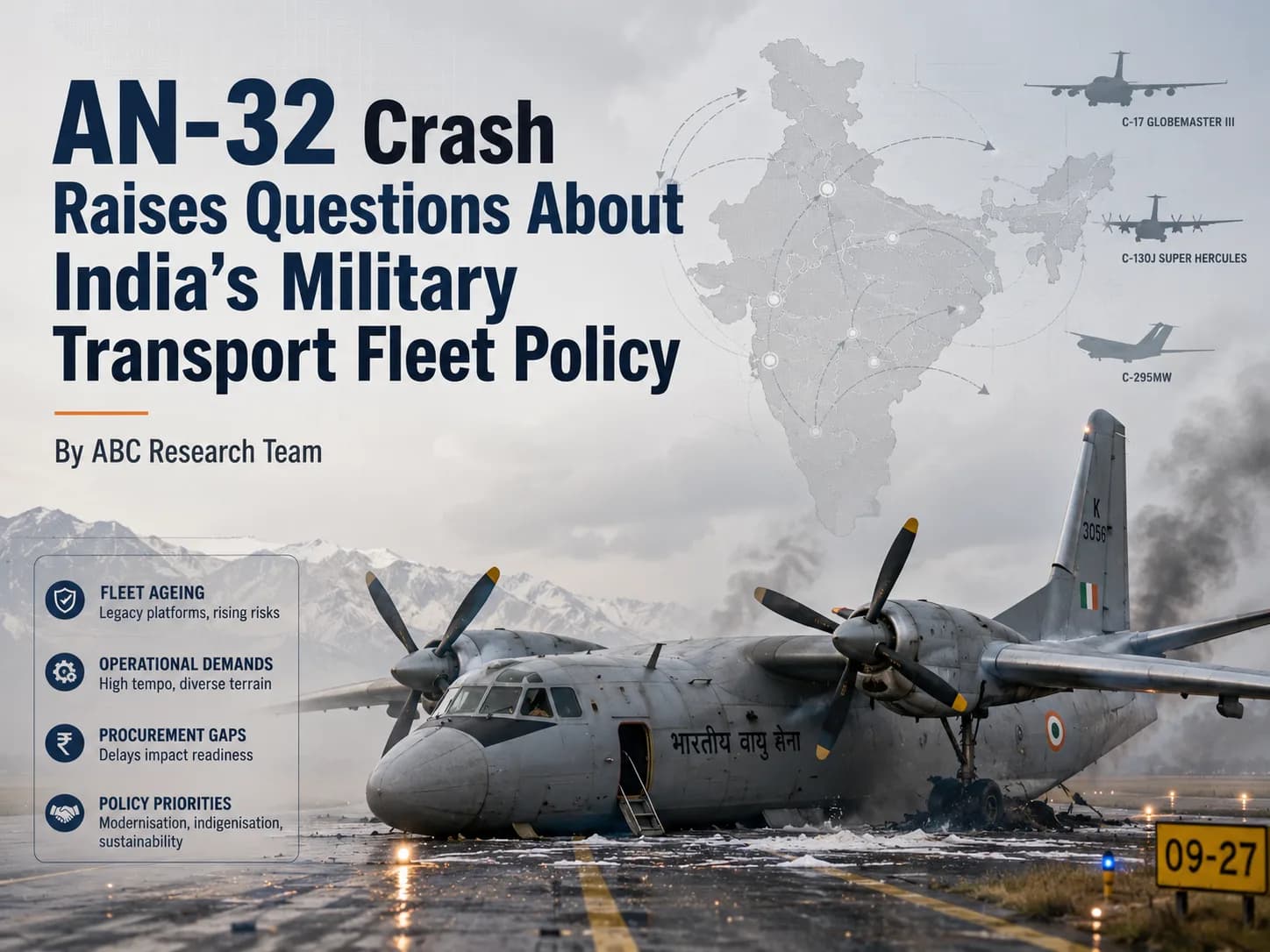
The fatal crash of an Indian Air Force (IAF) Antonov AN-32 at Jorhat, Assam, on 13 June 2026 has renewed scrutiny of India’s ageing military transport fleet.
Five IAF personnel died in the accident. However, the co-pilot reportedly survived and received medical treatment. Meanwhile, the IAF ordered a Court of Inquiry to determine the cause.
Therefore, no conclusion should be drawn before the inquiry is completed. Nevertheless, the accident has exposed a wider policy concern. India still depends on transport aircraft inducted several decades ago, while replacement programmes remain at different stages of production or procurement.
India has already started inducting the Airbus C-295 to replace the Avro HS-748 fleet. Moreover, the Defence Acquisition Council (DAC) has granted Acceptance of Necessity (AoN) for a Medium Transport Aircraft programme intended to replace the AN-32 and IL-76 fleets.
However, these separate programmes do not create a complete military airlift policy. Instead, India needs a 20-year plan covering tactical transport, medium airlift, special operations and heavy strategic lift.
In addition, the plan must connect aircraft safety, retirement schedules, domestic manufacturing, maintenance rights and wartime availability. Accordingly, this policy brief recommends a three-tier fleet supported by an independent AN-32 safety audit, faster procurement and measurable domestic production.
Key Points
- Five IAF personnel died in the Jorhat AN-32 accident on 13 June 2026.
- However, the co-pilot reportedly survived with injuries.
- Meanwhile, the IAF ordered a Court of Inquiry.
- Public records indicate at least 17 IAF AN-32 accidents or serious occurrences.
- Nevertheless, this is not an official consolidated IAF total.
- The existing order for 56 C-295 aircraft primarily replaces the Avro HS-748 fleet.
- Moreover, the proposed Medium Transport Aircraft is intended to replace the AN-32 and IL-76 fleets.
- However, the AN-32 and IL-76 perform different roles.
- Therefore, one aircraft category may not efficiently replace both fleets.
- In addition, India needs a separate safety audit of the remaining AN-32 aircraft.
- Ultimately, India needs a three-tier structure covering tactical, medium and heavy transport.
Why ABC Live Is Publishing This Report Now
The Jorhat tragedy has turned military transport modernisation into an immediate policy issue.
The accident occurred while India was preparing a new Medium Transport Aircraft programme. Therefore, the country must now manage the difficult transition between ageing operational aircraft and replacements that may take years to enter service.
At the same time, the IAF cannot suddenly withdraw every AN-32. These aircraft continue to support troops, remote posts, high-altitude regions and humanitarian operations.
Consequently, the government must balance two duties. First, it must protect aircrew and passengers. Second, it must preserve enough transport capacity to meet national-security needs.
Upgrades can support immediate readiness. However, they cannot substitute permanently for fleet renewal. Therefore, India now needs a clear, funded and time-bound transport-fleet policy.
What Happened at Jorhat on 13 June 2026?
An IAF AN-32 transport aircraft met with an accident at Air Force Station Jorhat in Assam on 13 June 2026.
According to reports carrying the IAF’s statement, the accident occurred at approximately 10 a.m. during a routine sortie. Moreover, the aircraft reportedly met with the accident while landing at Jorhat.
Readers may review the initial reports published by The Economic Times, Associated Press and The New Indian Express.
Personnel Who Lost Their Lives
The IAF identified the five personnel as:
- Squadron Leader Prashant Singh;
- Flight Lieutenant Shubham Kumar;
- Sergeant Jitendra Sharma;
- Agniveervayu Khemaram Kumawat; and
- Agniveervayu Danish Alam.
However, the co-pilot reportedly survived. Subsequently, the injured officer received medical treatment.
Early Accounts Remain Unconfirmed
Initial reports gave different accounts of the final sequence.
For example, some reports stated that the aircraft veered from the runway and caught fire. By contrast, other reports referred to a fire or blast during or after landing.
However, these versions should not be treated as final findings. Instead, the technical inquiry must establish the exact sequence.
Court of Inquiry Ordered
The IAF has ordered a Court of Inquiry. Accordingly, the inquiry must determine whether the accident involved:
- technical failure;
- maintenance conditions;
- human factors;
- runway conditions;
- operational circumstances; or
- several contributing causes.
Until the inquiry is completed, therefore, the cause should remain officially undetermined.
Why One Accident Must Not Prejudge the Entire Fleet
A fatal accident naturally creates concern. However, one crash does not prove that every AN-32 is unsafe.
Military Operations Involve Multiple Risks
Military aircraft often operate under difficult conditions. For example, possible risks include severe weather, mountainous terrain, short runways, equipment failure, maintenance problems and operational pressure.
Therefore, the Jorhat accident must be investigated on its own evidence. Nevertheless, the age of the wider fleet remains relevant to policy.
Fleet Age Remains a Policy Concern
India began inducting AN-32 aircraft during the 1980s. Consequently, even upgraded aircraft remain based on older airframes, engines and supply systems.
Moreover, ageing aircraft usually require more inspections, repairs and spare-parts support. Therefore, the government cannot treat fleet age as irrelevant merely because the immediate accident cause remains unknown.
India Must Avoid Two Extreme Responses
The government should avoid two opposite mistakes.
First, it should not declare the entire fleet unsafe before receiving technical findings. Second, it should not use the absence of a final report to delay a wider safety review.
Therefore, the Jorhat inquiry and a fleet-wide audit should proceed separately. Together, they can address both the immediate accident and the wider policy question.
What Is the AN-32?
The Antonov AN-32 is a twin-engine turboprop military transport aircraft developed by the Antonov Design Bureau.
Designed for Difficult Conditions
The aircraft was designed to operate in hot weather and from high-altitude airfields. Moreover, its engine arrangement and performance made it useful for difficult military transport missions.
Main IAF Roles
The IAF has used the AN-32 for:
- troop movement;
- military cargo;
- high-altitude supply;
- paratroop operations;
- casualty evacuation;
- disaster relief;
- communications duties; and
- logistics support to remote regions.
In particular, the aircraft has played an important role in the Himalayan region and Northeast India. Therefore, replacing it requires more than selecting an aircraft with a similar payload.
Why Replacement Is Necessary
The AN-32 has served India for decades. However, successful past service does not remove the need for a planned retirement policy.
As a fleet ages, aircraft availability may fall. In addition, maintenance costs, spare-parts problems and structural concerns may increase.
Therefore, India must introduce replacement capacity before safety and availability pressures become unmanageable.
India’s AN-32 Upgrade Programme
India introduced an upgrade and life-extension programme to keep the AN-32 fleet operational.
According to the Ministry of Defence’s 1 July 2019 statement, 105 aircraft were planned for upgrading.
At that stage, 55 aircraft had been upgraded:
- 40 aircraft in Kyiv, Ukraine; and
- 15 aircraft at the IAF’s No. 1 Base Repair Depot in Kanpur.
Main Upgrade Areas
The programme covered avionics, navigation equipment, cockpit systems, communications, structural work and service-life extension. Therefore, the upgrades supported short-term operational readiness.
Limits of Life Extension
However, an upgraded aircraft is not the same as a newly manufactured aircraft.
An upgrade may improve navigation, communications and cockpit systems. Moreover, it may strengthen parts of the aircraft structure.
Nevertheless, it cannot permanently remove every concern related to airframe age, structural fatigue, engine support, spare-parts availability and rising maintenance needs.
Therefore, upgrades should support the transition period. They should not become a substitute for replacement.
How Many IAF AN-32 Accidents Have Occurred?
No current official document appears to provide one consolidated figure covering every IAF AN-32 crash, disappearance, collision, runway accident and serious occurrence.
Publicly Reported Estimate
A 2016 report based on aviation-safety records stated that IAF-operated AN-32 aircraft had suffered 15 accidents by that stage.
Readers may review the historical summary published by The Times of India.
After that assessment, two further major fatal accidents occurred.
First, an AN-32 crashed in Arunachal Pradesh on 3 June 2019, killing all 13 personnel aboard. Second, another AN-32 crashed at Jorhat on 13 June 2026, killing five personnel.
Accordingly, public records support a cautious estimate of at least 17 IAF AN-32 accidents or serious occurrences.
Why the Figure Must Be Qualified
However, this figure should not be presented as a final official IAF total.
Different databases use different definitions. For example, some include fatal crashes, disappearances, mid-air collisions, runway accidents and aircraft damaged beyond repair.
By contrast, other sources count only fatal crashes or complete aircraft losses. Therefore, the figure of 17 should be described as a minimum public-record estimate.
What the IAF Should Publish
The IAF should release a non-sensitive consolidated safety summary. In particular, it should include:
- total accidents;
- fatal accidents;
- lives lost;
- aircraft written off;
- broad cause categories;
- upgraded and non-upgraded aircraft involved; and
- safety measures introduced after inquiries.
Such disclosure would improve accountability. At the same time, it would not require the release of sensitive operational information.
Major Fatal IAF AN-32 Accidents and Disappearances
| Date | Place or route | Reported consequence |
|---|---|---|
| 25 March 1986 | Arabian Sea during a delivery flight towards India | Aircraft disappeared with seven people aboard |
| 15 July 1990 | Ponmudi mountain range, Kerala | Five people reportedly died |
| 1 April 1992 | Punjab | Two AN-32 aircraft collided; eight people reportedly died |
| 7 March 1999 | Near Delhi airport | Occupants and people on the ground died |
| 8 June 2009 | Arunachal Pradesh | All 13 people aboard died |
| 22 July 2016 | Chennai–Port Blair route over the Bay of Bengal | Aircraft disappeared with 29 people aboard |
| 3 June 2019 | Near Lipo, Arunachal Pradesh | All 13 people aboard died |
| 13 June 2026 | Air Force Station Jorhat, Assam | Five personnel died; co-pilot reportedly survived |
The 2019 accident is recorded in the Ministry of Defence’s official release.
Meanwhile, the 2016 disappearance was covered by ABC News Australia.
However, this table identifies only major publicly reported fatal events. Therefore, it should not be treated as a complete official register.
What Does the Accident History Show?
The raw accident count requires context.
Difficult Missions Increase Risk
The AN-32 has flown demanding missions over mountains, forests, oceans and remote regions. Therefore, an accident count alone does not prove that aircraft age caused every event.
Accident Causes Can Differ
For example, accidents may involve weather, terrain, technical failure, crew decisions, maintenance or several factors acting together.
Accordingly, each accident must be examined separately. Nevertheless, the overall record still supports a stronger replacement policy.
The Wider Policy Lesson
An old aircraft can remain airworthy when properly maintained. However, ageing fleets usually require more inspections, longer repairs and harder-to-find components.
Therefore, the policy question is not whether every old aircraft is unsafe. Instead, the real question is whether India is introducing replacements before maintenance, availability and safety pressures become unacceptable.
India’s Present Military Transport Fleet
The IAF operates several transport-aircraft categories because different missions require different payloads, ranges and runway capabilities.
| Aircraft or programme | Main role | Policy position |
| Dornier 228 | Light transport and communications | Continue for suitable light missions |
| Avro HS-748 | Older light transport | Being replaced by C-295 |
| C-295 | Modern light tactical transport | Under induction and domestic production |
| AN-32 | Tactical transport and remote logistics | Maintain temporarily and replace in phases |
| C-130J Super Hercules | Special operations and tactical missions | Retain as a specialised platform |
| IL-76 | Medium and heavy transport | Requires planned replacement |
| C-17 Globemaster III | Heavy strategic airlift | Retain and protect availability |
Advantages of a Mixed Fleet
A mixed fleet allows the IAF to match aircraft with particular missions. For example, it supports light cargo movement, tactical transport, special operations, medium airlift and strategic heavy lift.
Therefore, some fleet diversity is operationally necessary.
Cost of Excessive Fleet Diversity
However, too many aircraft types increase training costs, spare-parts requirements, maintenance systems and infrastructure needs.
Consequently, modernisation should reduce unnecessary diversity while preserving specialised capability.
The C-295 Programme
India signed a ?21,935-crore contract in September 2021 for 56 Airbus C-295 aircraft.
According to the official Press Information Bureau account, the programme includes:
- 16 aircraft supplied in flyaway condition from Spain;
- 40 aircraft manufactured in India by Tata Advanced Systems Limited;
- a final assembly line at Vadodara in Gujarat;
- rollout of the first Made-in-India aircraft by September 2026; and
- delivery of the remaining Indian-built aircraft by August 2031.
Main C-295 Capabilities
The C-295 is a modern tactical transport aircraft with a rear cargo ramp. Therefore, it can support troop transport, military cargo, paratroop missions, medical evacuation and disaster relief.
Moreover, it can operate from short or semi-prepared airfields.
Is the C-295 Replacing the AN-32?
The existing order primarily replaces the Avro HS-748 fleet. Therefore, the current C-295 contract should not be described as the complete AN-32 replacement programme.
However, the C-295 may perform some AN-32 missions. Consequently, India may consider further orders after assessing its performance under Indian conditions.
Need for Indian Operational Trials
Before placing additional orders, India should test high-altitude performance, hot-weather capability, payload, operating costs and difficult-runway performance.
Accordingly, future orders should follow operational evidence rather than assumption.
Why the C-295 Programme Matters Beyond 56 Aircraft
The C-295 programme is also an industrial project.
India’s First Private Military Aircraft Assembly Line
The Vadodara facility is India’s first private-sector final assembly line for military aircraft. Moreover, the programme covers manufacturing, assembly, testing, delivery and maintenance work.
Wider Aerospace Benefits
As a result, the programme can support an Indian aerospace supply chain, skilled employment, component manufacturing and maintenance capacity.
In addition, it may support specialised variants and future exports.
Local Assembly Is Not Full Self-Reliance
However, local assembly alone does not create strategic independence.
India must also measure domestic value addition, access to technical data, maintenance rights, software control, upgrade participation and engine-support capacity.
ABC Live’s report, Explained: India’s Defence Exports in FY 2025–26, explains why sustainable defence capability depends on production depth and control over important technologies.
Therefore, the programme should be judged by more than the number of aircraft assembled.
The Medium Transport Aircraft Decision
The Defence Acquisition Council has granted Acceptance of Necessity for a Medium Transport Aircraft programme intended to replace the AN-32 and IL-76 fleets.
What Acceptance of Necessity Means
Acceptance of Necessity is an initial procurement approval. However, it does not mean that an aircraft has been selected or a contract has been signed.
Moreover, it does not confirm fleet strength, an Indian production partner or a delivery schedule.
ABC Live previously examined this distinction in Critical Analysis of India’s DAC ?3.60 Lakh Crore AoN.
Remaining Procurement Stages
India must still finalise technical requirements, issue procurement documents, evaluate aircraft, conduct trials and negotiate commercial terms.
Thereafter, it must settle the production model and sign the final contract. Therefore, operational induction may still take several years.
Can One Aircraft Replace Both AN-32 and IL-76?
The proposal raises an important policy question.
The Aircraft Perform Different Roles
The AN-32 is a smaller tactical transport aircraft. For example, it supports regional logistics, remote-area supply and high-altitude operations.
By contrast, the IL-76 can carry much heavier loads over longer distances.
Risk of Selecting the Wrong Aircraft Size
One medium aircraft may be too expensive for routine AN-32 missions. At the same time, it may be too small for some IL-76 tasks.
Therefore, India should not define the programme only through the broad label of Medium Transport Aircraft.
Instead, it should first identify mission requirements. Thereafter, it should determine the correct fleet mix.
The Central Policy Problem
India’s fleet modernisation has largely proceeded through separate procurement programmes.
Separate Programmes Without One Public Roadmap
The C-295 addresses the Avro replacement. Meanwhile, the proposed Medium Transport Aircraft addresses the AN-32 and IL-76.
Similarly, the C-130J supports special operations, while the C-17 provides heavy strategic lift.
However, no public document connects all these aircraft through one long-term transport policy.
Questions India Must Answer
Therefore, India must determine:
- how many aircraft are required in each class;
- when ageing fleets will retire;
- which AN-32 missions can shift to the C-295;
- what payload should define the new medium aircraft;
- how IL-76 missions will be replaced;
- how many aircraft must remain available during war;
- what level of domestic production is required; and
- who will control maintenance and upgrades.
These questions should be answered before India signs another major transport-aircraft contract.
Policy Objective
India should establish an integrated airlift system capable of supplying remote military locations, moving troops and transporting vehicles and air-defence systems.
Moreover, the system should support special operations, island deployments, overseas evacuations and disaster relief.
Finally, it should remain operational during electronic disruption or foreign supply restrictions. Therefore, the policy must cover both peacetime logistics and wartime operations.
Recommended Three-Tier Transport Structure
Tier One: Light and Tactical Transport
The C-295 should become the main platform for light tactical transport.
First, it should replace the Avro fleet. Thereafter, it should gradually absorb suitable AN-32 missions.
Moreover, India should consider additional C-295 orders after evaluating the aircraft under Indian conditions.
A larger common fleet could reduce training and maintenance costs. However, not every AN-32 role should be transferred without realistic trials.
Tier Two: Medium Operational Airlift
India should procure a genuine Medium Transport Aircraft capable of carrying substantially more than the C-295.
In particular, it should support theatre-level troop movement, engineering equipment, longer-distance logistics and island operations.
Moreover, it should support overseas evacuations and humanitarian relief. Therefore, the selected aircraft must combine payload, range and flexible runway performance.
Tier Three: Heavy Strategic Airlift
India should separately determine its long-term heavy-lift requirement.
The C-17 fleet provides strong strategic capacity. However, C-17 production has ended.
Moreover, a medium aircraft may not fully replace every IL-76 mission. Therefore, India should conduct a heavy-lift study covering large vehicles, helicopters, missile systems and overseas deployments.
Policy Recommendation 1: Order an Independent AN-32 Fleet-Safety Audit
The Court of Inquiry should investigate the Jorhat accident. However, a separate technical audit should review the whole AN-32 fleet.
Areas the Audit Should Examine
The audit should examine structural life, airframe fatigue, engine condition, landing gear, braking systems and fire protection.
Moreover, it should review spare-parts availability, maintenance quality, cockpit equipment, crew training and accident patterns.
Classify Every Aircraft by Condition
| Aircraft category | Recommended action |
| Fully serviceable with adequate structural life | Continue operations with monitoring |
| Serviceable but needing extra inspection | Permit restricted operations after clearance |
| High maintenance burden | Limit flying and plan early withdrawal |
| Unsafe or uneconomical | Retire and use for training or spares |
Accordingly, the government should publish a non-sensitive summary of the audit.
Policy Recommendation 2: Publish a 20-Year Military Airlift Plan
The Ministry of Defence should prepare a detailed classified plan. However, it should also publish an unclassified summary.
The plan should identify fleet numbers, retirement dates, annual flying needs, wartime capacity and high-altitude requirements.
Moreover, it should include maintenance capacity and domestic manufacturing targets. As a result, Indian companies would receive greater certainty for long-term investment.
Policy Recommendation 3: Define Missions Before Selecting Aircraft
India should not begin with a preferred aircraft and later adjust operational needs around it.
Instead, the IAF should first define payload, range, runway length, cargo dimensions, altitude and defensive requirements.
Moreover, aircraft trials should include Himalayan airfields, desert bases, island territories and semi-prepared runways.
Therefore, the final selection should reflect Indian conditions rather than only manufacturer claims.
Policy Recommendation 4: Accelerate Procurement Without Weakening Testing
The Jorhat accident should not become a reason to bypass proper evaluation. However, India should remove avoidable administrative delays.
Therefore, the government should establish deadlines for finalising requirements, issuing documents, conducting trials and completing evaluations.
ABC Live’s Draft Defence Acquisition Procedure-2026 analysis explains why faster procurement must still preserve testing and technology ownership.
Therefore, speed and scrutiny must proceed together.
Policy Recommendation 5: Keep Tactical and Heavy-Lift Needs Separate
India should not assume that one aircraft can efficiently replace both AN-32 and IL-76 missions.
Instead, the IAF should separate light tactical missions, medium transport, special operations and heavy strategic lift.
The final structure may require more than one replacement class. Although multiple aircraft types create additional costs, an incorrectly sized platform may create larger problems.
Policy Recommendation 6: Make Domestic Production Meaningful
The Medium Transport Aircraft programme should involve more than final assembly.
Therefore, India should require increasing indigenous content, local structural production and Indian maintenance rights.
Moreover, the contract should include engine-support facilities, technical documentation, upgrade participation and safeguards against supply denial.
Finally, payments should be linked to measurable domestic-production targets.
Policy Recommendation 7: Build on the Vadodara Aerospace Ecosystem
The C-295 line should become the foundation of a wider Indian transport-aircraft industry.
Therefore, India should support local production of fuselage sections, wing components, avionics, defensive systems and mission computers.
In addition, India should invest in aircraft design, systems integration, testing and certification.
Otherwise, India may assemble aircraft without gaining the ability to design future platforms.
Policy Recommendation 8: Protect Aircraft in Contested Airspace
Future transport aircraft may operate near conflict zones.
Therefore, new platforms should include radar-warning receivers, missile-warning systems and electronic countermeasures.
Moreover, they should include secure communications, protected navigation and secure data links.
ABC Live’s Critical Analysis of India’s RudraM-II Missile Test explains why aircraft integration and technology ownership matter beyond platform purchase.
Policy Recommendation 9: Use Performance-Based Logistics
Traditional spare-parts contracts do not always guarantee aircraft availability.
Therefore, India should measure mission-capable rates, fleet availability, engine availability, spare-parts delivery and repair time.
However, the IAF must retain its own repair and maintenance capacity. Otherwise, India could become permanently dependent on foreign manufacturers.
Policy Recommendation 10: Create a Protected Modernisation Fund
Transport-aircraft programmes require stable funding over many years.
Therefore, the defence budget should create a protected transport-modernisation allocation.
The fund should cover aircraft, spare engines, simulators, defensive systems, hangars, training and life-cycle support.
As a result, stable funding would reduce repeated procurement delays.
Policy Recommendation 11: Manage the AN-32 Transition Carefully
India cannot retire the whole AN-32 fleet before replacements become available.
Therefore, it should follow a phased transition.
Aircraft with adequate structural life should continue operating after technical inspection. By contrast, aircraft with high maintenance needs should be withdrawn first.
Meanwhile, suitable AN-32 missions should shift to the C-295 and other aircraft as new capacity enters service.
Proposed Implementation Timeline
| Period | Priority action |
| June–December 2026 | Complete Jorhat inquiry and start an AN-32 fleet-safety audit |
| 2026–2027 | Finalise Medium Transport Aircraft requirements and fleet numbers |
| From September 2026 | Begin rollout of Made-in-India C-295 aircraft |
| 2027–2029 | Conduct trials, evaluation and contract negotiations |
| 2028–2032 | Establish production, maintenance and training infrastructure |
| 2030 onward | Retire AN-32 and IL-76 aircraft as replacements become operational |
| By 2035 | Finalise a long-term heavy strategic airlift policy |
However, these are proposed policy targets. They are not confirmed government delivery schedules.
Financial and Industrial Impact
A new transport fleet will require substantial public investment.
However, delayed replacement also creates costs. For example, older aircraft may require more maintenance, longer repairs and scarce imported parts.
Moreover, low availability can force the IAF to use larger aircraft for smaller missions.
Domestic manufacturing can create skilled employment, supplier networks and repair capacity. Nevertheless, India should measure actual domestic value addition rather than only final assembly.
Main Policy Risks
Procurement Delay
Acceptance of Necessity does not guarantee quick induction. For example, trials, changing requirements and negotiations may delay the programme.
Capability Gap
The AN-32 and IL-76 fleets may lose availability before replacements arrive. Consequently, India could face an airlift shortage.
Premature Retirement
Retiring aircraft too quickly could weaken logistics. Therefore, withdrawal must follow replacement capacity.
Excessive Fleet Diversity
Too many aircraft types can increase costs. However, excessive standardisation may also weaken specialised capability.
Superficial Indigenisation
Assembly without control over engines, software and maintenance data may preserve foreign dependence. Therefore, India must measure real technology control.
Wrong Aircraft Category
An aircraft selected mainly for payload may perform poorly from short or high-altitude airfields. Accordingly, Indian trials remain essential.
High Life-Cycle Costs
A low purchase price may hide expensive maintenance and engine support. Therefore, India should compare complete life-cycle costs.
ABC Live Policy Assessment
India is moving in the correct direction. However, its approach remains based on separate programmes rather than one integrated military airlift policy.
Progress Already Made
The C-295 programme replaces the Avro fleet and creates domestic manufacturing capacity.
Moreover, the Medium Transport Aircraft proposal recognises the need to replace the AN-32 and IL-76 fleets.
Why the Jorhat Crash Matters
However, the Jorhat accident shows why policy cannot stop at procurement approvals.
India must determine how many aircraft it needs, what missions they will perform and when old fleets will retire.
Moreover, it must introduce replacements without creating a dangerous capability gap.
Separate the Accident Inquiry From the Fleet Audit
The Court of Inquiry should determine the cause of the Jorhat accident.
Meanwhile, a separate fleet audit should identify wider technical or maintenance risks.
Therefore, the two processes should complement each other.
Avoid Both Emotional Grounding and Indefinite Delay
India should not ground the entire fleet only because it is old.
Equally, it should not allow procurement delays to make ageing aircraft permanently indispensable.
Ultimately, India needs a controlled and evidence-based transition.
What Should Happen Next?
The Ministry of Defence and IAF should:
- complete the Jorhat Court of Inquiry;
- conduct an independent AN-32 fleet-safety audit;
- publish a non-sensitive accident summary;
- finalise Medium Transport Aircraft requirements;
- assess further C-295 orders;
- prepare a separate heavy-lift plan; and
- publish a 20-year military airlift roadmap.
Together, these steps would connect safety, procurement and long-term force planning.
Conclusion
The AN-32 has served India through difficult military, humanitarian and logistical missions.
However, past service cannot justify indefinite dependence on an ageing fleet.
The Jorhat Crash Should Become a Turning Point
The Jorhat accident must first be investigated through evidence.
Nevertheless, it should also become a turning point in India’s military transport policy.
India Needs a Three-Tier Structure
First, the C-295 should support light tactical operations.
Second, a new Medium Transport Aircraft should provide greater operational lift.
Third, India must preserve a separate heavy strategic capability.
Modernisation Must Create Self-Reliance
In addition, India should build domestic manufacturing, maintenance, design, testing and upgrade capacity.
Therefore, the correct policy is neither immediate emotional grounding nor another indefinite life extension.
Instead, India needs a safe, funded and time-bound transition from ageing aircraft to a modern military airlift system.
Frequently Asked Questions
What happened to the AN-32 at Jorhat?
An IAF AN-32 met with an accident while landing at Jorhat on 13 June 2026. Five personnel died. However, the co-pilot reportedly survived.
Has the cause been established?
No. The IAF ordered a Court of Inquiry. Therefore, preliminary media accounts should not be treated as final findings.
How many IAF AN-32 accidents have occurred?
Public records support a cautious estimate of at least 17 accidents or serious occurrences. However, this is not an official consolidated IAF total.
Is the C-295 replacing the AN-32?
The existing C-295 order primarily replaces the Avro HS-748. Nevertheless, the C-295 may take over some AN-32 missions.
What will replace the AN-32?
India has approved the initial requirement for a Medium Transport Aircraft programme. However, no final aircraft selection or contract has been publicly announced.
Why can India not continue upgrading the AN-32?
Upgrades can extend service life. However, they cannot permanently remove every structural, engine and maintenance concern linked to an ageing fleet.
Should the entire AN-32 fleet be grounded?
That decision should depend on technical evidence. Therefore, India should inspect every aircraft and retire those that fail safety standards.
Related ABC Live Reports
- Explained: Draft DAP-2026 and India’s Defence Procurement
- Critical Analysis of India’s DAC ?3.60 Lakh Crore AoN
- Explained: India’s Defence Exports in FY 2025–26
- Critical Analysis of India’s RudraM-II Missile Test
- Explained: DRDO VSHORADS—India’s Last-Mile Air Defence
Sources and Resources
Official Sources
- Ministry of Defence: AN-32 Upgrade Programme, 1 July 2019
- Ministry of Defence: 2019 Missing AN-32 and Search Operation
- Ministry of Defence: Mortal Remains Airlifted After 2019 AN-32 Crash
- Press Information Bureau: C-295 Manufacturing Facility at Vadodara
- Press Information Bureau: Tata Aircraft Complex and C-295 Programme
Jorhat Crash Reports
- Associated Press: Five Killed in IAF Transport Aircraft Crash
- The Economic Times: Five IAF Personnel Killed in Jorhat AN-32 Crash
- The New Indian Express: Jorhat Crash Renews Attention on AN-32 Safety
Accident-History Sources
- The Times of India: AN-32 Accident History
- ABC News Australia: 2016 IAF AN-32 Disappearance
- Aviation Safety Network
Sources and Methodology
ABC Live reviewed Ministry of Defence records, reports carrying the IAF’s statement and publicly available aviation-safety information.
Moreover, the report separates confirmed facts from early accounts of the Jorhat accident.
Similarly, it treats at least 17 accidents or serious occurrences as a minimum public-record estimate rather than an official total.
Finally, the proposed timelines and policy recommendations represent ABC Live’s independent assessment.
ABC Live — Making Complex Public Issues Simple.