

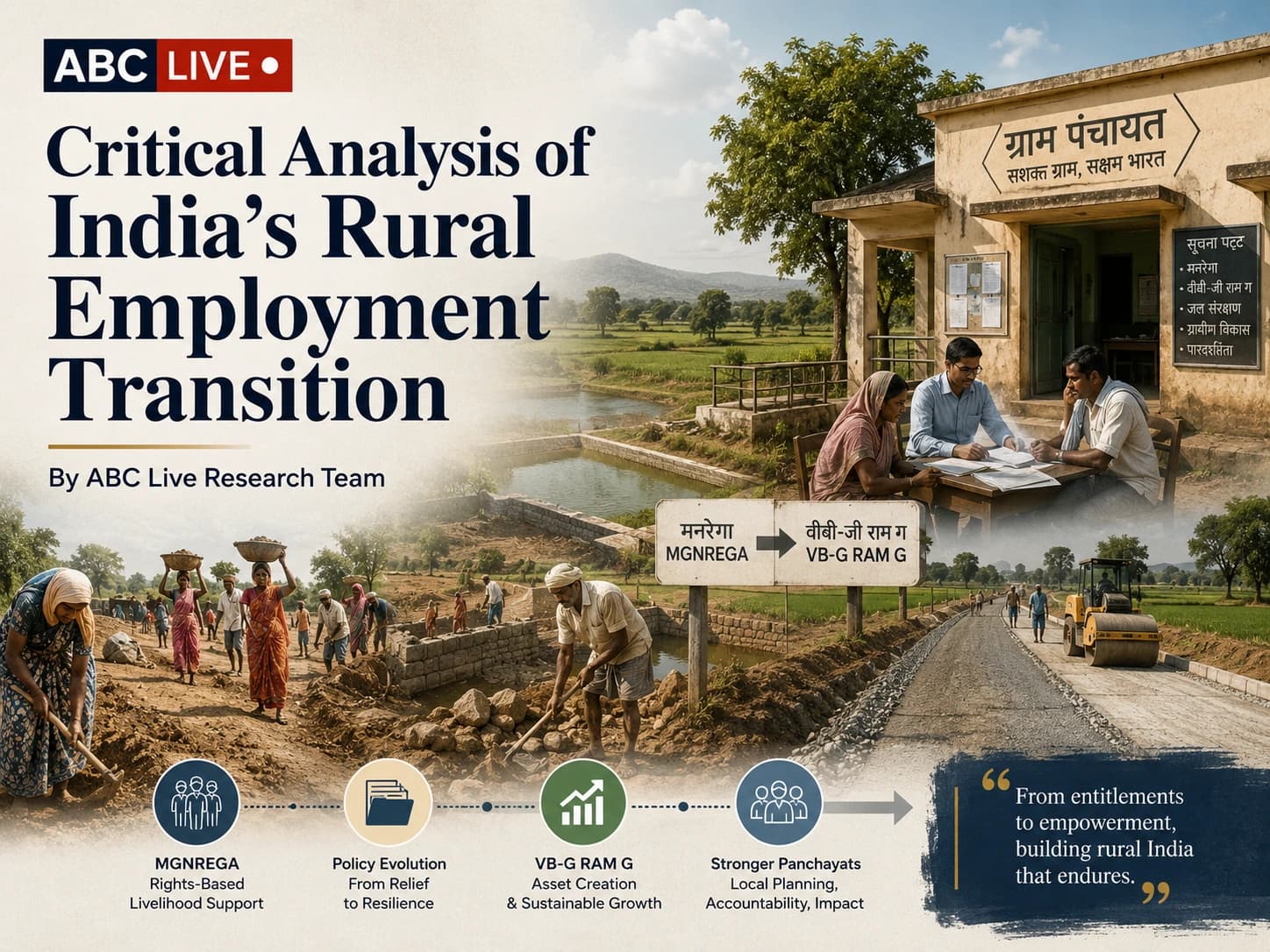
New Delhi (ABC Live):India’s rural employment system is entering a major legal and policy transition. Until now, the Mahatma Gandhi National Rural Employment Guarantee Act, 2005 (MGNREGA) has shaped India’s rights-based rural employment guarantee. Now, the Viksit Bharat – Guarantee for Rozgar and Ajeevika Mission (Gramin), or VB-G RAM G Act, 2025, is set to replace it from July 1, 2026.
The Government has presented VB-G RAM G as a stronger rural employment and livelihood framework. Moreover, it has increased the employment guarantee from 100 days to 125 days. In addition, it has linked rural employment with village development, digital systems, livelihood planning, and the larger Viksit Bharat 2047 goal.
However, the real question is not only whether the number of workdays has increased. Instead, the real question is whether the new law protects the legal soul of MGNREGA.
Therefore, this comparison must examine worker rights, wage security, Gram Sabha control, social audit, digital exclusion, State capacity, and funding design.
Key Points
| Issue | MGNREGA | VB-G RAM G | ABC Live Reading |
|---|---|---|---|
| Legal status | Existing 2005 Act | New 2025 Act from July 1, 2026 | Major legal transition |
| Employment days | 100 days | 125 days | Higher promise, but delivery is key |
| Core identity | Rights-based employment guarantee | Employment plus livelihood and village development mission | Broader scope may help, but rights must remain clear |
| Work demand | Central feature | Should remain enforceable | Demand-based character needs scrutiny |
| Wage payment | Time-bound wage protection | Must preserve or improve wage security | Wage delay will test credibility |
| Gram Sabha role | Local planning and accountability | Continued role claimed | Real local control must be protected |
| Digital systems | Digital records and wage transfer | Stronger Direct Benefit Transfer, e-KYC, and face authentication push | Reform can become exclusion without safeguards |
| Accountability | Social audit and legal duties | Social audit must continue strongly | Accountability must not become symbolic |
| Main risk | Delays, corruption, weak implementation | Transition disruption, digital exclusion, rights dilution | Field outcomes will decide success |
Why ABC Live Is Publishing This Report Now
ABC Live is publishing this report because rural employment guarantee is not a routine welfare issue. Rather, it affects crores of rural households, especially landless workers, women workers, small farmers, and seasonal migrants.
Moreover, MGNREGA was not designed merely as a scheme. Instead, it was designed as a legal safety net. It gave rural households a right to demand work. It also created duties around wage payment, transparency, and accountability.
Now, VB-G RAM G is being projected as a wider rural transformation framework. Therefore, public scrutiny is necessary.
The central question is simple:
Will VB-G RAM G expand the rural employment guarantee, or will it convert a rights-based law into a centrally managed development programme?
What Was MGNREGA?
MGNREGA was enacted in 2005 to enhance livelihood security in rural India. Its long title states that the law provides at least 100 days of guaranteed wage employment in every financial year to rural households whose adult members volunteer to do unskilled manual work.
This wording matters. It shows that MGNREGA was not merely a government scheme. Instead, it was a statutory employment guarantee.
In simple words, MGNREGA treated the rural worker as a rights-holder, not merely as a beneficiary.
Its core protections included:
- work on demand;
- wage employment for unskilled manual work;
- time-bound wage payment;
- unemployment allowance if work was not provided within the legal period;
- Gram Panchayat and Gram Sabha participation;
- transparency through records;
- social audit.
Therefore, MGNREGA’s real value was not only 100 days of work. Its real value was the idea that rural employment could become a legal right.
What Is VB-G RAM G?
The Viksit Bharat – Guarantee for Rozgar and Ajeevika Mission (Gramin) Act, 2025 is the new rural employment and livelihood framework. According to official Government communication, the Act will come into force across rural India from July 1, 2026. Moreover, MGNREGA will stand repealed from the same date.
The Government states that VB-G RAM G provides a statutory guarantee of 125 days of wage employment. In addition, it presents the law as a broader rural development framework linked with livelihood, Gram Panchayat-led development, digital systems, and Viksit Bharat.
Therefore, VB-G RAM G is not only a change in name. Instead, it is a major restructuring of rural employment policy.
However, broader policy ambition must not weaken enforceable worker rights.
Core Difference: 100 Days vs 125 Days
The most visible difference is the increase in guaranteed employment days.
| Framework | Guaranteed Employment |
| MGNREGA | 100 days |
| VB-G RAM G | 125 days |
The increase from 100 days to 125 days is important. Moreover, a 25-day increase can help rural households if actual work is available.
However, the number alone is not enough. The real test is whether workers actually receive those additional days.
For example, if households struggled to receive 100 days under MGNREGA, then 125 days will remain a paper guarantee unless implementation improves.
Therefore, VB-G RAM G must be judged by actual employment generated, not only by statutory promise.
Legal Character: Right or Administrative Scheme?
This is the most important policy question.
MGNREGA’s strength came from its rights-based character. It allowed workers to demand employment. Moreover, it created consequences when the State failed to provide work within the required period.
VB-G RAM G is also being described as a statutory guarantee. However, its rules and field implementation will decide whether the guarantee remains enforceable.
Therefore, the following questions need clear answers:
- Can a rural household demand work in the same simple manner?
- Will unemployment allowance remain practical and enforceable?
- Will wages remain time-bound?
- Will Gram Sabhas control local work selection?
- Will social audit remain independent?
- Will workers have accessible grievance remedies?
- Will digital systems allow manual correction and backup?
If the answer is yes, VB-G RAM G may strengthen rural employment rights. However, if the answer is no, the new framework may dilute MGNREGA’s strongest protection.
Wage Payment: The First Ground Test
Wage payment is where rural employment guarantee becomes real.
MGNREGA recognised wage payment as a legal obligation. Therefore, the new framework must improve this standard, not weaken it.
A rural worker cannot wait endlessly for wages. As a result, delay means debt, food insecurity, migration pressure, and loss of trust in the system.
Therefore, VB-G RAM G must ensure:
- faster wage processing;
- transparent wage status tracking;
- quick correction of payment failures;
- accountability for delay;
- compensation where delay causes hardship;
- local grievance support.
The Government’s promise of 125 days will matter only if wages arrive on time.
Gram Panchayat and Gram Sabha Role
Both MGNREGA and VB-G RAM G place importance on village-level institutions.
This is necessary because Gram Sabhas understand local needs. For example, they know where water conservation, drainage, land development, rural roads, ponds, irrigation, and common assets are required.
However, local participation must be real.
A Gram Sabha cannot become a rubber stamp. Similarly, a Gram Panchayat cannot implement large works without funds, staff, technical support, and administrative clarity.
Therefore, VB-G RAM G must provide:
- timely fund flow;
- approved shelf of works;
- trained local staff;
- transparent digital and physical records;
- technical support;
- worker awareness;
- functioning social audit.
Without these, local democracy will remain only on paper.
Digital Systems: Transparency or Exclusion?
The Government has linked the new framework with Direct Benefit Transfer (DBT), electronic Know Your Customer verification (e-KYC), face authentication, and digital tracking.
These tools can reduce leakages. Moreover, they can improve payment transparency.
However, digital systems can also exclude genuine workers.
The risk is serious in rural areas because workers may face:
- biometric failure;
- face authentication failure;
- poor internet connectivity;
- Aadhaar mismatch;
- bank account errors;
- wrong job-card details;
- lack of digital literacy;
- delayed correction of records.
Therefore, VB-G RAM G must follow a worker-first digital policy.
No genuine worker should lose wages because a server fails, a device malfunctions, or face authentication does not work. In addition, every digital system must have a practical offline backup.
Digital reform must support rights. It must not replace rights.
Funding Design: Demand-Based or Budget-Controlled?
MGNREGA’s core idea was demand-driven employment. In principle, work availability should respond to rural workers’ demand.
This principle is crucial because rural distress is not fixed. For example, demand for work may rise during drought, crop failure, price shocks, poor monsoon, or local economic stress.
Therefore, VB-G RAM G must avoid becoming a fixed-budget scheme that restricts work when demand rises.
If funding caps become too strict, the guarantee may weaken. As a result, workers may face work denial despite a legal promise.
Therefore, the funding model should remain flexible, demand-responsive, and transparent.
Social Audit Must Remain Central
Social audit was one of MGNREGA’s strongest accountability tools. It allowed communities to verify records, wages, works, and expenditure.
Therefore, VB-G RAM G must preserve and strengthen this system.
A meaningful social audit should check:
- whether workers received work on demand;
- whether wages arrived on time;
- whether muster rolls were genuine;
- whether digital attendance excluded anyone;
- whether Gram Sabha decisions were respected;
- whether assets were useful;
- whether complaints were resolved;
- whether funds were misused.
If social audit becomes a formality, corruption and exclusion may increase.
Therefore, independent social audit is essential.
Comparative Dashboard
| Question | MGNREGA Position | VB-G RAM G Test |
| Is employment legally guaranteed? | Yes, 100 days | Must deliver 125 days in practice |
| Can workers demand work? | Yes | Must remain simple and enforceable |
| Is unemployment allowance available? | Yes | Must remain accessible, not merely written |
| Are wages time-bound? | Yes | Must improve actual payment speed |
| Are Gram Sabhas involved? | Yes | Must retain real planning power |
| Is social audit important? | Yes | Must remain independent and effective |
| Are digital tools used? | Yes, increasingly | Must not exclude genuine workers |
| Is funding demand-responsive? | Demand-driven in principle | Must not become capped in practice |
| Is the worker a rights-holder? | Yes | Must remain yes |
ABC Live Critical Analysis
VB-G RAM G has a stronger headline than MGNREGA because it promises 125 days of wage employment. Moreover, it seeks to connect rural employment with livelihood development and village transformation.
However, the strength of rural employment law lies in enforceability.
Therefore, the new law must answer one basic question: Can a rural worker still demand work as a right and receive wages on time?
If yes, VB-G RAM G can become an improved rural employment guarantee.
However, if the new system increases administrative control, imposes rigid digital barriers, weakens Gram Sabha authority, or limits demand-based funding, then the transition may reduce the rights-based protection built under MGNREGA.
The new framework must avoid three dangers.
First, Rights Dilution
A higher number of days cannot compensate for a weaker right to demand work.
Therefore, the law must protect the worker’s enforceable claim.
Second, Digital Exclusion
Technology should reduce corruption. However, it must not punish genuine workers for technical failure.
Therefore, every digital process needs a clear fallback.
Third, Centralised Governance
Village development must remain rooted in Gram Sabhas. Otherwise, local needs may get replaced by top-down priorities.
Therefore, VB-G RAM G should be treated as a serious rural policy reset, not merely as a rural employment upgrade.
Public-Interest Questions
Before the July 1 transition, the Government should clarify:
- How will work demand be registered?
- How will unemployment allowance be paid if work is denied?
- What is the wage payment timeline?
- What happens if face authentication fails?
- Will offline attendance backup exist?
- How will Gram Sabhas approve works?
- How independent will social audit remain?
- Will funding rise automatically when demand rises?
- How will State-level delays be handled?
- What grievance system will protect workers?
These answers will decide whether VB-G RAM G strengthens or weakens rural employment security.
Worker-Centric Test for VB-G RAM G
ABC Live identifies eight worker-centric tests.
| Test | Why It Matters |
| Work on demand | Guarantee must remain real |
| 125 actual workdays | Higher promise must become actual employment |
| Timely wages | Delayed payment defeats livelihood security |
| Unemployment allowance | Accountability must continue if work is denied |
| Digital backup | Genuine workers must not be excluded |
| Gram Sabha control | Local people must shape local works |
| Social audit | Public money must face public scrutiny |
| Asset quality | Employment must create useful rural infrastructure |
If VB-G RAM G passes these tests, it may become a stronger law than MGNREGA. However, if it fails, it may become a weaker replacement despite a better headline.
ABC Live View
MGNREGA’s main contribution was not only employment. Instead, its main contribution was the legal recognition that rural workers could demand work from the State.
Therefore, VB-G RAM G must protect this legal foundation.
The new framework should not treat workers as passive beneficiaries. Instead, it should treat them as rights-holders.
Moreover, Gram Sabhas must remain central. Social audit must remain independent. Wage payment must remain time-bound. Digital systems must remain inclusive. In addition, funding must remain demand-responsive.
Only then can VB-G RAM G become a genuine improvement.
Conclusion
MGNREGA gave India a rights-based rural employment guarantee of 100 days. VB-G RAM G promises to replace it with a wider rural employment and livelihood framework offering 125 days.
This is a major change.
However, the success of VB-G RAM G will depend on whether it protects the legal soul of MGNREGA.
The real issue is not only 100 days versus 125 days.
Instead, the real issue is this:
Will rural workers still have the right to demand work, receive timely wages, participate through Gram Sabhas, and hold the system accountable through social audit?
If yes, VB-G RAM G may become a stronger rural employment framework.
However, if the transition weakens enforceability, digital inclusion, wage protection, or local accountability, it may reduce the worker protection that MGNREGA created.
Therefore, the July 1 transition must follow one clear principle:
Rural employment reform must strengthen workers’ rights, not merely rename the system.
FAQ
What is the main difference between MGNREGA and VB-G RAM G?
MGNREGA guarantees 100 days of rural wage employment. However, VB-G RAM G promises 125 days and a broader rural employment and livelihood framework.
Is VB-G RAM G replacing MGNREGA?
Yes. Official Government communication says VB-G RAM G will come into force from July 1, 2026. Moreover, MGNREGA will stand repealed from the same date.
Why is MGNREGA called rights-based?
MGNREGA allowed rural households to demand work. In addition, it created legal duties around employment, wage payment, unemployment allowance, transparency, and social audit.
Is 125 days better than 100 days?
It is better on paper. However, it will matter only if workers actually receive work and wages on time.
What is the biggest risk in VB-G RAM G?
The biggest risk is that the rights-based guarantee may weaken through digital exclusion, funding limits, weak Gram Sabha role, or poor implementation.
What should be protected during transition?
The Government should protect work on demand, timely wages, unemployment allowance, Gram Sabha role, social audit, digital backup systems, and grievance redressal.
Source note:
The analysis relies on India Code’s record of MGNREGA’s 100-day statutory guarantee,VB-G RAM G Act, PIB’s June 2026 communication on VB-G RAM G and ABC Live Follwing Internal Reports.