

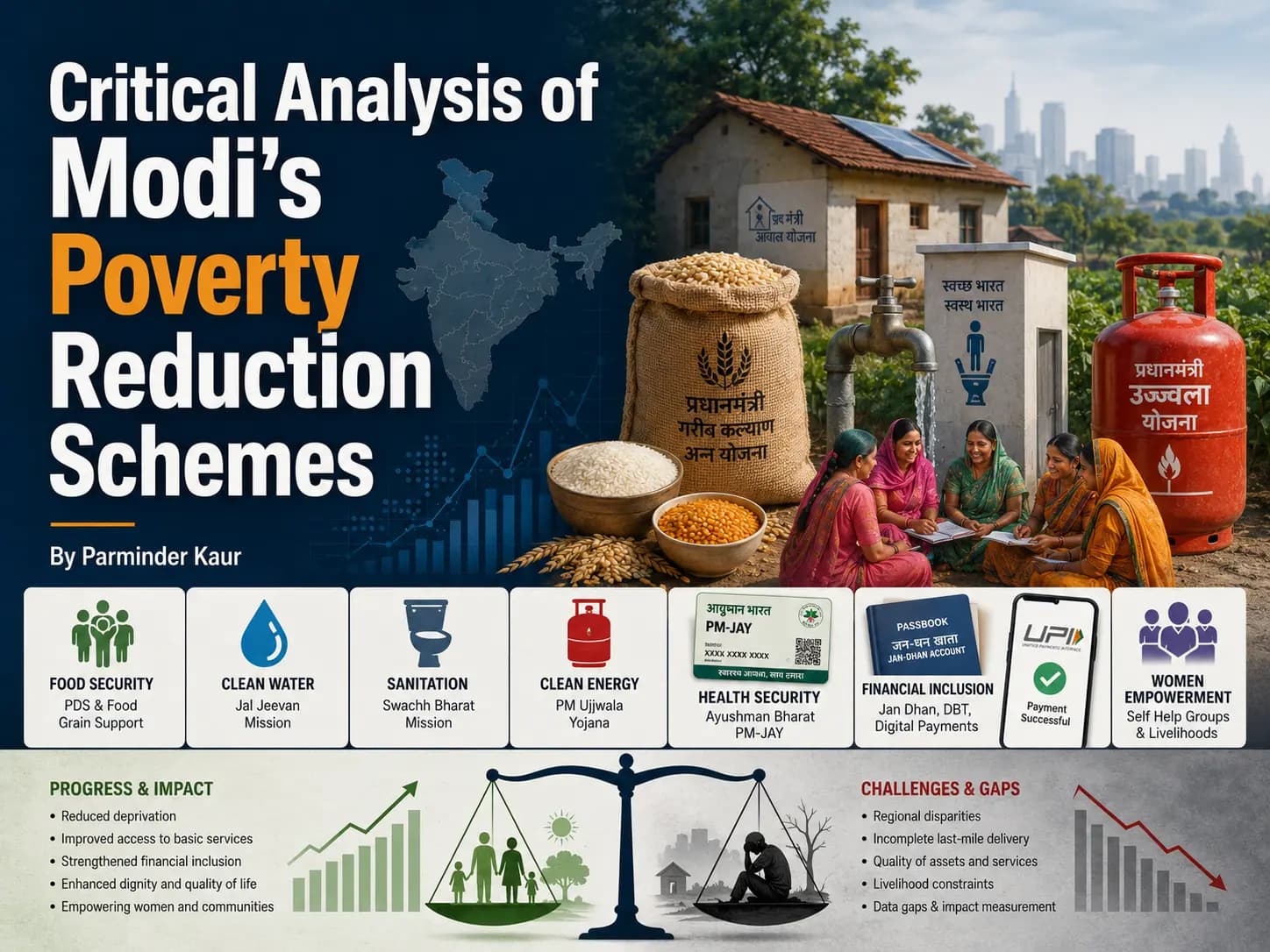
New Delhi (ABC Live): To begin with, Prime Minister Narendra Modi’s poverty reduction model relies on large-scale welfare delivery. In particular, it focuses on food security, housing, drinking water, sanitation, Liquefied Petroleum Gas (LPG), health insurance, banking access, digital governance, women-led livelihoods and support for vulnerable communities.
According to the official welfare note, nearly 25 crore people escaped multidimensional poverty. In addition, the same note records major expansion in tap water connections, toilets, LPG connections, health cards, rural housing, Jan Dhan accounts, Self-Help Groups (SHGs), digital payments and foodgrain distribution.
However, the same data raises a deeper policy question. If more than 81 crore people still receive free foodgrains under the Pradhan Mantri Garib Kalyan Anna Yojana (PMGKAY), can India say that poverty has been fully defeated? Therefore, the answer must be cautious.
Poverty Reduction or Poverty Trap?
On one hand, Modi’s poverty reduction schemes have reduced visible deprivation. On the other hand, they have not fully broken the poverty trap. For example, a household may have a toilet, tap water, LPG connection, ration card, bank account and health card. Yet, it may remain vulnerable if it lacks stable income, savings, nutrition security, quality education and protection from medical debt.
Therefore, the fair conclusion is clear. Although Modi’s poverty reduction schemes have moved millions from extreme deprivation to welfare-supported survival, the journey from welfare-supported survival to durable economic dignity remains incomplete.
Key Points
| Scheme Area | Major Official Claim | Critical ABC Live Reading |
|---|---|---|
| Poverty reduction | Nearly 25 crore people exited multidimensional poverty | Deprivation declined; however, income insecurity may continue |
| PMGKAY | Over 81 crore people receive free foodgrains | Therefore, mass food support shows continuing vulnerability |
| Jal Jeevan Mission | 15.84 crore rural households have tap water coverage | However, water quality, regular supply and sustainability need audit |
| Swachh Bharat | Over 12.11 crore rural toilets built | Moreover, usage, maintenance and waste treatment remain key tests |
| Ujjwala | Over 10.57 crore LPG connections given | Yet, refill affordability decides real clean-cooking benefit |
| Ayushman Bharat | 43.93 crore cards issued | Therefore, real protection depends on lower out-of-pocket health costs |
| PMAY | Crores of houses sanctioned and completed | However, livability depends on services, location and livelihood access |
| Jan Dhan | 58.16 crore beneficiaries | Nevertheless, bank access is not financial security |
| MUDRA | Over 57 crore loan accounts | Therefore, loan growth must translate into income growth |
| SHGs | 10 crore women in SHGs | However, real empowerment requires control over income and decisions |
| eShram | 31.64 crore registrations | Thus, registration is not automatic social security |
Why ABC Live Is Publishing This Report Now
Poverty Reduction Is a Public-Interest Question
First, poverty reduction is one of the most important claims in India’s current governance debate. Moreover, the government presents welfare expansion as proof of inclusive transformation. Therefore, citizens need a balanced assessment that goes beyond scheme numbers.
Second, the real question is not whether Modi’s schemes reached low-income and economically vulnerable households. Clearly, they did. Instead, the real question is whether these schemes created permanent escape from poverty or mainly reduced deprivation through state-supported welfare.
Third, poverty is not only about income. Rather, it is also about dignity, nutrition, health, education, housing, work, safety and opportunity. Therefore, welfare claims must be tested through official data, household vulnerability and lived experience.
Why This Debate Matters Now
Moreover, the poverty debate matters because welfare claims now influence public spending, electoral narratives, social policy and India’s development image. Consequently, the public must know whether welfare expansion has created lasting economic security or only reduced immediate deprivation.
Therefore, ABC Live examines the official claims through a simple test: have these schemes enabled households to survive, or have they also enabled them to rise?
What Is Poverty?
Simple Definition
Simply put, poverty means the inability of a person or household to meet the basic needs required for a dignified life.
In practical terms, it includes lack of income, food, clean water, housing, healthcare, education, sanitation, electricity, work, social security and opportunity.
Economic Definition
Economically, poverty means that a person’s income or consumption falls below a minimum level required for basic living. However, income alone cannot capture all forms of deprivation.
Multidimensional Poverty
Unlike income poverty, multidimensional poverty goes beyond money. Instead, it measures deprivation in several areas of life.
| Dimension | Indicators |
|---|---|
| Health | Nutrition, child mortality and maternal health |
| Education | School attendance and years of schooling |
| Living standards | Housing, sanitation, drinking water, electricity, cooking fuel and assets |
Therefore, a family may exit multidimensional poverty after gaining basic services. However, it may still remain economically vulnerable if its income is unstable.
Is There a Legal or International Definition of Poverty?
No Single Universal Legal Definition
Importantly, there is no single universal legal definition of poverty that binds every country in the same way. Instead, poverty is measured through different legal, policy and statistical systems.
Generally, international systems measure poverty through income poverty and multidimensional poverty. For example, income poverty checks whether income or consumption is below a poverty line. Meanwhile, multidimensional poverty checks whether people lack basic health, education and living-standard indicators.
However, these tools do not always decide legal entitlement in every country. In India, for example, poverty is identified differently for food security, welfare schemes, economic surveys, reservation policy and multidimensional poverty reports.
Thus, poverty in India is both a policy category and a statistical category. Moreover, it changes according to the scheme and measurement method.
The Central Contradiction: PMGKAY and Poverty Escape
Two Claims, One Policy Tension
On one hand, the official note says nearly 25 crore people escaped multidimensional poverty. At the same time, it says over 81 crore people receive free foodgrains under PMGKAY.
In principle, both claims can exist together. However, they must be read carefully. Therefore, the poverty debate cannot stop at headline numbers.
PMGKAY Poverty Trap Table
| Claim | Critical Question |
|---|---|
| 25 crore people exited multidimensional poverty | Did they also gain stable income? |
| 81 crore people receive free foodgrains | Why does such a large population still need food support? |
| Welfare reduced deprivation | Did it reduce dependency? |
| Food security improved | Did nutrition security improve equally? |
| Basic services expanded | Can households survive without subsidised grain? |
ABC Live Reading
Clearly, PMGKAY proves that India has prevented hunger at scale. However, it also proves that income vulnerability remains serious.
Therefore, Modi’s poverty reduction model should not be read as complete poverty elimination. Instead, it should be read as a large welfare shield that reduced deprivation but still leaves many households dependent on state support.
Moreover, food dependency should not be treated as failure alone. Rather, it should be treated as evidence that income security, nutrition security and employment security still need deeper policy attention.
Data Dashboard: Modi’s Poverty Reduction Schemes
| Sector | Major Data Point | Policy Meaning |
|---|---|---|
| Poverty | Nearly 25 crore exited multidimensional poverty | Deprivation reduction |
| Food security | Over 81 crore PMGKAY beneficiaries | Continuing food-support dependence |
| Water | 15.84 crore rural households with tap water | Basic service expansion |
| Sanitation | Over 12.11 crore rural toilets constructed | Sanitation infrastructure push |
| LPG | Over 10.57 crore Ujjwala connections | Clean-cooking access |
| Health | 43.93 crore Ayushman Bharat cards | Health insurance scale |
| Housing | 3.03 crore PMAY-G houses completed | Rural housing expansion |
| Banking | 58.16 crore Jan Dhan beneficiaries | Financial inclusion |
| Women’s livelihoods | 10 crore women in SHGs | Women-led mobilisation |
| Informal workers | 31.64 crore eShram registrations | Labour database expansion |
| Tribal education | 499 Eklavya Model Residential Schools operational | Tribal education infrastructure |
Scheme-Wise Critical Analysis
1. PMGKAY: Hunger Protection, Not Poverty Elimination
To begin with, PMGKAY is one of India’s largest food-security schemes. According to the official note, it provides free foodgrains to over 81 crore beneficiaries.
As a result, the scheme has protected low-income households from hunger. In addition, it has strengthened food security during economic shocks. However, the scale of PMGKAY also exposes a structural weakness. If such a large population still needs free grains, India’s income base remains fragile.
| Indicator | Latest Position | Critical Meaning |
|---|---|---|
| PMGKAY beneficiaries | Over 81 crore | Large dependence on free foodgrains |
| Fair Price Shops automated | Over 5.50 lakh out of 5.51 lakh | Strong digitisation |
| Ration cards digitised | 100% across States and Union Territories | Administrative modernisation |
| One Nation One Ration Card transactions | Over 2.07 billion | Portability for migrants |
| Child stunting | 29.3% in 2023–24 | Nutrition concern remains |
| Child wasting | 19% in 2023–24 | Slow improvement |
| Underweight children | 31.8% in 2023–24 | Persistent nutrition deficit |
Certainly, PMGKAY is a strong welfare shield. However, it is not proof of poverty elimination. Rather, it proves that hunger is being managed through state support.
Moreover, foodgrain support does not automatically solve nutrition poverty. Therefore, India must also address protein deficiency, anaemia, child wasting, maternal nutrition and diet diversity.
2. Jal Jeevan Mission: Tap Connection Is Not the Same as Water Security
Likewise, the Jal Jeevan Mission has expanded rural tap water access. According to the official note, coverage rose from 3.23 crore households in August 2019 to 15.84 crore households by May 2026.
Undoubtedly, this is a major infrastructure achievement. However, water poverty ends only when households receive regular, safe and affordable drinking water. Therefore, the next stage must focus on quality, not just coverage.
| Indicator | Earlier Position | Latest Position |
|---|---|---|
| Rural tap water coverage | 3.23 crore households in August 2019 | 15.84 crore households by May 2026 |
| Tap water coverage share | — | 81.87% of 19.35 crore households |
| 100% tap water villages | — | 2.77 lakh villages |
| Schools with tap water | 29,711 | 9.23 lakh |
| Anganwadi Centres with tap water | 15,464 | 9.66 lakh |
Although the scheme has expanded access, independent audits must test water quality, daily supply, maintenance, local source sustainability and grievance redressal.
Additionally, village-level water systems need trained staff, repair funds and transparent local monitoring. Otherwise, tap coverage may not become true water security.
3. Swachh Bharat: Toilet Construction Must Lead to Sanitation Quality
Similarly, Swachh Bharat has changed India’s sanitation landscape. According to the note, rural sanitation coverage increased from 39% in 2014 to universal coverage. In addition, over 12.11 crore rural household toilets were constructed.
| Indicator | Earlier Position | Latest Position |
|---|---|---|
| Rural sanitation coverage | 39% in 2014 | 100% in 2019 |
| Rural toilets built | — | Over 12.11 crore |
| Urban door-to-door waste collection | 43% in 2014 | 98% in 2026 |
| Urban waste processing | 16% in 2014 | 82% in 2026 |
| ODF cities | — | 4,692 |
| ODF+ cities | — | 4,314 |
| ODF++ cities | — | 1,973 |
Of course, toilet construction reduced visible deprivation. However, real sanitation success depends on usage, maintenance, sludge treatment, greywater management and solid waste systems.
Therefore, the next Swachh Bharat phase must focus on waste treatment, not only toilet coverage. In addition, local bodies need funds, staff and technical capacity.
4. Ujjwala Yojana: LPG Access Needs Refill Affordability
In the same way, Ujjwala expanded clean-cooking access. According to the official note, the scheme provided over 10.57 crore free LPG connections to women from low-income households. Meanwhile, total LPG connections increased from 14.52 crore in 2014 to 33.39 crore in 2026.
| Indicator | Earlier Position | Latest Position |
|---|---|---|
| PMUY LPG connections | — | Over 10.57 crore |
| Total LPG connections | 14.52 crore in 2014 | 33.39 crore in 2026 |
Clearly, Ujjwala improved access and reduced the burden of smoke-based cooking. However, low-income households need affordable refills. Otherwise, many families may continue mixed-fuel use.
Thus, the success of Ujjwala should be measured by annual refill use, not only connection numbers. Moreover, refill patterns should be published by income group and region.
5. Ayushman Bharat: Health Card Is Not Full Health Security
Further, Ayushman Bharat has expanded health-financing coverage. According to the note, the scheme has issued 43.93 crore health cards. In addition, it has recorded 12.03 crore hospitalisations and treatment support of ?1.80 lakh crore by May 2026.
| Indicator | Latest Position |
|---|---|
| Ayushman Bharat cards | 43.93 crore |
| Hospitalisations | 12.03 crore |
| Treatment cost covered | ?1.80 lakh crore |
| Ayushman Bharat Health Account records | 88.33 crore accounts |
| Linked health records | 97.81 crore |
| Ayushman Arogya Mandirs | Over 1.85 lakh |
| Visits to Ayushman Arogya Mandirs | 540 crore |
Certainly, Ayushman Bharat improves financial protection for hospitalisation. However, poverty is often deepened by outpatient costs, medicine costs, diagnostics, chronic disease and transport expenses.
Therefore, public health capacity remains essential. In addition, insurance expansion must be matched with stronger public hospitals, transparent claim settlement and affordable medicines.
Moreover, health security cannot depend only on hospitalisation coverage. Instead, India must also reduce regular household spending on medicines, tests and outpatient care.
ABC Live Internal Link: ABC Live has separately analysed the strengths and limits of Ayushman Bharat and Ayushman Bharat – Pradhan Mantri Jan Aarogya Yojana (AB-PMJAY). That report explains why health insurance expansion must be matched with public hospital capacity, lower out-of-pocket expenditure and stronger claim transparency. Read the related ABC Live analysis here: Ayushman Bharat and AB-PMJAY.
6. PMAY: Housing Must Become Livable Dignity
Next, housing must be treated as a dignity issue, not only as a construction target. According to the note, 3.03 crore houses were completed under Pradhan Mantri Awas Yojana–Gramin (PMAY-G) by May 2026. Similarly, 98.10 lakh urban houses were completed between 2015 and 2026.
| Indicator | Latest Position |
|---|---|
| PMAY-U houses completed | 98.10 lakh |
| PMAY-U houses sanctioned | 1.25 crore |
| PMAY-U total outlay | ?8.77 lakh crore |
| PMAY-G houses sanctioned | 3.91 crore |
| PMAY-G houses completed | 3.03 crore |
| Women beneficiaries under PMAY-G | Around 75% |
| AMRUT investment | ?2.79 lakh crore |
| AMRUT tap water connections | Over 2.53 crore |
In reality, a house is not only a roof. Instead, it must also have water, electricity, drainage, transport, school access, healthcare access and livelihood access. Without these, housing support remains incomplete.
Moreover, women’s ownership should translate into real decision-making power. Therefore, housing policy must measure possession, livability and women’s control over assets.
7. Jan Dhan and DBT: Banking Access Is Not Financial Security
Further, Jan Dhan expanded banking access to low-income and previously unbanked households. According to the note, the number of beneficiaries increased from 17.9 crore in August 2015 to 58.16 crore in May 2026.
| Indicator | Earlier Position | Latest Position |
|---|---|---|
| Jan Dhan beneficiaries | 17.9 crore | 58.16 crore |
| Jan Dhan account balance | — | ?3.02 lakh crore |
| Bank Mitras | — | 13.55 lakh |
Undoubtedly, bank accounts help Direct Benefit Transfer and financial inclusion. However, account ownership does not mean stable income, savings, insurance awareness or creditworthiness.
Therefore, financial inclusion must move from account access to financial resilience. In addition, banking correspondents must remain available in rural and remote areas.
8. MUDRA and Credit Schemes: Loans Must Create Income
Similarly, the Pradhan Mantri MUDRA Yojana expanded micro-credit. According to the note, loan accounts increased from 3.49 crore in 2016 to over 57 crore in 2026.
| Indicator | Earlier Position | Latest Position |
|---|---|---|
| MUDRA loan accounts | 3.49 crore in 2016 | Over 57 crore in 2026 |
| MUDRA loans to women | — | 38.29 crore loans |
| PM SVANidhi beneficiaries | 26.37 lakh in 2021 | 75.27 lakh in 2026 |
| PM SVANidhi loan disbursement | — | ?17,710.55 crore |
| PM Vishwakarma artisans registered | — | Over 30 lakh |
| PM Vishwakarma artisans trained | — | 23.97 lakh |
On paper, credit can support enterprise. However, loans can also create debt stress if income does not rise. Therefore, the success of credit schemes should be measured by business survival, net income growth and repayment capacity.
Moreover, micro-credit must not be treated as poverty escape by itself. Rather, it should be judged by whether borrowers build stable and dignified livelihoods.
9. Skill Schemes: Training Must Lead to Stable Work
Likewise, the note highlights large-scale skilling under Pradhan Mantri Kaushal Vikas Yojana (PMKVY) and Deen Dayal Upadhyaya Grameen Kaushalya Yojana (DDU-GKY). Accordingly, PMKVY trained over 1.64 crore youth, while DDU-GKY placements rose substantially.
| Indicator | Earlier Position | Latest Position |
|---|---|---|
| DDU-GKY candidates trained | 43,038 | 17.71 lakh |
| DDU-GKY candidates placed | 21,446 | 11.51 lakh |
| PMKVY youth trained | — | Over 1.64 crore |
| PMKVY 4.0 candidates trained | — | 27.43 lakh |
| PMKVY 4.0 sectors covered | — | 38 sectors |
Although training numbers are useful, the real test is wage level, job retention, employer quality and career progression. After all, poverty reduction requires income mobility, not only certificates.
Therefore, skilling dashboards should publish salary bands, 12-month retention data and gender-wise outcomes. In addition, they should track whether trainees move into formal, safe and stable work.
10. Women’s SHGs: Mobilisation Must Become Agency
Similarly, women’s participation in SHGs increased from 2.37 crore to 10 crore. Meanwhile, the number of SHGs rose from 21.31 lakh to 91.75 lakh.
| Indicator | Earlier Position | Latest Position |
|---|---|---|
| Women in SHGs | 2.37 crore | 10 crore |
| SHGs | 21.31 lakh | 91.75 lakh |
| SHG loan disbursement | ?22,944 crore | ?1.2 lakh crore |
| Capitalisation support | ?1,501 crore | ?42,098 crore |
| Lakhpati Didi | — | 3.07 crore women |
| Bank Sakhis | — | 50,548 |
| Krishi Sakhis | — | 1.91 lakh |
| Pashu Sakhis | — | 1.70 lakh |
Undoubtedly, SHGs are a strong social platform. However, women’s empowerment requires control over income, assets, mobility, credit decisions and enterprise profits.
Moreover, women’s participation in a scheme should not be confused with women’s agency. Therefore, policy evaluation must measure decision-making power, not only enrolment.
11. eShram and Informal Workers: Registration Is Only the First Step
Furthermore, the eShram portal registered 31.64 crore informal workers by May 2026.
| Indicator | Earlier Position | Latest Position |
|---|---|---|
| eShram registrations | 14.40 crore in Dec 2021 | 31.64 crore in May 2026 |
| Wage employment person-days | 1,660 crore | 3,036.7 crore |
| Central funds released | ?2,13,220 crore | ?7,81,635.65 crore |
| Works completed | 153 lakh | 809.05 lakh |
| Women’s participation in wage work | 48% | 58.19% |
Certainly, registration creates visibility. However, it does not automatically create social security. Instead, informal workers need accident insurance, pension access, health protection, maternity support, portable benefits and income security.
Thus, eShram should become a gateway to benefits, not only a database. Otherwise, registration may create records without protection.
12. Digital Governance: Efficiency Must Not Exclude Eligible Citizens
In addition, India’s welfare delivery has become more digital. For example, Aadhaar, Direct Benefit Transfer, Unified Payments Interface (UPI), eGramSwaraj and digitised ration systems have changed public delivery.
| Indicator | Latest Position |
|---|---|
| Gram Panchayats connected under BharatNet | 2.19 lakh |
| eGramSwaraj cumulative payments | Over ?3 lakh crore |
| PRIs onboarded in FY2025–26 | 2.59 lakh |
| PRIs using online payments | 2.50 lakh |
| Gram Panchayats uploading development plans | 2.55 lakh |
| UPI monthly transactions | Over 2,100 crore |
| UPI participating banks | 705 |
| UPI transaction value | ?29.52 lakh crore |
Of course, digital systems can reduce leakages. However, they can also exclude genuine beneficiaries when authentication fails. Therefore, every digital welfare scheme must have an offline fallback.
In particular, no eligible citizen should lose food, pension, health benefit or wages because of biometric failure, data mismatch or network failure. In addition, grievance systems must be simple, local and time-bound.
13. Tribal Development: Delivery Must Respect Rights
Finally, the note highlights PM-JANMAN, Janjatiya Unnat Gram Abhiyan, Van Dhan Vikas Kendras and Eklavya Model Residential Schools (EMRS).
| Indicator | Latest Position |
|---|---|
| PM-JANMAN houses completed | 2.66 lakh |
| PM-JANMAN roads completed | 1,949 km |
| Mobile Medical Units | 750 |
| Villages with piped water access | 8,473 |
| Households electrified | 1.36 lakh |
| Tribal habitations with mobile connectivity | 3,037 |
| Houses sanctioned under Janjatiya Unnat Gram Abhiyan | 12.89 lakh |
| Van Dhan Vikas Kendras sanctioned | 1,146 |
| EMRS operational schools | 499 |
| EMRS enrolment | 1.54 lakh students |
Importantly, tribal development cannot be judged only through houses, roads and schools. Instead, it must also protect forest rights, land security, local language education, community consent and cultural dignity.
Otherwise, delivery without rights can become another form of exclusion. Therefore, tribal development must remain both service-based and rights-based.
Policy Reading
Welfare Must Move Beyond Delivery
Overall, Modi’s poverty reduction schemes have built a large welfare delivery system. However, the next stage must go deeper. In other words, welfare must connect dignity, ecology, local resilience and income security.
Thus, a deep green welfare approach does not treat economically vulnerable citizens only as beneficiaries. Instead, it treats them as citizens with rights, capabilities and local knowledge.
Policy Gaps
1. Poverty Measurement Must Include Vulnerability
First, India should measure not only poverty exit but also the risk of falling back into poverty. Otherwise, official success may hide continuing household fragility.
2. PMGKAY Beneficiaries Need Income Pathways
Second, food support should continue where needed. However, beneficiaries also need jobs, nutrition, skills and enterprise support.
3. Welfare Dashboards Must Measure Quality
Third, dashboards should track reliability, usage, service quality, grievance redressal and exclusion errors. In addition, they should publish state-wise and district-wise gaps.
4. Digital Delivery Needs Human Safeguards
Fourth, no eligible citizen should lose food, pension, health benefit or wages because of biometric failure or data mismatch. Therefore, offline fallback systems must remain mandatory.
5. Nutrition Must Go Beyond Free Grain
Fifth, food policy must address protein, anaemia, child wasting, maternal nutrition and diet diversity. Moreover, nutrition planning should reflect local food habits.
6. Credit Schemes Need Income Audits
Sixth, loan schemes must be judged by income growth, business survival and debt stress. Otherwise, credit expansion may hide repayment pressure.
7. Social Audits Must Expand
Finally, water, sanitation, housing, health, food, digital welfare and livelihood schemes need independent social audits. As a result, citizens can compare official claims with ground reality.
What Happens Next?
Five Tests for the Welfare Model
Going forward, Modi’s poverty reduction model faces five tests.
| Test | Key Question |
|---|---|
| Quality test | Are services reliable and useful? |
| Income test | Are households earning enough without food dependency? |
| Equity test | Are Dalits, Adivasis, migrants, women and informal workers fully included? |
| Fiscal test | Are schemes sustainable? |
| Accountability test | Can citizens complain and get quick correction? |
If India passes these tests, welfare expansion can become a foundation for inclusive growth. However, if policy remains focused only on coverage numbers, India may reduce visible deprivation without breaking deeper poverty traps.
ABC Live Editorial Conclusion
Welfare Has Expanded
In conclusion, Modi’s poverty reduction schemes have changed India’s welfare landscape. Indeed, they have expanded basic services, reduced visible deprivation and created a wider safety net for low-income and economically vulnerable households.
Poverty Escape Remains Incomplete
However, the poverty debate must remain honest. If a person receives free foodgrains, depends on irregular work, lacks savings and fears medical debt, that person cannot be described as fully free from poverty. Although such a person may no longer face some old forms of deprivation, that person may still remain economically insecure.
Final ABC Live View
Therefore, ABC Live’s conclusion is clear:
Modi’s poverty reduction schemes have reduced multidimensional deprivation. However, mass dependence on PMGKAY shows that the poverty trap remains alive for millions. Therefore, the next stage of welfare policy must move from coverage to capability, from entitlement to income, and from survival support to durable dignity.
Sources and Methodology
Source Base
ABC Live reviewed the government background note titled “Empowering the Poor: A Decade of Inclusive Transformation,” posted on 8 June 2026 by PIB Delhi. In particular, the report uses official figures from the note on poverty, PMGKAY, Jal Jeevan Mission, Swachh Bharat, Ujjwala, Ayushman Bharat, PMAY, Jan Dhan, MUDRA, SHGs, eShram, education, digital welfare and tribal development.
Method
Therefore, this report applies a public-policy lens. Specifically, it separates scheme coverage from service quality, multidimensional poverty reduction from income security, and welfare delivery from poverty-trap escape.
Key Source Links
- PIB: Official Government Releases
- NITI Aayog: Multidimensional Poverty in India
- Jal Jeevan Mission Dashboard
- Swachh Bharat Mission Grameen Dashboard
- Swachh Bharat Mission Urban
- National Health Authority Dashboard: Ayushman Bharat PM-JAY
- Ayushman Bharat Digital Mission Dashboard
- Pradhan Mantri Jan Dhan Yojana
- MUDRA Yojana
- UPI Product Statistics: National Payments Corporation of India
- PMAY-G Dashboard
- NRLM Dashboard
- eShram Dashboard
- PM Vishwakarma
- Ministry of Education
- Ministry of Tribal Affairs: Eklavya Model Residential Schools
- National Family Health Survey
- Union Budget Documents
ABC Live Internal Link
For further reading, see ABC Live’s related report on India’s healthcare welfare architecture:
FAQ
What are Modi’s major poverty reduction schemes?
Broadly, major schemes include PMGKAY, Jan Dhan Yojana, Ujjwala Yojana, Jal Jeevan Mission, Swachh Bharat, PMAY, Ayushman Bharat, MUDRA, PM SVANidhi, PM Vishwakarma, PMKVY, eShram and women-led SHG programmes.
Have Modi’s schemes reduced poverty?
Yes, they have reduced deprivation and expanded access to basic services. However, full poverty escape requires stable income, nutrition security, health protection and quality education.
Why is PMGKAY important in this debate?
Importantly, PMGKAY matters because over 81 crore people still receive free foodgrains. Therefore, it shows that large-scale food dependency continues.
Does free foodgrain mean people are poor?
Not necessarily, free foodgrain does not mean every beneficiary is poor in the same way. However, mass dependence on free foodgrains shows economic vulnerability and weak consumption security.
What is the main criticism?
Essentially, the main criticism is that welfare coverage is being presented as poverty escape. However, coverage does not always prove durable income security.
What should be the next policy goal?
Going forward, the next goal should be income security, nutrition diversity, quality services, women’s agency, stronger public health and accountable delivery.